
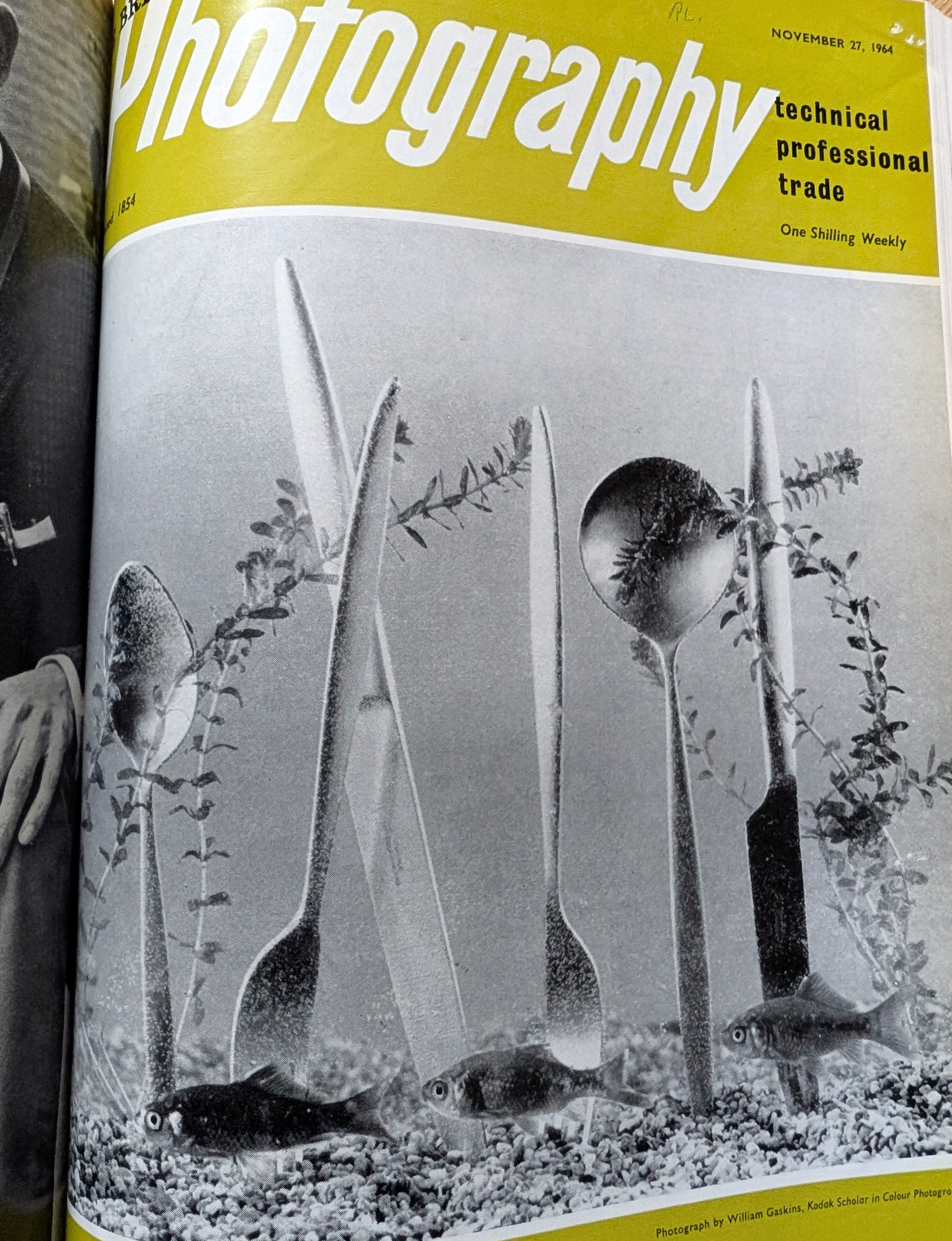
I was born on November 30th 1964 and therefore when I received an archive of bound copies of the British Journal of Photography I was intrigued to find out what was happening in the world of photography in the week I was born. I know that may seem sad, but we all get our fun where we can! Anyway, an issue of the magazine came out on the 27th of November (it used to be a weekly publication) and I decided to start at the beginning by reading the editor’s letter. The editor was Arthur J. Dalladay, a man with an impressive list of letters after his name on the masthead, and the title of his letter was A Photographer’s Licence?
This was the opening paragraph, “We have been rather fascinated by the debate going on in the ‘electronic’ press caused by the free sale in this country of walkie-talkie transceivers. As readers will probably know, a Radio Amateurs licence must be obtained before a private person can go on the air, and this licence cannot be obtained by anyone who has not passed the nesccessary examination standard in basic electronic theory and practice.” Oh, how times have changed since I was born!
Dalladay continues, “No one connected with photography could read this controversy without a quizzical smile at the thought of a similar situation applying in our field… A beginning could be made by making the use of a high precision professional camera illegal without the posession of a photographer’s licence. This would only be obtained by passing a stiff practical and theoretical examination in the photographic craft.”
Putting the use of language to one side (although it is particularly illuminating as to how many saw photography at the time) Dalladay raises a number of issues I still see and hear sixty-two years after he penned his letter. He could never have seen or perhaps wanted to see how photography was going to evolve over that time, but he may have been pleased to see how many people still equate ‘serious’ photography with a ‘serious’ camera.
Dalladay confirms my thoughts when he goes on to say “Naturally, fully automatic cameras would only be purchasable by those who were able to prove that they throughly understand how to carry out for themselves all the operations taken over by these automatic cameras.” If that doesn’t sound enough like a photographic dictator he makes his feelings clear concerning the ‘non-serious’ photographer by saying, “Cameras available to the family snap-shotter could be restricted to those capable only of inferior results, and on the strict understanding that they should only be used for family pictures and not pictures for sale.”
Now, I may not be reading between the lines here as well as I could. There is a part of me that thinks that Mr Dalladay may have his tongue firmly in his cheek. However, the fact that I still hear and see similar thought process’s all across social media (how I wish to read his thoughts on that!) suggests that he may have been deadly serious. To prove my theory just ask yourself how often you see an enthusiast photographer name the camera they used to ‘get a shot’, include a cmera brand in their social media name tag or tell us that an image has been created on a smartphone, as if to downplay the potential criticism of the image they may receive.
The fact that photography in all senses has freed itself of its technical requirements is to me a good thing. You may disagree. However, on this point Dalladay pins his belief firmly to the mast, well as far as men are concerned anyway, “With an automatic camera and a colour film, the camera user today has full artistic freedom, limited only by his own awareness. However, as well as being an outstanding advantage, this freedom within photography may well be its major pitfall. We sometimes wonder if it would be a good plan were it a lot more difficult to take a picture, so that there was some element of struggle and overcoming of obstacles as in Victorian times.” That was the thinking within photography, amongst some, when I was born. Make it harder and it will be better, and don’t forget the Victorians. An age which was exactly sixty-four years prior to Dalladays article. It is now sixty-two years after his letter and to me writing this. There is some synchronicity there, but little if any agreement of message.
I often hear the word gatekeeper used when it comes to photography. I have even been called one myself. I have written about such ideas of gatekeeping and spoken about them on the A Photographic Life podcast. I do believe that it exists, but not in the context or amount that many believe. However, there is one area of photography where I do feel gatekeepers exist and have always existed as Dallaway illustrates. Such gatekeeping is based in the belief that photography in the hands of the untrained is valueless and that technical proficency equals photographic excellence. I have never believed that this is the case and cannot be persuaded that it is, however vociferous a defence of such a position maybe given. That is a debate I would have enjoyed with the editor of the 1964 BJP, but unfortunately at the time that discussion would have been beyond me.
Dr.Grant Scott
After fifteen years art directing photography books and magazines such as Elle and Tatler, Scott began to work as a photographer for a number of advertising and editorial clients in 2000. Alongside his photographic career Scott has art directed numerous advertising campaigns, worked as a creative director at Sotheby’s, art directed foto8 magazine, founded his own photographic gallery, edited Professional Photographer magazine and launched his own title for photographers and filmmakers Hungry Eye. He founded the United Nations of Photography in 2012, and is now a Senior Lecturer and Subject Co-ordinator: Photography at Oxford Brookes University, Oxford, and a BBC Radio contributor. Scott is the author of Professional Photography: The New Global Landscape Explained (Routledge 2014), The Essential Student Guide to Professional Photography (Routledge 2015), New Ways of Seeing: The Democratic Language of Photography (Routledge 2019), What Does Photography Mean To You? (Bluecoat Press 2020) and Inside Vogue House: One building, seven magazines, sixty years of stories, (Orphans Publishing 2024). His photography has been published in At Home With The Makers of Style (Thames & Hudson 2006) and Crash Happy: A Night at The Bangers (Cafe Royal Books 2012). His film Do Not Bend: The Photographic Life of Bill Jay was premiered in 2018.
© Grant Scott 2026


Leave a Reply