
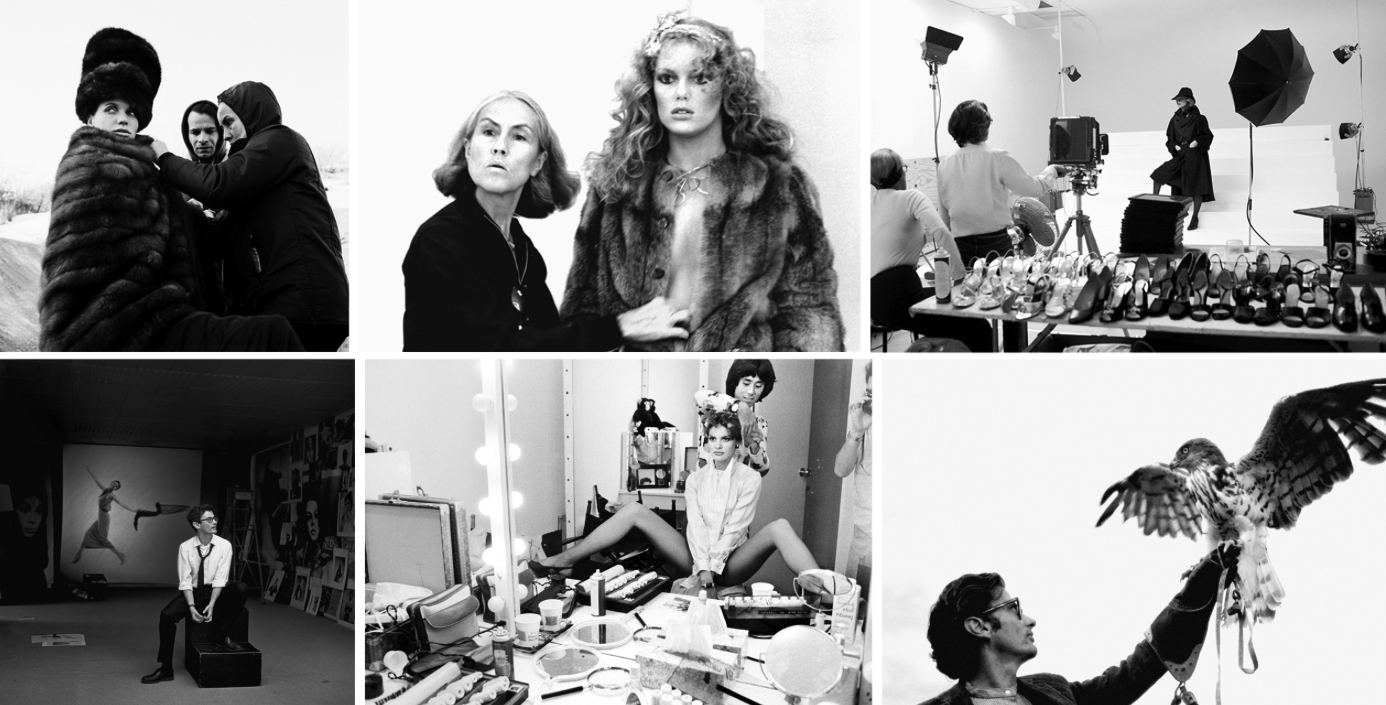
In episode 87 UNP founder and curator Grant Scott is in his shed reflecting on working with Richard Avedon, getting books signed by him, remembering stories about Avedon told to him by photographer Jean Loup Sieff and long-time Avedon assistant Gideon Lewin takes on the UNP Photo Proust Questionnaire in which he speaks about fellow Avedon assistant and photographer Hiro.
In this week’s episode Grant speaks of an Avedon fashion shoot with photographer Jean Loup Sieff as a model with iconic sixties model Jean Shrimpton for Vogue Italia, March 1967. These are the images that appeared in the magazine.


Grant also speaks of his time working with Avedon and the packaged print he was sent. Here is the label from that packaging.

Gideon Lewin was born in Jerusalem, Israel and graduated from the Art Center College of Design, in Los Angeles, majoring in advertising and photography. He was the studio manager and ‘right-hand man’ to legendary photographer Richard Avedon for 16 years during which time he collaborated with Avedon on many projects, including exhibitions, books, whilst traveling with him extensively for editorial assignments. Lewin also continued to create his own work during this period and established his own independent studio in 1980 collaborating with American and European designers on advertising, promotions and books, including Bill Blass, Avon, Revlon, Clairol, and Saks Fifth Avenue. Lewin has photographed and produced two books and his editorial work has been published in Harpers Bazaar, Vogue and Elle, and many other magazines. He has photographed personalities including Clint Eastwood, Lauren Bacall, Ariel Sharon, Rupert Murdoch, Donna Karen, and of course Richard Avedon. A retrospective exhibition of his work was held at the museum of Photography in Mougins, France, and his work has been featured in solo exhibitions in the US and Europe. Gideon Lewin, the Avedon Years, 1964-1980, was published in 2019.
Gideon Lewin, the Avedon Years, 1964-1980 www.penguinrandomhouse.com/books/610904/avedon-by-gideon-lewin/
The Proust Questionnaire’s origins lie not with the legendary French novelist, but with a popular parlour game known as the ‘Confession Album’. These albums were passed out among friends, who would sign their names and complete them with poetry and prose, or answers to questions contained within. In the case of the Proust Questionnaire, the questions were devised by a friend of Proust’s, Antoinette Faure, the daughter of the future French President Félix Faure. Just fourteen at the time, Proust was only too happy to fill out his friend’s questions. Although he answered in French, the album was eventually translated and published for English-speaking audiences. But it was the original handwritten questionnaire that led to its eventual popularity. Faure’s son, the psychologist André Berge, discovered the original in his mother’s effects in 1924, two years after Proust’s death. Not only did Proust’s answers become a sensation, but so did the questionnaire itself.
Yasuhiro Wakabayashi, known as Hiro, was born in Shanghai in 1930 to Japanese parents. Hiro’s family returned to Japan from China at the end of the Second World War and In 1954, he travelled to America, and briefly enrolled in the School of Modern Photography in New York. He was dissatisfied with the school, and apprenticed himself to the studio of Lester Bookbinder and Reuben Samberg. At the end of 1956, he began working for Richard Avedon and at the same time, met Alexey Brodovitch, the art director at Harper’s Bazaar, and worked as his assistant for a time, at Brodovitch’s Design Laboratory at the New School. By the end of 1957, Hiro was no longer Avedon’s assistant, and had launched his own career. Within only a few years, Hiro became a fashion photographer in his own right. He contributed as a staff photographer to Harper’s Bazaar from 1956 to 1975, and was named Photographer of the Year by the American Society of Media Photographers in 1969. Surreal and unique, Hiro’s photographs are noted for their elegance and clean appearance.
If you have enjoyed this podcast why not check out our A Photographic Life Podcast Plus. Created as a learning resource that places the power of learning into the hands of the learner. To suggest where you can go, what you can read, who you can discover and what you can question to further your own knowledge, experience and enjoyment of photography. It will be inspiring, informative and enjoyable! You can find out here: www.patreon.com/aphotographiclifepodcast
You can also access and subscribe to these podcasts at SoundCloud https://soundcloud.com/unofphoto on iTunes https://itunes.apple.com/gb/podcast/a-photographic-life/id1380344701 on Player FM https://player.fm/series/a-photographic-life and Podbean www.podbean.com/podcast-detail/i6uqx-6d9ad/A-Photographic-Life-Podcast
Grant Scott is the founder/curator of United Nations of Photography, a Senior Lecturer and Subject Co-ordinator: Photography at Oxford Brookes University, Oxford, a working photographer, and the author of Professional Photography: The New Global Landscape Explained (Focal Press 2014) and The Essential Student Guide to Professional Photography (Focal Press 2015). His next book New Ways of Seeing: The Democratic Language of Photography will be published by Bloomsbury Academic in 2019.
His documentary film, Do Not Bend: The Photographic Life of Bill Jay can now be seen at www.youtube.com/watch?v=wd47549knOU&t=3915s.
© Grant Scott 2019


Leave a Reply