
I previously wrote that Joel Meyerowitz’s book Where I Find Myself is the only photo book any photographer needs. You might want others, but that is the one you need in my opinion, whatever type of photography you make. The book I am recommending here is not a book of photographs. It is a book of words.
The book in question is a dense coming together of thoughts, suggestions, lists, angst, considerations, commandments, revelations, advice, indecision, questions, answers, statements and facts. All of which take us on a chronological physical and mental journey, that is the creative life of Josef Koudelka. A life of dedication to photography. Comfort, food, sleeping and money come secondary to the photograph for Koudelka. All is sacrificed in his search to create a body of work that will satisfy his questing nature. It starts in 1969 and ends in 2020.
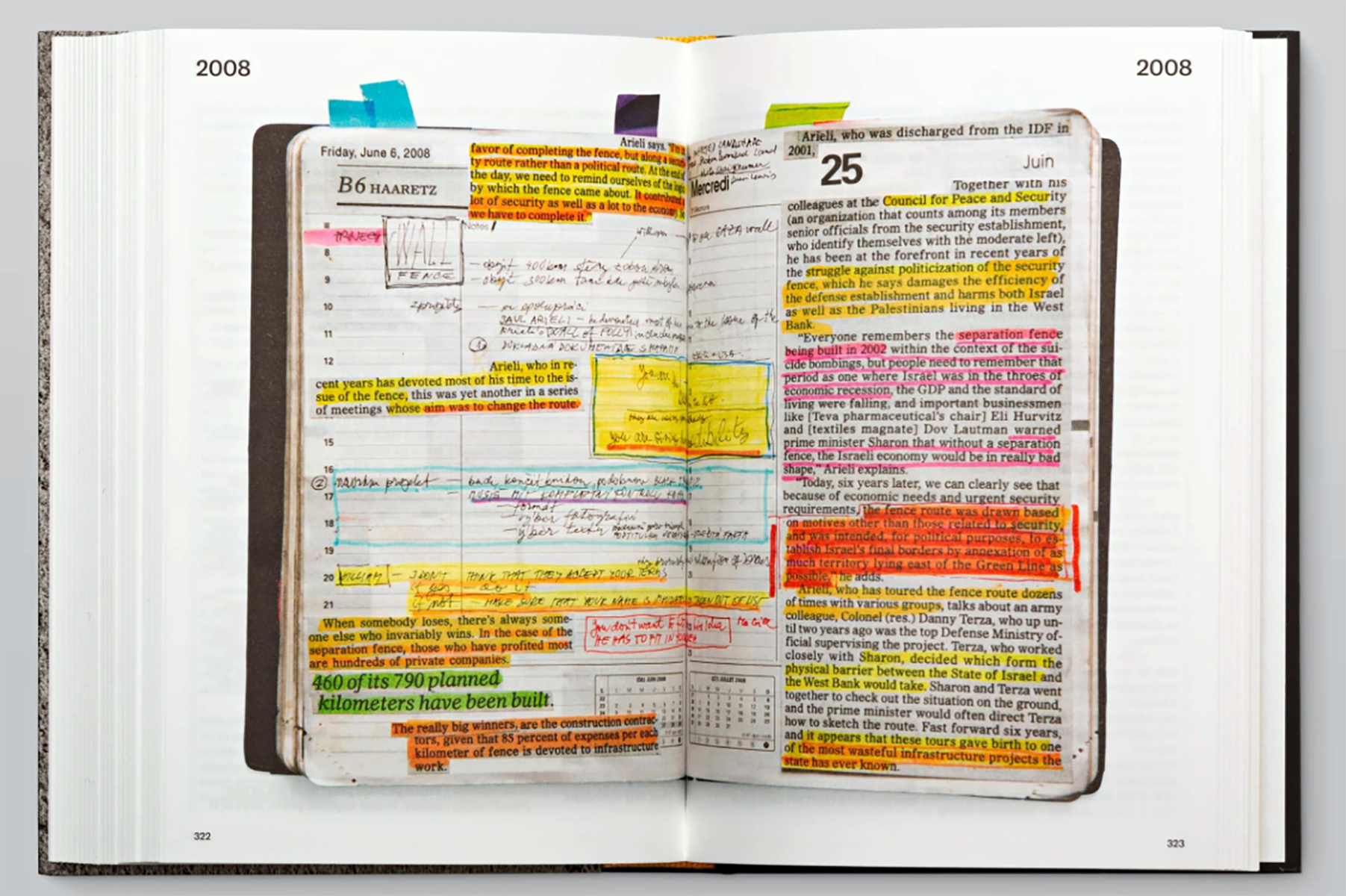
Distilled from sixty‑nine journals kept over the course of his fifty‑plus years of photography, Josef Koudelka: Diaries presents a deconstructed, snap-shot, collage detailing his internal dialogue, whilst creating bodies of work including his legendary projects on the Roma, the 1968 Soviet-led invasion in Prague, and the devastating impact humans have on the landscape. Facsimile pages from the diaries, along with the occasional image by Koudelka, including self‑portraits, present a life of constant movement, both physically and intellectually. The book is fascinating, frustrating and brilliant, all at the same time.
Koudelka was born in Moravia, Czechoslovakia, in 1938 and became a naturalized Frenchmen in 1987. He began his career as an aeronautical engineer before turning full-time to photography in the late 1960s. When in 1968 he photographed the Soviet-led invasion of Czechoslovakia. In 1969, he was anonymously awarded the Overseas Press Club’s Robert Capa Gold Medal for his Czech photographs that were published with the initials ‘P.P. ‘(Prague Photographer). Koudelka left Czechoslovakia seeking political asylum in 1970, and joined Magnum Photos. The rest as they say is history. Today he is based in Paris and Prague.
A restless spirit, Koudelka, throughout the book, is constantly asking others what they think of his work, whilst questioning his response to such advice. Sometimes he is in agreement, most obviously with his mentor Henri Cartier-Bresson, but most often he seems troubled by the opinions of others. In photography he seems driven, but unsure. He does not understand how Don McCullin can make the work he does. He seems in awe of his photographic confidence and nihilistic approach to life. In his life, unlike in his photography, Koudelka shows no indecision. His willingness to live the life of the itinerant wanderer, with no conventional ties to people or place, is intrinsic to his person and his photography. He understands that, but it is through his personal interrogation of his purpose as a photographer that makes this book so universal and essential.
Every page is filled with nuggets of inspiration, aspiration and confirmation. Often these are abstract thoughts, written without context forcing the reader to make of it what they will. This is not a manual or guide book. It is hard work to make your way through its kaleidoscopic narrative, but rewarding of the effort you make. But, it is not hard work, as so many academic books are when speaking about photography. The language and concepts are not obtuse or reliant on prior reading. It is useful to have a knowledge of the great documentary photographers of the last century, with particular referance to Magnum members, so that you recognise the names that are mentioned, and there are a lot. However, it is not a barrier to this book if you don’t have that knowledge. There is even an argument to say that it may introduce you to many photographers whose work you should know about, if you are serious about photographic storytelling.
In my experience the information people want to know to support their photographic development is from those they respect. Those who have already trodden the road they are travelling on. They want information that is useful and approachable. This book delivers in doing this from a position of knowledge and experience that cannot be matched. Koudelka is the real deal.
You could, as I have begun to do, read this book in chronological order. You could pick years at random or treat it as a ‘dip in-and-out’ well of inspiration. I don’t think it matters how you use this book as long as you approach it with an open mind. It’s not cheap at £50, but if you consider only buying one book to support your photography it’s a bargain. It’s just small enough to fit into a camera bag, just light enough to become a travelling companion. I know that it will now sit above the desk in my studio, within easy reach for those moments I need to be challenged, or inspired.
If you love Koudelkas work you need to buy this book, if you don’t, you need to buy this book. If you have never heard of him you need to buy this book. If you own a camera you need to buy this book. If you are interested in photography you need to buy this book. I would even suggest it is the only book on photography you should buy.
*I purchased this book and the Meyerowitz book with my own money. I did not recieve a review copy of either and my opinions are not tainted by any commercial transaction. My positivity is real.
Further Reading
https://unitednationsofphotography.com/2026/01/01/you-only-need-one-photobook-and-this-is-it/
Dr.Grant Scott
After fifteen years art directing photography books and magazines such as Elle and Tatler, Scott began to work as a photographer for a number of advertising and editorial clients in 2000. Alongside his photographic career Scott has art directed numerous advertising campaigns, worked as a creative director at Sotheby’s, art directed foto8 magazine, founded his own photographic gallery, edited Professional Photographer magazine and launched his own title for photographers and filmmakers Hungry Eye. He founded the United Nations of Photography in 2012, and is now a Senior Lecturer and Subject Co-ordinator: Photography at Oxford Brookes University, Oxford, and a BBC Radio contributor. Scott is the author of Professional Photography: The New Global Landscape Explained (Routledge 2014), The Essential Student Guide to Professional Photography (Routledge 2015), New Ways of Seeing: The Democratic Language of Photography (Routledge 2019), What Does Photography Mean To You? (Bluecoat Press 2020) and Inside Vogue House: One building, seven magazines, sixty years of stories, (Orphans Publishing 2024). His photography has been published in At Home With The Makers of Style (Thames & Hudson 2006) and Crash Happy: A Night at The Bangers (Cafe Royal Books 2012). His film Do Not Bend: The Photographic Life of Bill Jay was premiered in 2018.
© Grant Scott 2026
Leave a Reply