
I’m sure this article will upset many who write camera reviews or believe them, but that is not a reason to not write it. It may be worth commenting from the start that I write this from the position of having been the editor of photography magazines that relied on camera manufacturer advertising revenue, twenty-five years as a professional photographer and as a lecturer in photography for fourteen years. Oh, and forty two years working with professional photography. Just for context.
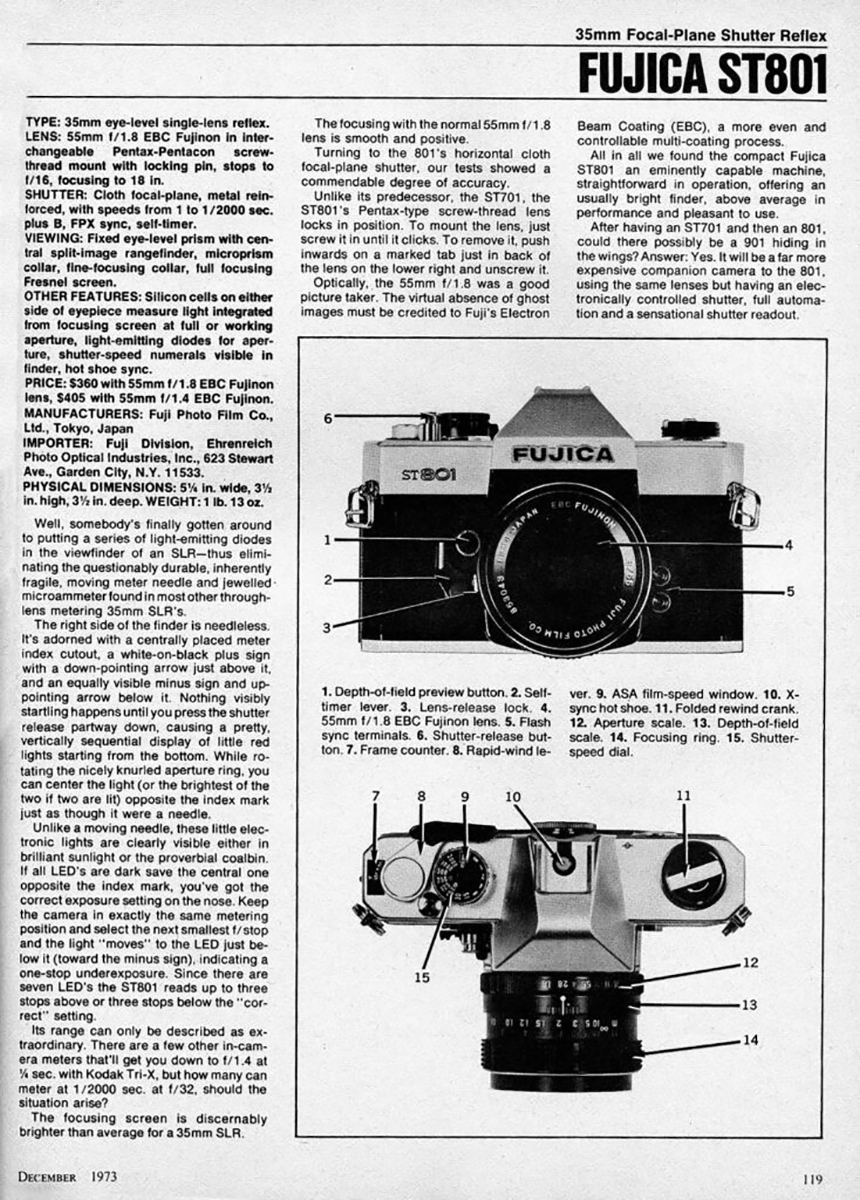
There were two cameras that featured in my childhood and I was not allowed to touch either. They were my father’s Fujica 35 EE, purchased in 1964 to document our family as we grew throughout the 1960s, and its replacement in 1974, a Fujica ST801, chosen on the basis of a photo magazine review. My father could have bought a Nikon, Olympus, Chinon, Pentax, Minolta or Canon, but he didn’t because he had no knowledge of cameras. Instead he accepted the opinion of a camera reviewer. The Fujica ST801 was a very popular mid-range 35mm SLR during a transitional era where cameras were moving more and more towards electronic shutters and exposure automation. Although still a fully mechanical camera, it had a modern through the lens silicon photocell and supported open aperture metering. It was this functionality that appealed to my father. In addition, the ST801 had a top 1/2000 shutter speed, a 7 LED meter display, and one of the brightest viewfinders of any SLR of its era. It was a good camera and he still has it today in working order. Although I am still not allowed to touch it. This is no surprise as in 1974 it retailed for $440, which compares to approximately $2,900 today. That was quite some investment for a South London bricklayer in the 1970s.
This is the power of the camera review and when I edited photography magazines I took this responsibility seriously. What this meant in reality was that no one on the staff was allowed to review any new camera that came our way. I banned camera reviews. This was not the case on any other photography magazine in the UK at the time, despite the self-appointed reviewers never having worked professionally as a photographer. However, they had worked their way up the magazine mastheads and developed close relationships with those who worked for camera brands whose job it was to get press coverage. These relationships ensured that they were sent on all expenses paid trips across the world to ‘review’ new models (I myself was sent to Los Angeles, Istanbul, Stockholm, Cape Town and New York even though I never reviewed cameras!) Cameras were given for review purposes and the reviewers would use them to make some mediocre images, at best, to accompany their re-writes of the press releases they had been sent.
Everyone was happy. The manufacturers got their multiple pages of positive coverage with mentions and images of their cameras on the issue cover. The people on the magazine got cheap, easy content, the associated advertising spend and a free holiday. None of this sat comfortably with me and I decided to work with the manufacturers on a different basis, but that is a different story for another time for those who want to know how to build advertising revenue without selling out.
My point is that in reality most camera reviews are little more than a series of tech based facts regurgitated from a press release. That was the case in the 1970s and that is the case today. However, in the 70s there was actual technological development, something new to comment on and report on. The same was also the case in the early days of DSLRs, but it is not the case today. New cameras may boast higher numbers of achievement, but few if any are revolutionary in their offering. Retro styling is seen as the way forward, echoing the golden days of photography as a nostalgic sales pitch. Little else is new, and whilst smartphone manufacturers continue to promote their product as being able to capture ‘professional’ images, traditional camera sales plummet.
The photography magazines no longer have the reach and influence they once had. They attempted to respond to dropping sales by moving online long ago in an attempt to own the camera review environment in the new world. This worked for a while, but independent YouTubers soon stole their position as camera buying influencers. That is where we are today. A compromised group of reviewers telling us what we can read on any manufacturers website. Unwilling to speak negatively or honestly for fear of losing their relationships with their suppliers. Just as it has always been. The difference today is that the cameras are not developing and the prices are increasing dramatically. Therefore, the responsibility for these people to tell the truth is more important than ever. To not be honest in recomending a considerable spend is to my eyes a deriliction of duty and morally corrupt. Lies and exagerations have long been the basis of consumerism I am not naive to this, but the reviewer should be able to bring a level of independent thought to the commercial transaction. This would make the review relevant and important. Without it they are nothing more than a compromised voice with no opinion. A chocolate teapot. Something we need, pretending to be something it is not. Useful!
Dr.Grant Scott
After fifteen years art directing photography books and magazines such as Elle and Tatler, Scott began to work as a photographer for a number of advertising and editorial clients in 2000. Alongside his photographic career Scott has art directed numerous advertising campaigns, worked as a creative director at Sotheby’s, art directed foto8 magazine, founded his own photographic gallery, edited Professional Photographer magazine and launched his own title for photographers and filmmakers Hungry Eye. He founded the United Nations of Photography in 2012, and is now a Senior Lecturer and Subject Co-ordinator: Photography at Oxford Brookes University, Oxford, and a BBC Radio contributor. Scott is the author of Professional Photography: The New Global Landscape Explained (Routledge 2014), The Essential Student Guide to Professional Photography (Routledge 2015), New Ways of Seeing: The Democratic Language of Photography (Routledge 2019), What Does Photography Mean To You? (Bluecoat Press 2020) and Inside Vogue House: One building, seven magazines, sixty years of stories, (Orphans Publishing 2024). His photography has been published in At Home With The Makers of Style (Thames & Hudson 2006) and Crash Happy: A Night at The Bangers (Cafe Royal Books 2012). His film Do Not Bend: The Photographic Life of Bill Jay was premiered in 2018.
© Grant Scott 2026
Leave a Reply