
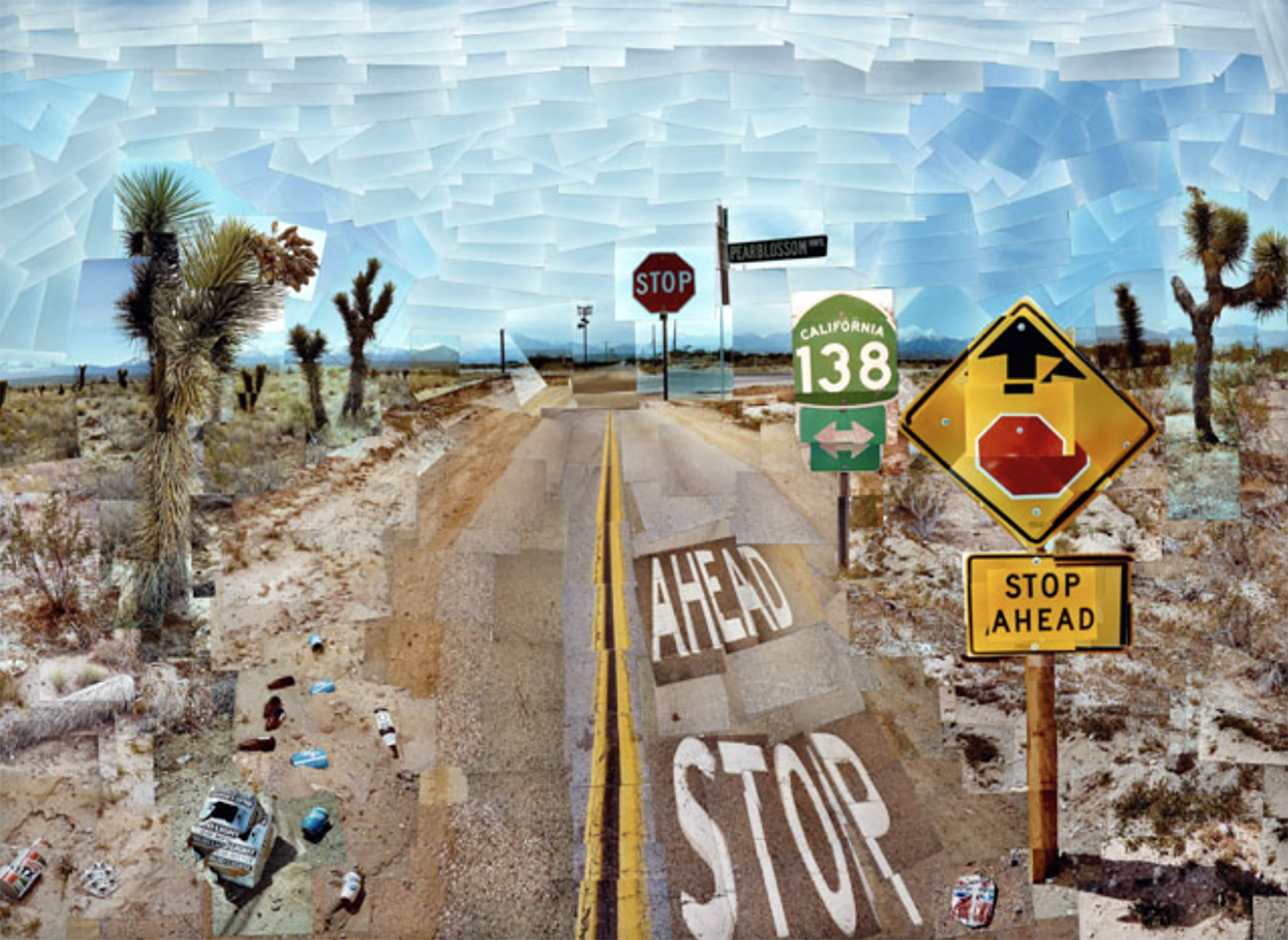
David Hockney means a lot to me and his passing has made me reflect on that meaning. Initially it was his delicate sensitive pen drawn portraits that inspired me, then it was his dress sense and no nonsense approach to making work, then his splash paintings and interviews, in which he made the complicated seem simple. Finally, it was his approach to photography.
Hockney deconstructed photography. He played with it, challenged it, dismissed it, used it, and reimagined it. A process that inspired every art student, at the time, to imitate the master and spend all of their money on packet, after packet of cheap 6 x 4 inch prints, to build their own ‘Hockneyesque’ view of the world. Including me!
Hockney’s creation of his “joiners” occurred accidentally, when he noticed in the late sixties that photographers were using cameras with wide-angle lenses. Unconvinced by the distortion they created whilst working on a painting of a living room and terrace in Los Angeles, he made Polaroids of the living room and glued them together as a preparatory work, not intending for them to be a composition on their own. Upon looking at the final composition, he realized that he had created a visual narrative, as if the viewer was moving through the room. He began to work more and more with photography after this discovery and even stopped painting for a period of time to exclusively pursue this new approach to the medium. Reflecting extensively on this process and its connection to the Cubist sense of multiple angles and movement. Hockney argued, that these “multiples” conveyed a strong sense of movement not evident in conventional photography, in that the viewer had to keep adjusting their imagined viewpoint as the eye travels from print to print.
I saw the photographer Christopher Anderson on social media , describe Hockney as “possibly my favorite photographer.” I was surprised and not surprised. I think admiration for Hockney can be seen by some as a guilty secret. He was good at playing the media game, and some people don’t like that, in the art world. It’s not cool! He was always entertaining when interviewed, intelligent, well informed and never afraid to speak his mind, often with a cigarette in hand. His flamboyant dress sense and circular glasses to the fore. Hockney and his work was, and is, easily accessible. Exhibitions, films, postcards, posters and books, became part of our popular cultural landscape. He was many people’s idea of an artist, and he had no problem with that.
But, his relationship with photography was ambivalent at best. Despite his success with the medium, he was always dissatisfied with its abilities to record, to the extent that he often used it as his reason to draw. Drawing could do what photography couldn’t. As he said, “When is the present? When did the past end and the present occur, and when does the future start? Ordinary photography has one way of seeing only, which is fixed, as if there is kind of an objective reality, which simply cannot be. Picasso…knew that every time you look there’s something different. There is so much there but we’re not seeing it, that’s the problem.”
Hockney explored every medium that allowed him to explore the two dimensional form. Drawing and painting with pencils and paint on paper alongside his iPad. Printing with ink and photography. Exploring the Camera Obscura, as he challenged ideas of perspective and the use of the photographic image, as a starting point for further creative practice.
Hockney understood photography in both his practice and when being photographed. There can be few photographers, certainly in the UK, who have not photographed him, usually to accompany a magazine interview. From the beginning of his career in the early 1960s, until his last months, Hockney delivered for the photographer sent to attempt to capture his spirit with only light and a box with a lens.
I met him once at the Chelsea Flower Show. He was sitting on his own, completely ignored, smoking a cigarette. I approached him to express my gratitude for all of the inspiration he had given me. He was kind, gentle and humble. I made a few portraits of him and left him to his solitude and cigarette. Just sitting and watching the world. I lost the photographs when I moved to Spain, but the memory of that moment lives with me. As does his work and words.
If you are not familiar with David Hockney, his work or his impact on photography I suggest you visit YouTube and allow yourself to travel down the rabbit hole you will inevitably enter. I’ll just finish with a few of his words, that for me encapsulate why he continues to mean so much to me. “Photography hankers after the condition of the neutral observer. But there can be no such thing as a neutral observer. For something to be seen, it must be looked at by somebody, and any true and real depiction must be an account of the experience of that looking.”
Dr.Grant Scott
After fifteen years art directing photography books and magazines such as Elle and Tatler, Scott began to work as a photographer for a number of advertising and editorial clients in 2000. Alongside his photographic career Scott has art directed numerous advertising campaigns, worked as a creative director at Sotheby’s, art directed foto8 magazine, founded his own photographic gallery, edited Professional Photographer magazine and launched his own title for photographers and filmmakers Hungry Eye. He founded the United Nations of Photography in 2012, and is now a Senior Lecturer and Subject Co-ordinator: Photography at Oxford Brookes University, Oxford, and a BBC Radio contributor. Scott is the author of Professional Photography: The New Global Landscape Explained (Routledge 2014), The Essential Student Guide to Professional Photography (Routledge 2015), New Ways of Seeing: The Democratic Language of Photography (Routledge 2019), What Does Photography Mean To You? (Bluecoat Press 2020) and Inside Vogue House: One building, seven magazines, sixty years of stories, (Orphans Publishing 2024). His photography has been published in At Home With The Makers of Style (Thames & Hudson 2006) and Crash Happy: A Night at The Bangers (Cafe Royal Books 2012). His film Do Not Bend: The Photographic Life of Bill Jay was premiered in 2018.
© Grant Scott 2026
Image: David Hockney,Pearblossom Hwy., 11-18th April 1986 No. 1
Leave a Reply