
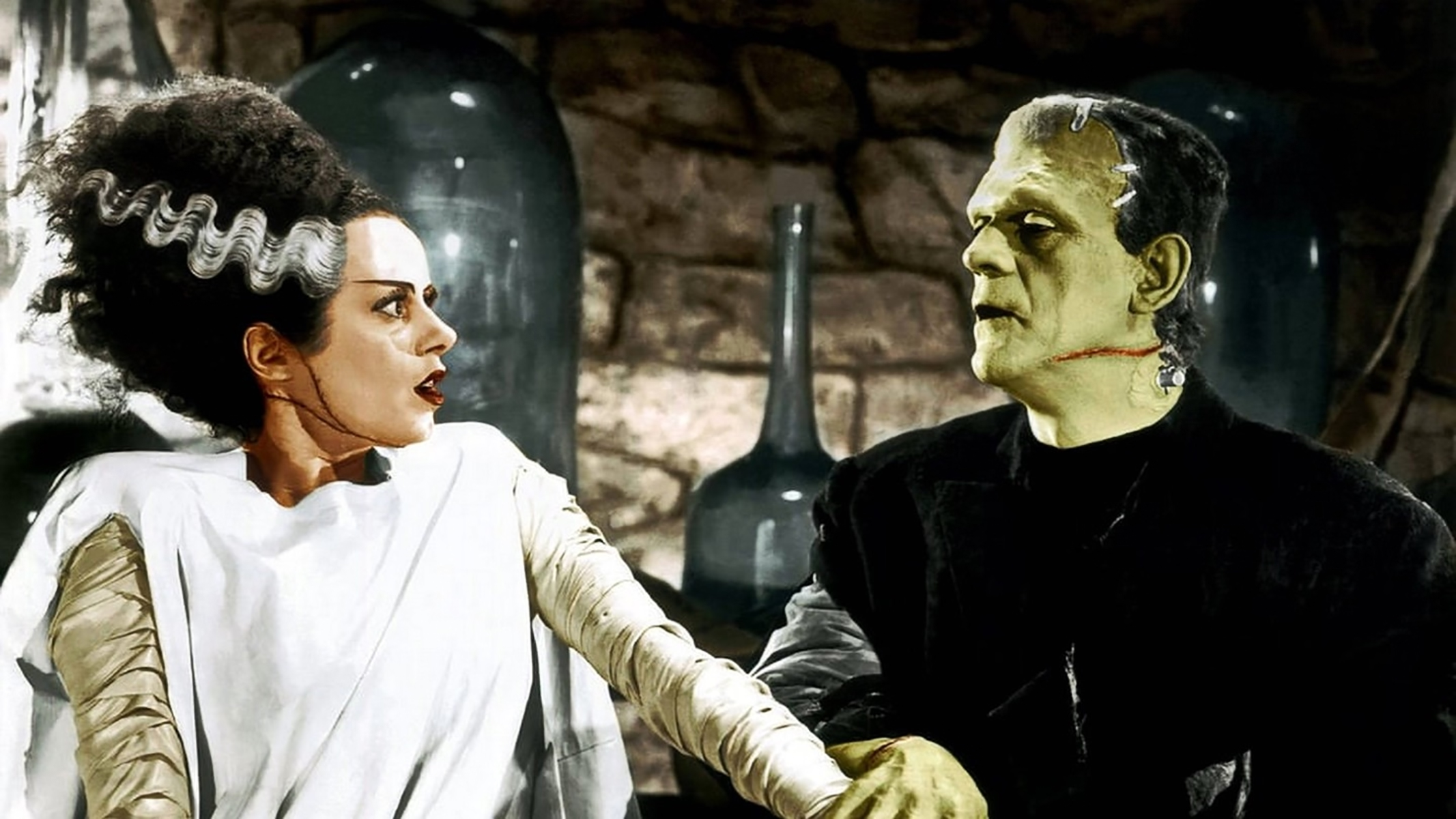
Let’s begin to answer this question by stating what it isn’t. It isn’t a group of photographs, put together by a photographer. It isn’t a group of photographs, put into a sequence. It isn’t a bunch of photographs, made by one photographer. It is all of these things and more than any of these things.
Intrinsically it is a grouping of photographs that have a reason to exist, that relate to each other through a combination of aesthetic and narrative understanding. Sounds simple, I know, but evidently it isn’t. I say that as I probably spend more of my time trying to explain to photographers what a body of work is than I do anything else!
Now, before you say to me, Grant you are wrong, a body of work is also the combined fruits of one photographer’s labours, over their life, yes I agree with you. But, and it is a big ‘but’, that body of work is the same as any other body of work. It is a curated collection of images spoken in the same visual language. In that sense, see it as a collection of short stories rather than one novel.
The use of a writing metaphor here is essential to the understanding what constitutes a body of work. A body of work must have a narrative spine, which connects the images, and explains why the images are made. Their reason to existent independently and together. Without this, it is not a body, merely a selection of independent limbs and parts, that don’t make a whole.
The body of work therefore has to be defined from the very beginning. The more clearly it is defined, in my opinion, the more chance there will be of a successful outcome. That definition can evolve and develop, it can be long form or short form in nature, but it has to exist. Let, me continue with another writing metaphor to give further clarity to this logic. When speaking with photographers hoping to build a body of work, not surprisingly I ask them what story they are aiming to tell and I am usually met with variations on “I am going to document” this, that or the other. The issue is that what they are actually saying is, I am not sure, but I know it will be good. A writer may say that they are going to write about a crime and that would be the umbrella subject area for the story. It would not be the story, that would focus on who, where, when and how. It would be detailed in its intention. The photographer hoping to make a body of work must understand this.
That body of work may come together as a series of prints, a book or an exhibition. The outcome is not important at the beginning, the work, as it is being made, will suggest the appropriate contexts, in which it should, or could exist. To start off at this point is to put the horse right in front of the cart, with the expected disastrous results, for both the horse and the cart. A body of work requires research, thought and consideration at the beginning. The more of each the better. It requires the photographer to look at other bodies of work that appeal to them and have been successful in there intention. Not to just look a photographer’s website and single images, the most common mistake that I see taking place. Disconnected single images will not unlock the structure of a body of work. To understand how to make a body of work, you have to look at bodies of work. As I often say you wouldn’t expect to write a successful pop song, if you had never heard one. The same rules apply to photography!
It usually takes me a couple of months, when I am working with young photographers, to get them to understand what a body of work is in photography. This is not because I am a bad teacher, I hope, but because my explanation is so simple that they don’t believe that I could be right. Surely, it is more difficult than this, their internal voices tell them. It takes a while for them to believe me, but when they do it is as if a weight has been lifted off their shoulders. They even start smiling and laughing, confused by how hard they found the concept at the beginning of their journey. The foundation of any successful body of work is doing a simple thing well, telling a clear story with clarity. That’s it, pure and simple. Some may wish that I had a more complicated, complex and academically deep piece of advice for you, but I don’t. Sometimes simple solutions are the best and the fewer words the better.
Dr.Grant Scott
After fifteen years art directing photography books and magazines such as Elle and Tatler, Scott began to work as a photographer for a number of advertising and editorial clients in 2000. Alongside his photographic career Scott has art directed numerous advertising campaigns, worked as a creative director at Sotheby’s, art directed foto8 magazine, founded his own photographic gallery, edited Professional Photographer magazine and launched his own title for photographers and filmmakers Hungry Eye. He founded the United Nations of Photography in 2012, and is now a Senior Lecturer and Subject Co-ordinator: Photography at Oxford Brookes University, Oxford, and a BBC Radio contributor. Scott is the author of Professional Photography: The New Global Landscape Explained (Routledge 2014), The Essential Student Guide to Professional Photography (Routledge 2015), New Ways of Seeing: The Democratic Language of Photography (Routledge 2019), What Does Photography Mean To You? (Bluecoat Press 2020) and Inside Vogue House: One building, seven magazines, sixty years of stories, (Orphans Publishing 2024). His photography has been published in At Home With The Makers of Style (Thames & Hudson 2006) and Crash Happy: A Night at The Bangers (Cafe Royal Books 2012). His film Do Not Bend: The Photographic Life of Bill Jay was premiered in 2018.
© Grant Scott 2026
Leave a Reply