
Have you ever been asked what you do? Only to answer that you are a photographer and be met with the suggestions that constitute the title of this article. I have! Too many times to mention. However, this has only happened to me in the UK. These are the common understandings of the photographer in the land of my birth. That or the enthusiast photographing wildlife or landscapes. In the US I was often met with the exclamation “cool!” Followed by “who do you work for?” In Europe the response was more downplayed with a simple “interesting”.
Three responses based on geography that reveal national understandings of the role of the professional photographer. I say professional, because photography is what the professional photographer does. It’s their career, it’s their primary income and profession. Despite this it is an occupation that is widely misunderstood.
I think there are two main reasons for this. The first is a lack of awareness of the importance of photography in our everyday lives and the second is a lack of engagement with the medium outside of that commercial interaction. Let me explain.
Photography is so ubiquitous in our lives today that it has become invisible. We accept it without question. It is there wherever we turn and there is no consideration as to who made it or how it was made. It exists to sell stuff. The evolution of AI image making has taken the photograph even further away from the personal. The belief that a team of people are responsible for its existence. Who needs them when an algorithm can make images better and cheaper than a real person? Of course I am being deliberately confrontational here, but it is a belief held by some outside of the photographic community. We all know that.
In the UK the most obvious point of contact someone may have with an actual living, breathing photographer is a wedding. It is the one time there is an acceptance that a professional photographer is required. The shock of what that photographer will charge for “just taking some photos” further illustrates the lack of respect and understanding that exists in relation to photography. Cake, dress, flowers, cars, venue are accepted as high costs, but photography? Are you kidding? But, let’s not get bitter or angry.
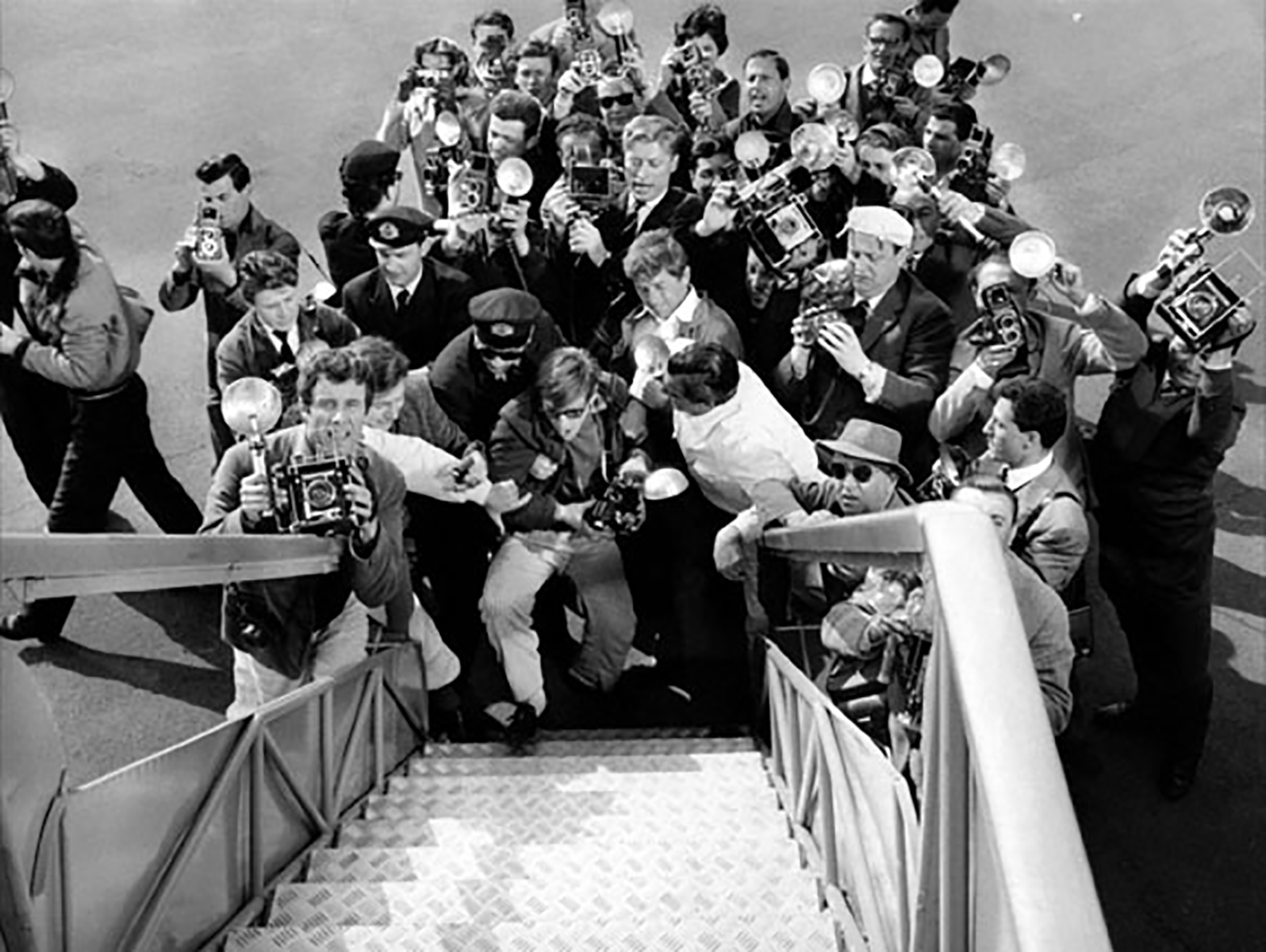
Few will remember or have seen the 1960 film La Dolce Vita in which the paparazzi on their Vespas and Lambrettas chase Anita Ekberg around the streets of Rome, but that is the film that brought the concept of the two-wheeled, news-hound-photographer to the public conscience. In the UK it was the death of Princess Diana in a Paris underpass that soiled forever the description of the celebrity chasing ‘snappers’. Not something any photographer would want to be associated with. Despite both of these instances being confined to the annals of time the idea of the paparazzi is still a commonly used term for anyone who earns their living from photography.
The history of photography in the US is different. It is more respected and established within education. Therefore it is not perceived as being confined to weddings and the paparazzi in New York and Los Angeles, where celebrities can be easily tracked and found. The idea of commissioned photography for magazines, newspapers and brands is therefore more widely understood. The idea of photography within the gallery/museum space is accepted as normal.
In Europe photography has always been better supported by governments and institutions through exhibitions and museums, both big and small. A clear example of this is occurring in France this year in how they are celebrating 200 years of photography. In the UK nothing is being staged, whereas across France events are being held throughout the country supported by their Ministry of Culture. I rest my case. In the UK we don’t even have a Ministry of Culture!
So, how photography is understood is largely based on where you live. the examples I have given here are all based on my personal experience. I’m sure you can add to them. Which raises the question, does it matter how we are perceived as a photographer? Well, not really, and as a photographer it is essential to develop a thick skin as protection against what we don’t want to hear. However, it can get tiring constantly having to explain exactly what it is that you do. If this is the case you may wish to adopt my response to the question. It is simple, easy to remember and accurate. My response is “I photograph people you may have heard of”. This may work for you and you may want to adapt it to meet your own needs. I’m happy either way.
Dr.Grant Scott
After fifteen years art directing photography books and magazines such as Elle and Tatler, Scott began to work as a photographer for a number of advertising and editorial clients in 2000. Alongside his photographic career Scott has art directed numerous advertising campaigns, worked as a creative director at Sotheby’s, art directed foto8 magazine, founded his own photographic gallery, edited Professional Photographer magazine and launched his own title for photographers and filmmakers Hungry Eye. He founded the United Nations of Photography in 2012, and is now a Senior Lecturer and Subject Co-ordinator: Photography at Oxford Brookes University, Oxford, and a BBC Radio contributor. Scott is the author of Professional Photography: The New Global Landscape Explained (Routledge 2014), The Essential Student Guide to Professional Photography (Routledge 2015), New Ways of Seeing: The Democratic Language of Photography (Routledge 2019), What Does Photography Mean To You? (Bluecoat Press 2020) and Inside Vogue House: One building, seven magazines, sixty years of stories, (Orphans Publishing 2024). His photography has been published in At Home With The Makers of Style (Thames & Hudson 2006) and Crash Happy: A Night at The Bangers (Cafe Royal Books 2012). His film Do Not Bend: The Photographic Life of Bill Jay was premiered in 2018.
© Grant Scott 2026


Leave a Reply to Richard AltonCancel reply