
For many months we asked photographers to send us a piece of audio no longer than five minutes in length to include on our A Photographic Life podcast. These became a book which is now out of print but remain in audio form within the podcast archive, available wherever you get your podcasts . However, we are responding to listener requests and offering transcriptions of some of our favourite contributions. Enjoy!
Brian Griffin was born in 1948 and lives and works in London. Considered “the photographer of the decade” by The Guardian in 1989, “one of Britain’s most influential photographers” by the World Photography Organisation in 2015, and worked as a freelance photographer, filmmaker and TV commercials and music video film director since 1972. Griffin published over thirty books and was awarded the Best Photography book in the World at the Barcelona Primavera Fotografica 1991. Life magazine used his photograph A Broken Frame on the front cover of its supplement The Greatest Photographs Of The 80’s. In 1991, after twenty years, he “walked away from photography” and began a career creating advertising commercials and music videos. He returned to photography in 2002 and has had more than fifteen solo shows and four retrospectives since. Griffin won many awards including four ‘Most Outstanding Awards’ from the D&AD (Design and Art Direction), and the ‘Freedom of the City of Arles, France’. He won the ‘Best Commercial of the Year’ at the Bafta Academy awards in 1992 and his short movie Claustrofoamia received the ‘Golden Monkey Award’ for Best Film at the Mons International Short Film Festival in Belgium and the ‘Certificate of Merit’ at the Chicago International Film Festival, both in 1995. In September 2013, he received the ‘Centenary Medal’ from the Royal Photographic Society in recognition of a lifetime achievement in photography. In 2014, he received an Honorary Doctorate by Birmingham City University for his lifetime contribution to the City of Birmingham. Griffin’s photographs are held in the permanent collections of major art institutions including the Victoria & Albert Museum, London; the Arts Council of Great Britain, London; the British Council, London; the National Portrait Gallery, London; the Museum Folkwang, Essen; the Birmingham Museum and Art Gallery; the Art Museum Reykjavik, Iceland; the Mast Foundation, Bologna; and the Museu da Imagem, Braga, Portugal. He died in 2024. www.briangriffin.co.uk
“I’m Brian Griffin and I am one of the most boring photographers on earth. I don’t even really like photography that much.
Where did this all start? Well I have to go back to when I was sixteen-years-old and I had to leave school. My parents made me leave school because I needed some money, and I ended up in a factory, the last place on earth I ever wanted to be. But in many ways that experience proved to be quite fruitful.
When I left the factory and went to art school I was equipped mathematically, as I’d studied engineering. Leaving art school, I needed to have a career in photography and all that analogue stuff where you had to understand, scientific things and exposure things, was dead easy for me. I could do all that stuff, because I’d spent five years of engineering leaving me right on top of analogue photography and its complexities. I was exploring light which is basically all I was interested in. I wasn’t interested in anything else photographically. I wanted to see how far I could take light.
Then came the digital universe and I could do that as well, because I had this technical mind. I could use the digital advances to my benefit. I’m still not that interested in photography I just use it and I have always used it to collect my ideas. I use it to put down evidence of my ideas, a lighting idea I have, a lighting development I have, so that I can see them, to see how my brain has been working. I’m a photographer, that is not really interested in photography.”
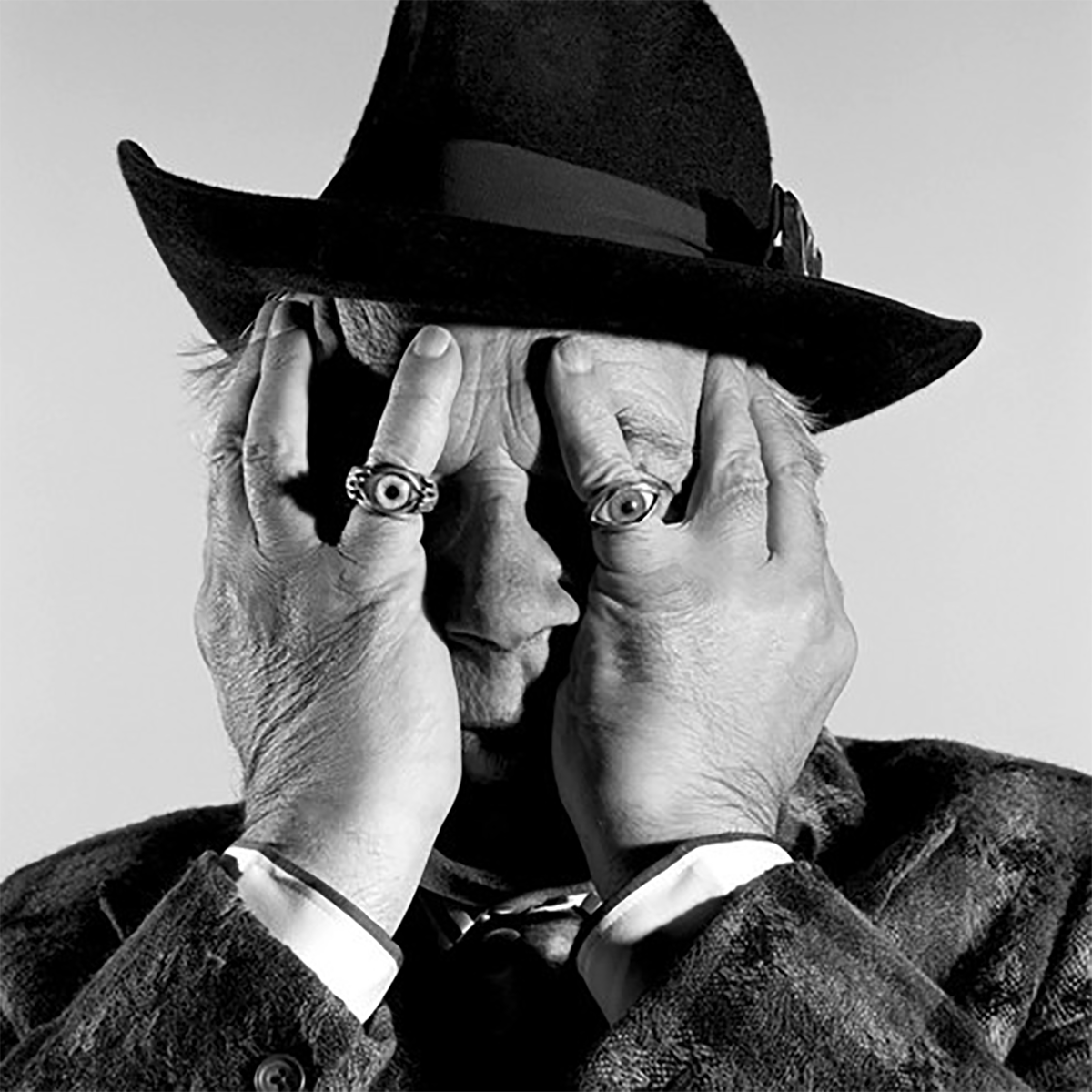
Image: Portrait of British jazz musician and humanist George Melly, an advertising campaign for Sony (1990)© Brian Griffin
© Grant Scott 2026
Leave a Reply