
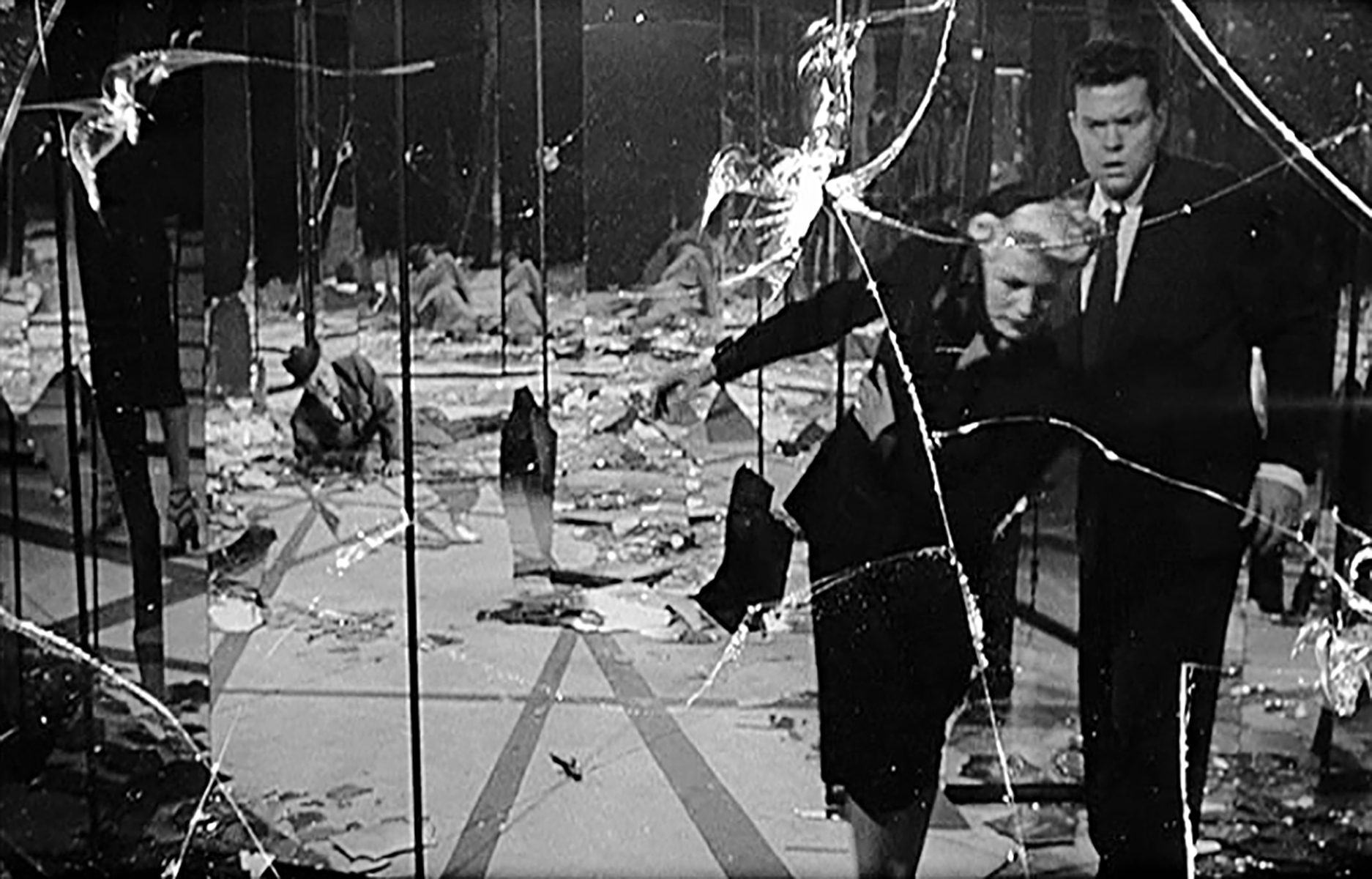
I was recently watching a documentary based on the last film that Orson Welles worked on. The documentary is called They’ll Love Me When I’m Dead. The film was called The Other Side of The Wind. A film that is two movies in one. One part is the last day of a directors life, and the other tells the story of the director’s film falling apart. In essence it is a film of a rejected aging film director. An autobiographical story? Probably, although he hated this description. The documentary is beautifully made and makes much of archive footage from Welles’s films, including The Other Side of The Wind. It’s an interesting narrative , but its most immediate impact for any photographer, has to be how he filmed and framed every shot in his films, including TOSOTW.
The documentary also includes film clips from some of the greats of European cinema, from the 1960s. Jacques Demy, Antonioni, Ingmar Bergman are sited as influences, and their work raised a similar feeling within me. One of excitement and concern. Excitement, because the cinemotography in the films these people made was so adventurous, experimental and inspiring. Concern, because it made me realize how little cinematography I see today in films that makes me feel the same. Yes, of course, there are exceptions. The recent film Ripley is an excellent example of beautiful narrative based image making. As is everything, In my opinion, directed by Wes Anderson.
The reason why I am discussing cinematography on a photography website is because its relationship with stills photography was once symbiotic, but now it seems disconnected. The reason I say that is based on what I see. There is no shortage of independent films being made and released, mainly due to the affordability of digital film production, but also thanks to the multiple platforms available to show and stream them on. Film is no longer reliant on a physical cinema building to be seen. Independent cinema encourages creative solutions to cinematography and narrative, but the issue is that without large marketing budgets, it can too easily live in a vacuum and go unnoticed. The work of Orson Welles was Hollywood cinema bringing creativity to every local cinema. It’s reach was extensive, and it encouraged those studying photography to move into films.
Today, I see too many photographers looking only at photography. The importance of cinematography seems to have been forgotten and dismissed, as the local multiplex is filled with animation and super hero movies, outside of the occasional film of worth. Such visual popcorn does little to feed the pot of inspiration for photographers.
If photographers only look at photography, a negative circle of repetition and imitation is formed. In short, photography becomes conservative with a small c! It becomes safe and boring.
Orson Welles was definitely neither of these things. Neither where the film makers who came out of the Nouvelle Vague. Or Terrence Malick or Wim Wenders or Stanley Kubrick or Martin Scorcese or David Lynch or Krzysztof Kieślowski or David Lean or Akira Kurosawa or Federico Fellini or Andrei Tarkovsky or Alfred Hitchcock. I could go on, and I am sure that I have missed names, that you think I should have included. More recent filmmakers such as, Lynne Ramsey, Christopher Nolan, Wong Kar-wai, Paul Thomas Anderson and Lars von Trier should also be included in any photographers inspiration bucket. If you need further persuasion to look to film making for photographic inspiration, you only need to look into the work of one of the greatest, Director’s of Photography (in my opinion), Roger Deakin. A man whose work includes The Shawshank Redemption (1994), Fargo (1996), O Brother, Where Art Thou? (2000), A Beautiful Mind (2001), No Country for Old Men (2007), True Grit (2010), Skyfall (2012), Sicario (2015), Blade Runner 204 (2017), and 1 17 (2019), the last two of which earned him Academy Awards. You could also look at a book of his photography titled Reflections.
So, if you want to improve your photography, avoid the camera shop and watch more films. But, never forget the wise words of Orson Welles, “I don’t believe in learning from other peoples pictures. I think you should learn from your own interior vision. What’s happening now is what happened before, and often what’s going to happen again, sometime or other.”
Further Reading
https://unitednationsofphotography.com/2022/10/07/how-to-improve-your-photography-make-films/
https://unitednationsofphotography.com/2026/03/14/photography-is-no-longer-enough/
https://unitednationsofphotography.com/2022/10/09/when-will-photographers-finally-accept-the-smartphone/
Dr.Grant Scott
After fifteen years art directing photography books and magazines such as Elle and Tatler, Scott began to work as a photographer for a number of advertising and editorial clients in 2000. Alongside his photographic career Scott has art directed numerous advertising campaigns, worked as a creative director at Sotheby’s, art directed foto8 magazine, founded his own photographic gallery, edited Professional Photographer magazine and launched his own title for photographers and filmmakers Hungry Eye. He founded the United Nations of Photography in 2012, and is now a Senior Lecturer and Subject Co-ordinator: Photography at Oxford Brookes University, Oxford, and a BBC Radio contributor. Scott is the author of Professional Photography: The New Global Landscape Explained (Routledge 2014), The Essential Student Guide to Professional Photography (Routledge 2015), New Ways of Seeing: The Democratic Language of Photography (Routledge 2019), What Does Photography Mean To You? (Bluecoat Press 2020) and Inside Vogue House: One building, seven magazines, sixty years of stories, (Orphans Publishing 2024). His photography has been published in At Home With The Makers of Style (Thames & Hudson 2006) and Crash Happy: A Night at The Bangers (Cafe Royal Books 2012). His film Do Not Bend: The Photographic Life of Bill Jay was premiered in 2018.
© Grant Scott 2026
Image: Lady From Shanghai. Orson Welles

Leave a Reply