
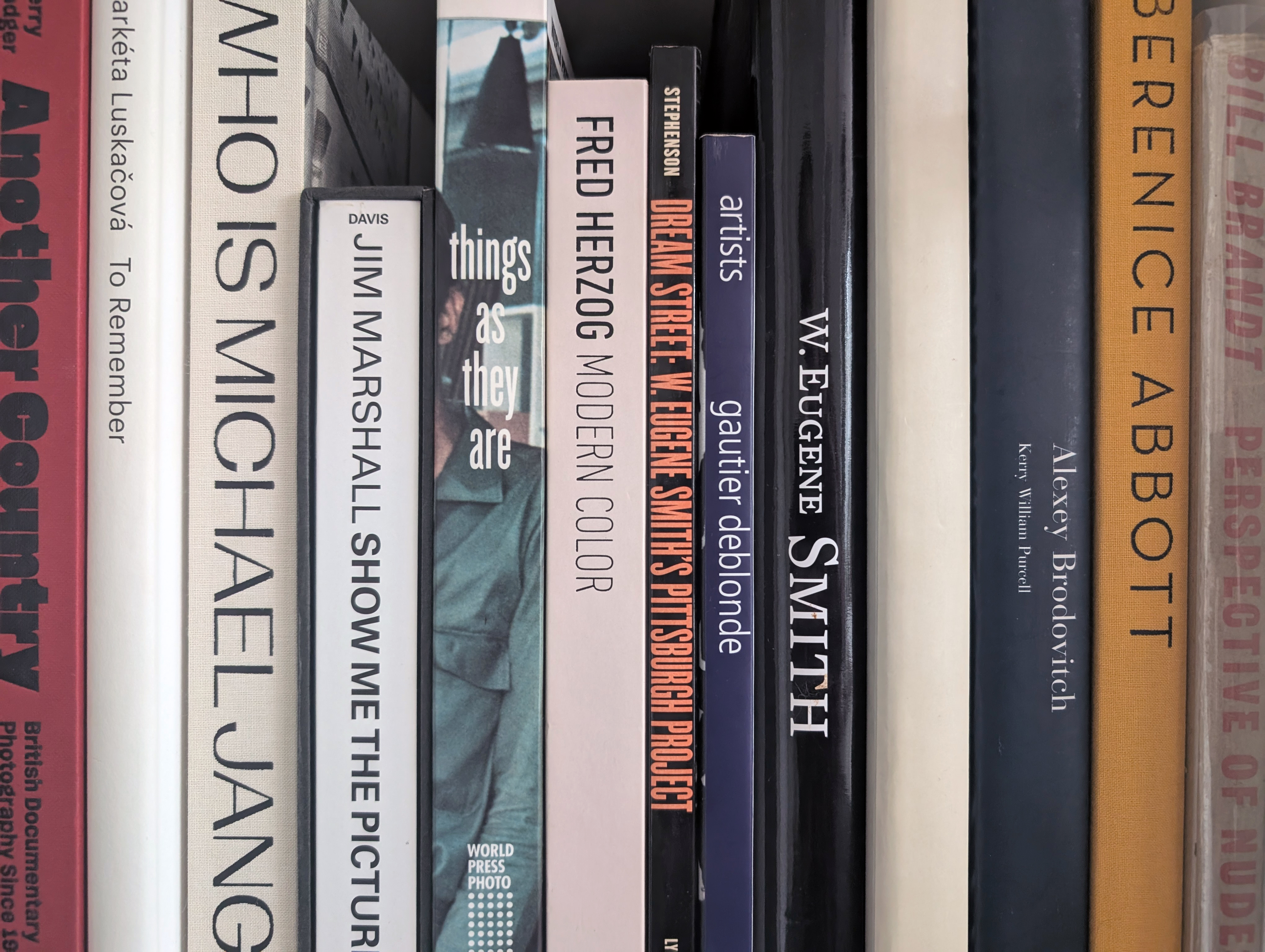
I already know before starting to write that I will be met with a torrent of comments stating a million reasons why this question is ridiculous. That I don’t know what I am talking about. That I am being deliberately contentious. I hope/think I do. I’m not.
Over the years I have owned many photo books. In fact so many that at different times their number could be counted in the thousands. I have seen even more than I have purchased. And I am getting bored. Bored of repetition.
There’s no doubt that you can come to a time of life when you feel that you have enough of anything. That is definitely the case for me when it comes to photo books. I have refined my collection down to just a few hundred essential tomes and I am happy with that. Therefore when I see a photo book for sale I really need to feel that I need it. I need to be persuaded.
It is this requirement that informs the question that heads this article. There may be no shortage of photo books being published but how many of them do you or I need to buy? The fact that I and many people I speak with in the photo community cannot find many, points to the death of the photo book in my opinion. As it is and not as it could be.
The issue is that so many look the same. They follow a template. They have type only highly tasteful, quietly spoken graphic covers. They are well printed. Minimal text and cryptic titles. A single photograph on every right hand page. Nothing on the left. Non-obvious narratives and images that almost perversely challenge you as to their photographic value. They are also invariably self- published. There are excellent books that fulfill some if not all of these criteria but they are few and stand tall by recording high sales figures.
Most are not trying to do anything different or appeal to anyone other than a photographic literate audience. Photographers selling to photographers. Printed in their hundreds they aim to recoup printing costs at best. And that’s okay if that’s what you want. I’m just not going to buy a copy and sadly many people will feel the same as me. Especially in such a tough economic climate as the one we are all currently trying to survive. A photo book is a luxury at best but one you don’t need is a luxury that can be rejected without feeling bad.
The issue for me is one of audience. If you don’t consider your audience before you start how can you expect to have one? No audience, no sales it’s a simple equation. And yet I don’t think that many photographers consider a potential audience before starting, making, funding and publishing their books. Too many photo books today are about the photographer. They meet the photographer’s need to see their work in print. They offer validation for time and money spent in the production process and they prove that photography is more than a back-lit image on a screen. In this sense the photo book lives, but I think it’s killing itself.
At a recent photo book festival I put forward the thoughts outlined here to a variety of photographers. All of them have had their work published. Either self- published or/and by established publishers and small imprints. They all agreed with me that although the festival offered many books for sale, a sense of repetition dulled the desire to buy. None of us bought one single book.
The festival was busy, it lasted two days, the ticketed talks were all sold out, there was a long queue for coffee and rigorous conversation filled the air but stall holders were only covering their costs at best. Even an engaged photographic audience were not buying books. A £4 coffee and a £10 burrito took priority.
It doesn’t bring me pleasure to write this and I am not intentionally raining on anyone’s parade. I’m in fact attempting to do the opposite. I’m suggesting that the old template is dead and that it’s time for a new approach. The photo book of today needs to be reconsidered and reinvented. The most interesting books I saw at the festival were second hand and from the seventies, sixties and fifties when different approaches were rife and when design did not suffocate content. When the audience was considered, text was incorporated and every book aimed to be original. I think we could learn a lot from those observations.
So, is the photo book dead? I think it is as it might be but I look forward to its resurrection in multiple different forms. The photo book is dead! Long live the photo book!
Dr.Grant Scott
After fifteen years art directing photography books and magazines such as Elle and Tatler, Scott began to work as a photographer for a number of advertising and editorial clients in 2000. Alongside his photographic career Scott has art directed numerous advertising campaigns, worked as a creative director at Sotheby’s, art directed foto8 magazine, founded his own photographic gallery, edited Professional Photographer magazine and launched his own title for photographers and filmmakers Hungry Eye. He founded the United Nations of Photography in 2012, and is now a Senior Lecturer and Subject Co-ordinator: Under and Post Graduate Photography at Oxford Brookes University, Oxford, and a BBC Radio contributor. Scott is the author of Professional Photography: The New Global Landscape Explained (Routledge 2014), The Essential Student Guide to Professional Photography (Routledge 2015), New Ways of Seeing: The Democratic Language of Photography (Routledge 2019), and What Does Photography Mean To You? (Bluecoat Press 2020). His photography has been published in At Home With The Makers of Style (Thames & Hudson 2006) and Crash Happy: A Night at The Bangers (Cafe Royal Books 2012). His film Do Not Bend: The Photographic Life of Bill Jay was premiered in 2018.
Scott’s book Inside Vogue House: One building, seven magazines, sixty years of stories, Orphans Publishing, is now on sale.
© Grant Scott 2025



Leave a Reply to gscott2012Cancel reply