
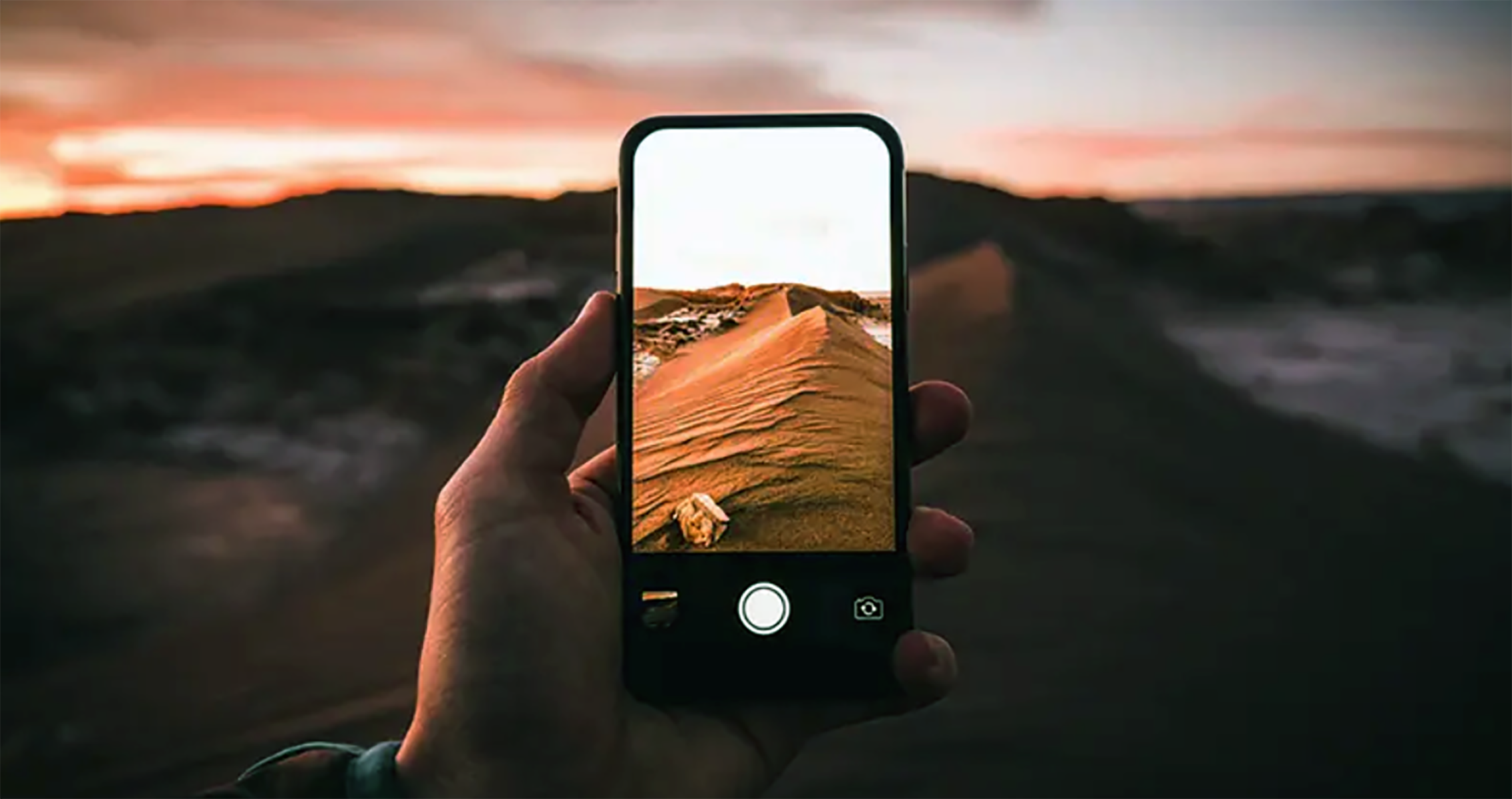
Before you tell me the answer to this question, let’s look at some 2026 data from a report conducted by photoaid.com. Smartphones capture 92.5% of all photographs, with just 7.5% made by conventional cameras. 61% of people typically keep their photos private, while 55% review them for nostalgia and 53% share them on social media. Nearly 54% of smartphone users, not surprisingly, find it overwhelming to search their phones for specific photos. The big fact to help us answer the title of this article is that the typical smartphone user stores 2,795 photos in their phones.
I am a photographer and someone who is pretty engaged with photography and yet I have only twenty-seven photographs stored on my phone. My wife and fourteen-year-old daughter have more than me, but no where near the typical figure photoaid.com suggest. I wonder who they spoke with to get their figure? I am not however, dismissing their findings. To do my own research I visited a local phone shop, the one aligned to the network I fund every month. I asked the friendly chap in there if the storage I pay for on my account was normal. He said it was not, and that I was at the very minimum that they offer. He went on to say that the majority of people who come in to see him are paying considerably more than me each month for their considerably larger data storage. I asked what they were storing and of course he said photographs and videos.
As a photographer I never trust my images to just one device and certainly not my camera. I am constantly downloading and storing my work, whatever type of camera I am using and that includes my phone. However, it is clear that others are using their phones as image makers and image storers. Which is a costly decision to make.
But, I am not going to comment on that. What I am commenting on is the amount of photographs non-photographers are making and keeping. These people are the true photographers, visual documentarians, of our times. Yet they are probably not aware of that fact, and this is a problem. These images are important for future generations who will want to study how we live today, but there is a distinct possibility that they may not survive. You may think that I am placing too much store on these random collections of everyday life, but let me put this into an historical perspective.
The Mass-Observation was the original name of a UK based social research project which ran from 1937 to the mid-1960s, which was revived in 1981 at the University of Sussex. It originally aimed to record everyday life in Britain through a panel of approximately 500 untrained volunteer observers who either maintained diaries or replied to open-ended questionnaires (known as directives). It also paid investigators to anonymously record people’s conversation and behaviour at work, on the street and at various public occasions, including public meetings, sporting and religious events. Created by three former students from Cambridge University; anthropologist Tom Harrisson, poet Charles Madge and filmmaker Humphrey Jennings. In addition to the three founders there were additional collaborators including literary critic William Empson, photographers Humphrey Spender and Michael Wickham, collagist Julian Trevelyan, novelists Inez Pearn and G.B. Edwards, spiritualist medium Rosemary Brown, journalist Anne Symonds, and painters William Coldstream and Graham Bell. Despite it’s distinct sense of George Orwell’s ‘Big Brother’ and its eclectic group of collaboraters the project was both creatively and socially important.
In 1939, Mass-Observation invited members of the public to record and send them a day-to-day account of their lives in the form of a diary. Four Hundred and eighty people responded and their diaries are now held in the organisation’s archive. During the Second World War, its research was influential in shaping British public policy and used by economist John Maynard Keynes to argue for tax policy changes. Today, the archives are housed at the University of Sussex, and Mass-Observation continues to collect the thoughts of its panel of writers, which are used by students, academics and media researchers. The project also continues to issue annual call-outs for day diaries on the 12th of May each year, echoing the initial call of 12th May 1937. Anyone is welcome to submit a diary of their activity on this day either digitally or physically. You can find out more here https://massobs.org.uk.
Even if you are not interested in the majority of the archives, I recommend looking at the photographs created as part of the project by Humphrey Spender. In the mid-1930s Spender was known for his commercial photography, before being recruited to work for the Daily Mirror newspaper under the nickname ‘Lensman’. His images for the Mass Observation project, included photographs of daily life in working class Bolton (know as Work Town) documenting communities, politics, elections, religion, street scenes, industrial landscapes, pubs, market scenes, new buildings and developments, sport and leisure time, workers in the textile mills, on holiday in Blackpool, street hoardings and advertisements. You can see them here https://boltonworktown.co.uk. Toward the end of his involvement with Mass Observation, Spender also took on work as a photographer for Picture Post magazine, but in 1955 he abandoned photography for painting and textile design, and taught at the Royal College of Art until he retired in 1975.
I hope that you can see where I am going with this. The deluge of images being made by all those paying for image storage for their phones are an informal digital Mass Observation. As such they have great value. This may be hard for those dedicated to photography to accept as it would be fair to say that many of these images will have little aesthetic value. However, the value lies in their existence as historical documents. I am not going to suggest that every image should be downloaded and stored, but if you are reading this and have an extensive archive of images sitting on your phone perhaps you should consider doing something with them. What that is I’m not sure, but at least by getting them off your phone you may save some money from going to your phone provider and some photographs from going missing.
Dr.Grant Scott
After fifteen years art directing photography books and magazines such as Elle and Tatler, Scott began to work as a photographer for a number of advertising and editorial clients in 2000. Alongside his photographic career Scott has art directed numerous advertising campaigns, worked as a creative director at Sotheby’s, art directed foto8 magazine, founded his own photographic gallery, edited Professional Photographer magazine and launched his own title for photographers and filmmakers Hungry Eye. He founded the United Nations of Photography in 2012, and is now a Senior Lecturer and Subject Co-ordinator: Photography at Oxford Brookes University, Oxford, and a BBC Radio contributor. Scott is the author of Professional Photography: The New Global Landscape Explained (Routledge 2014), The Essential Student Guide to Professional Photography (Routledge 2015), New Ways of Seeing: The Democratic Language of Photography (Routledge 2019), What Does Photography Mean To You? (Bluecoat Press 2020) and Inside Vogue House: One building, seven magazines, sixty years of stories, (Orphans Publishing 2024). His photography has been published in At Home With The Makers of Style (Thames & Hudson 2006) and Crash Happy: A Night at The Bangers (Cafe Royal Books 2012). His film Do Not Bend: The Photographic Life of Bill Jay was premiered in 2018.
© Grant Scott 2026


Leave a Reply to Richard AltonCancel reply