
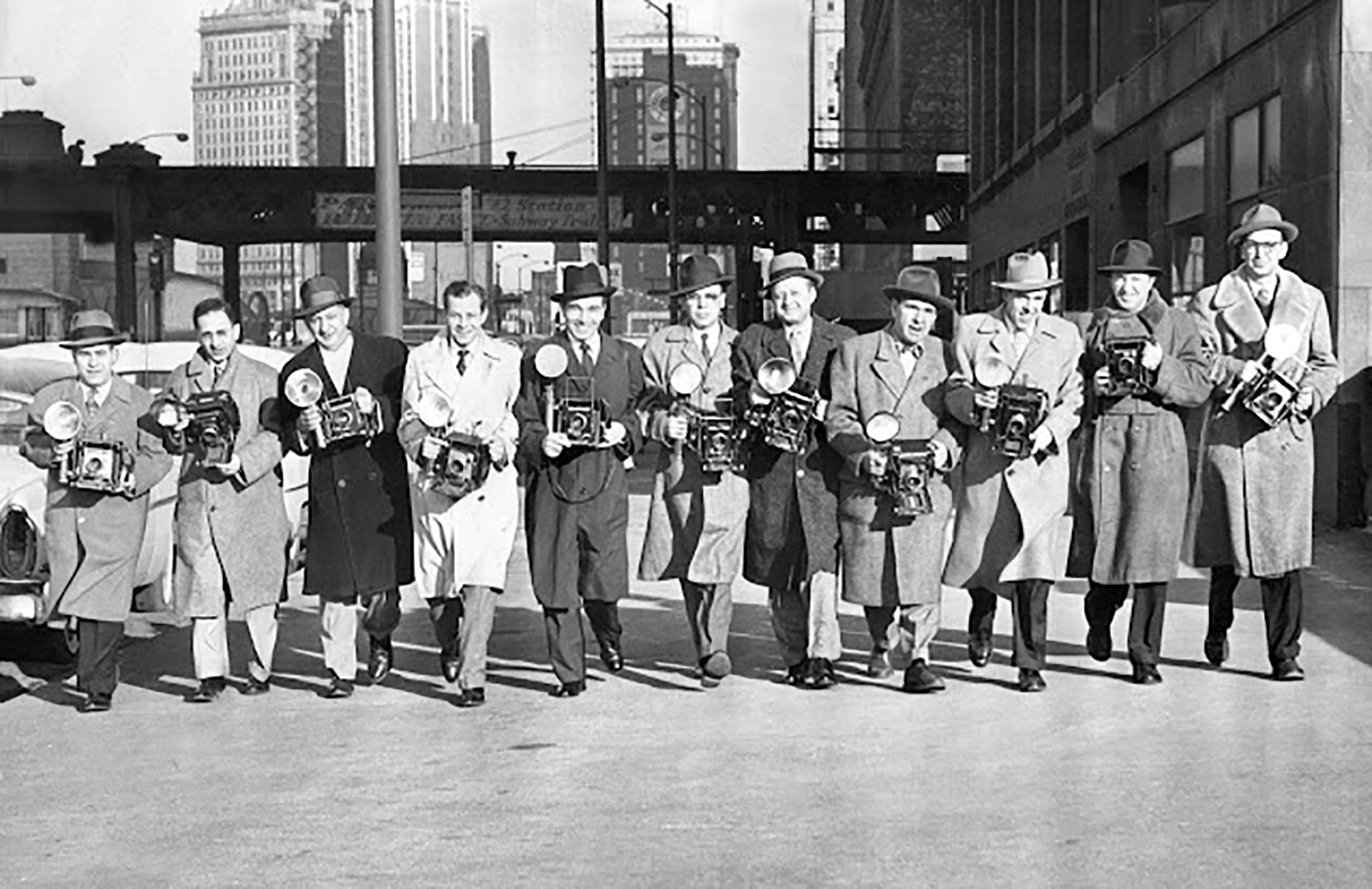
A reader of this website recently posted to say that I should be talking about the recent redundancies at The Washington Post newspaper. They suggested that I speak to someone involved. His point was that this was more important than some of the issues I discuss on the UNP. I responded by saying that I talk about a range of issues, both light and shade, but that although that story was obviously very important to him and others it may not be to those not connected to the USA, that area of practice or the newspaper. However, there is a bigger picture here and one that I will address. I have addressed it before (https://unitednationsofphotography.com/2021/05/31/the-slow-death-of-the-photo-editor/), but as time passes I think there are new things to say.
So, let’s start with some facts. Journalists have been witnessing the reduction and closure of local newspaper newsrooms for decades. In 1958, Francis Williams noted the closure of 225 UK based newspaper in the preceding 40 years. This trend has continued and the 2000s have seen more than 265 local papers close in the UK between 2005 and 2020. But, this situation is not just about newspapers closing it’s also about the decline in revenue, output, and readers. The reasons why they close. Analysis by the Press Gazette evidences the fact that revenue in the newspaper sector today is a quarter of the size it was in 2007 when adjusted for inflation. Data from Reach Plc, which owns 300 local papers across the UK, shows an annual loss of £1 billion in advertising spend over the past decade, with the majority going to Facebook and Google. That is a big drop, but it is not the only one. Circulations have also seen a steep decline.
No regional daily newspaper in Britain passes 20,000 daily readers in 2026 and that includes previously major titles such as the Liverpool Echo and the Manchester Evening News. The nationals are doing no better. The 2025 ABC figures revealed that no national newspaper had increased its year-on-year growth. All newspapers are in a state of managed decline and the worst affected are the weekend papers, a long established platform for all forms of photography through their multiple departments and sections. In 2025 the Sunday Mirror was year on year -17.3%, the Sunday Post -17.3%, the Sunday Express -16.8%, the Sunday People -20.7%, and the Sunday Mail -20.4%.
The Telegraph Group of newspapers and magazines in the UK has been for sale for years. With no buyer insight yet to commit to a purchase. Publishing is no longer a sexy or profitable game to play and that is our fault. Expenditure on newspapers fell from over £9.9 billion in 2005 to below £2 billion in 2022. Quite simply, we are not buying newspapers and magazines anymore as we now see the online environment as our provider of news, information, education, entertainment and aspiration.
Therefore the reasons for owning a newspaper or publishing/media group is about more than making money or supporting quality journalism. It is about power, influence and control. In essence political influence. Now, you may think that this has nothing to do with photography, but it is actually everything to do with photography. Musk (the richest man in the world) bought Twitter and renamed it X, Jeff Bezos (the second richest man in the world) owns The Washington Post, Rupert Murdoch owns The Times, The Sunday Times, The Sun, Fox News, The Wall Street Journal, The New York Post and several Australian titles, Mark Zuckerberg owns Facebook, Instagram and What’sApp. The Russian oligarch Lebedevs own Novaya Gazeta,The Evening Standard and The Independent, Lord Rothermere owns The Daily Mail, The Mail on Sunday, theMetro and the i. The Italian billionaire Agnelli family own The Economist, the French–Israeli telecoms billionaire Patrick Drahi owns Libération and L’Express.
None of these people are short of money and therefore you may think, and it may seem reasonable to you that they support high quality editorial content by employing and paying the best people they can find in the industry. Writers, editors, proof writers, photo editors, researchers, printers, production people and of course photographers. But to have such thoughts is to misunderstand their reasons for ownership.
A 2026 article in The Guardian (which is wholly owned by the Scott Trust Limited, which exists to secure the financial and editorial independence of The Guardian in perpetuity) accurately outlined the reality of how staff at The Washington Post were informed of the loss of their jobs. It said that during a morning meeting announcing the changes, the editor in chief, Matt Murray, told employees that the Post was undergoing a “strategic reset” to better position the publication for the future. He acknowledged that the Post had struggled to reach “customers” and talked about the need to compete in a crowded media marketplace. “Today, the Washington Post is taking a number of actions across the company to secure our future,” he said. Murray told employees that the Post was ending the current iteration of its popular sports desk… restructuring its local coverage, reducing its international reporting operation, cutting its books desk and suspending its daily news podcast Post Reports. Seeking to lay out the business case for the layoffs, Murray said the move was “about positioning ourselves to become more essential to people’s lives in what is becoming a more crowded and competitive and complicated media landscape”. The usual word salad rhetoric that is regularly used by management to deliver bad news.
The revelation soon after the annoncement that Bezos through Amazon had funded the feature-length documentary Melania and paid Ms. Trump’s production company $40 million for the rights, and $35 million for marketing of the film proved that money was available when a politically positive outcome was a possibility. Why didn’t this go to the Post was the cry?
The issue for newspapers is that they are based on the idea of providing the truth. That is the core belief of all responsible, professional journalists and in this I include photographers. The reality is of course that newspapers have always presented ‘a truth’ rather than ‘the truth’ (just read the brilliant novel Scoop by Evelyn Waugh if you want to be reminded that none of this is new, and realise that the online news channel The Daily Beast title comes from the 1930s thanks to its founding editor Tina Brown). The history of newspapers is filled with titles being co-opted to promote the political leanings and desires of their wealthy owners.
Therefore, the wealth of the owners has no importance in relation to whether or not photographers or journalists have a job. The issue is that newspapers and magazines are no longer financially viable and those owners do not see it as being their responsibilty to fund money losing operations. Bezo’s could have funded the Post as he did Melania, but it is politically more important for him to diminish the multiple voices of the Post, whilst promoting the singular voice of Trump. It is therefore clear that the day of the staff photographer is dead, however much money the owner of the newspaper has.
I could have spoken to someone on the Washington Post or any newspaper, local or regional before writing this article, but I saw no point. I redesigned an Istanbul based daily Turkish newspaper in the 80s for Murdoch, and worked on The Guardian in the 90s. I spent twenty-five years art directing and editing magazines and the last twenty-five photographing for magazines and newspaper supplements. I therefore have many friends and colleagues within the publishing industry. They all tell me the same thing. There is no great secret as to why newspapers are failing and unfortunately we have to accept that truth. As photographers that avenue has been closed, and now we have to find a new route. Not by picking over the weeds of what was, but buy looking to what could be.
Dr.Grant Scott
After fifteen years art directing photography books and magazines such as Elle and Tatler, Scott began to work as a photographer for a number of advertising and editorial clients in 2000. Alongside his photographic career Scott has art directed numerous advertising campaigns, worked as a creative director at Sotheby’s, art directed foto8 magazine, founded his own photographic gallery, edited Professional Photographer magazine and launched his own title for photographers and filmmakers Hungry Eye. He founded the United Nations of Photography in 2012, and is now a Senior Lecturer and Subject Co-ordinator: Photography at Oxford Brookes University, Oxford, and a BBC Radio contributor. Scott is the author of Professional Photography: The New Global Landscape Explained (Routledge 2014), The Essential Student Guide to Professional Photography (Routledge 2015), New Ways of Seeing: The Democratic Language of Photography (Routledge 2019), What Does Photography Mean To You? (Bluecoat Press 2020) and Inside Vogue House: One building, seven magazines, sixty years of stories, (Orphans Publishing 2024). His photography has been published in At Home With The Makers of Style (Thames & Hudson 2006) and Crash Happy: A Night at The Bangers (Cafe Royal Books 2012). His film Do Not Bend: The Photographic Life of Bill Jay was premiered in 2018.
© Grant Scott 2026
Leave a Reply