

For many months we asked photographers to send us a piece of audio no longer than five minutes in length to include on our A Photographic Life podcast. These became a book which is now out of print but remain in audio form within the podcast archive, available wherever you get your podcasts . However, we are responding to listener requests and offering transcriptions of some of our favourite contributions. Enjoy!
Mark Steinmetz was born in New York City and raised in the Boston suburbs of Cambridge and Newton, where he lived until he was 12. He then moved to the Midwest and studied photography at the Yale School of Art in New Haven, Connecticut. He left the MFA programme after one semester, and in mid 1983 aged just 22 he moved to Los Angeles in search of the photographer, Gary Winogrand, whom he befriended. Steinmetz makes photographs of ordinary people in the ordinary landscapes they inhabit, and in the midst of activity. He finds many of his subjects whilst walking, but he has also spent time at Little League Baseball and summer camps. His work has been exhibited in many major institutions, including the Museum of Modern Art New York, the Whitney Museum of American Art, the Museum of Contemporary Art Georgia, the Art Institute of Chicago, the Museum of Fine Arts, Houston and Los Angeles County Museum of Art. Public collections featuring his work include the Metropolitan Museum of Art in New York, the Whitney New York Museum of Modern Art, the Art Institute of Chicago, San Francisco Museum of Modern Art, Yale University Art Gallery and the Los Angeles County Museum of Art. Nazraeli Press has published nine monographs of his work, including South Central in 2006; South East in 2008; Greater Atlanta in 2009; The Players in 2015; and Angel City West in 2016. Among other awards, Mark’s been the recipient of a John Simon Guggenheim Memorial Foundation Fellowship in 1994 and he resides now in Athens Georgia.
Mark Steinmetz: “Hi, I’m Mark Steinmetz. I’m in Athens Georgia, USA. And I have been asked the question, the big question, “What does photography mean to me?” And first, I would say that photography has no intrinsic meaning in and of itself. It’s a tool. Nothing more. A chef may have a fondness for his or her spatula, but finally, it’s just a tool. And the mammoth beast of photography, all the various uses of photography is not something that I really think about too much or dwell upon. I would paraphrase James Agee, who wrote in an essay on Helen Levitt’s book A Way of Seeing that only a few practitioners have really helped us to see better. Most photography has…sort of dumbed down people’s ability to see. It’s made people blind. But a small percentage have really improved our ability to see.
If some mad scientist were to strap me to a table or some very mean sorcerer were going to cast a spell on me, and they told me that they were going to wipe from my memory, all traces of the late work of Eugène Atget or the or the early work of Henri Cartier-Bresson, I would be more than terrified.
Jean Renoir, the great filmmaker, the son of the painter, was asked whether cinema is art. And his answer was, “what does it matter?” He compared cinema to baking bread, which was very French of him. He said that it’s something that can be done wonderfully, and anything that can be done wonderfully is, well, that’s enough. I think questions such as, is cinema art? Is like other questions about meaning, which is, really, is this valuable? Is doing this thing something to cherish? And it leads us to other questions like, What is the meaning of life? And does my life have meaning? And for all of these heavy questions, I would refer you to a cat lying in the sun. The cat lying in the sun is not asking himself if his life has meaning. He knows that he is the meaning of his life. He has no guilt trip about lying in the sun. He doesn’t feel like he has to do anything. He doesn’t have to have a purpose. He is the purpose. We don’t have to have purpose. We are the purpose.
For me, photography has been the vessel, the funnel, the container that directs my thoughts. It orchestrates my life. And I can’t really reach in deep enough to express all that it means to me. For me, photography is a kind of literature. But it’s a literature that affects people, not through words, but through images. Images can touch other people in a different space and time and in a way that words cannot. It’s a system of sharing, a way of touching other people, and somewhere in this is its meaning.”
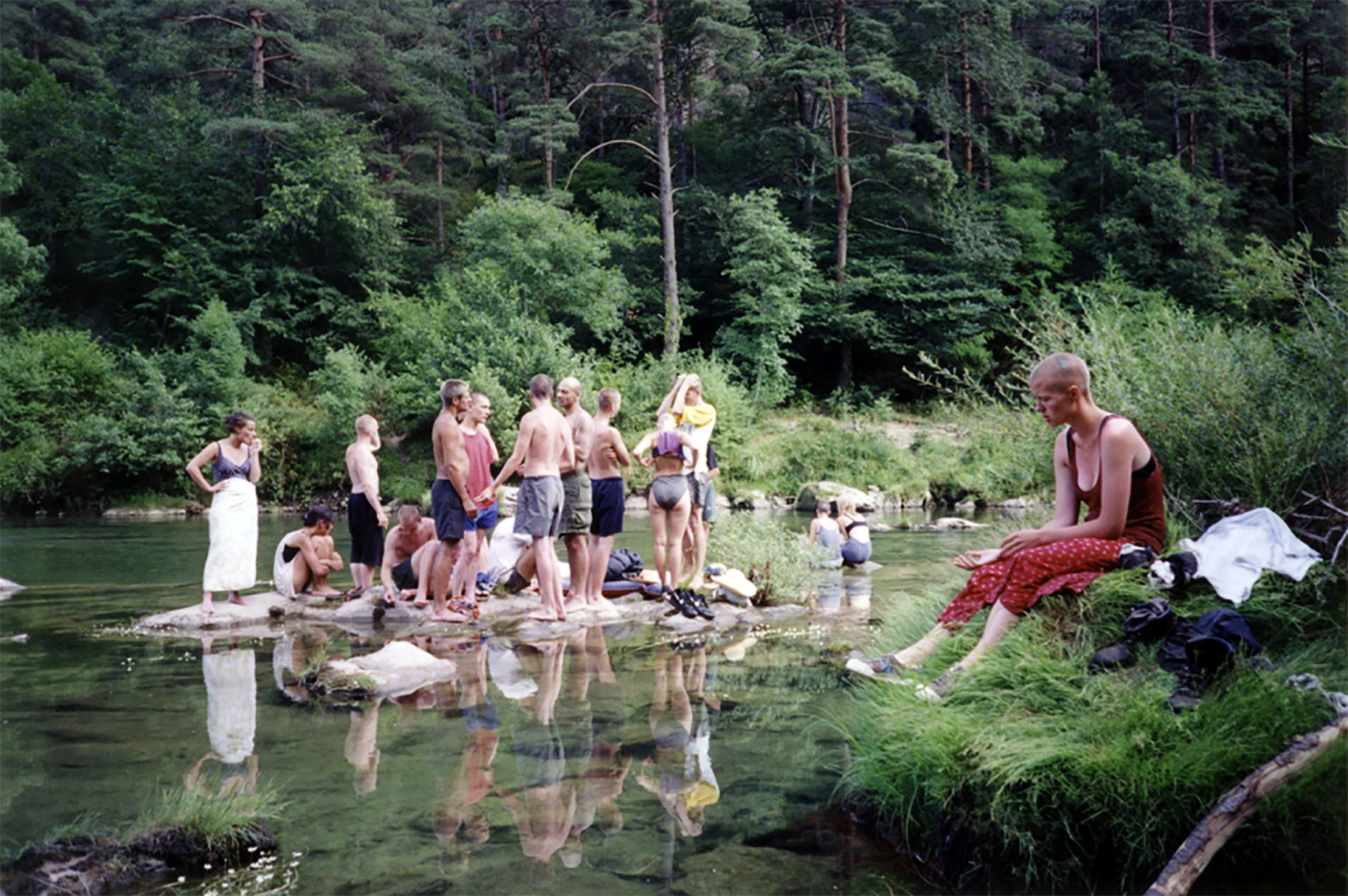
Image: © Mark Steinmetz
© Grant Scott 2026

Leave a Reply