
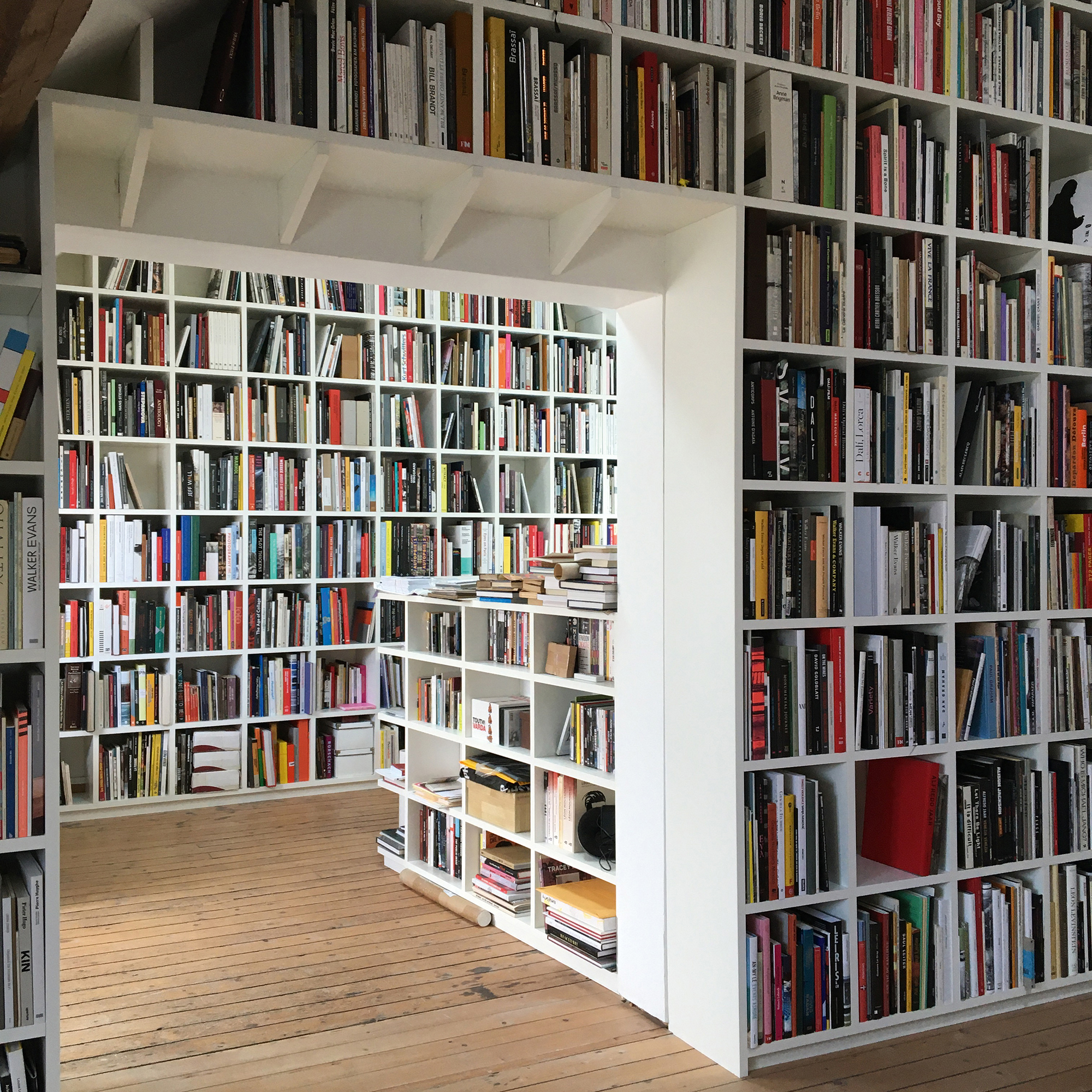
What is the difference between a collector and a hoarder? Maybe I’m not the best person to answer that question, but anyway it’s an important one to answer. Especially when it comes to photo books. They are not cheap, they are not easy to physically track down (easy online, but a photobook purchase is to my mind a tactile decision), they can take up a lot of space and many are heavy in weight as well as subject matter. In short the purchase of a photobook is a serious act.
A purchase that should be made with some consideration not only individually, but collectively. Therefore, my suggestion is to think about buying photo books on the basis of creating a library. A library with purpose and defined areas of focus. That is the basis of a collection rather than a ‘rag bag’ mix of books with little connection between them. That is hoarding, not collecting.
A useful library is defined by its organisation and usefulness. Its sense of curation and completeness. A bringing together of disparate items that becomes a greater whole. A collection like a library is a greater whole but one that should reflect your personality and interests but also be useful, providing information, inspiration and aspiration. For this to happen some difficult decisions have to be made.
I’m going to work under the presumption that if you are reading this you probably own at least a few photo books. Depending on your age those books will have either been collected over a long or short period of time, but either way I guarantee that you will have books you have never looked at or that you have looked at no more than once or twice. If you have ‘how to’ books I doubt that you have ever read them, at least not every chapter. And yet you keep them on your shelves. Perhaps for emotional reasons or on the basis of financial commitment.
My suggestion is that you start again and cull those you don’t need, use or want. Once that difficult process is over the fun begins. The identification of the areas you are really interested in. Collectors are completeists who focus on a narrow area of collecting. Unlike hoarders who keep everything. A good example of the former is collector William M Hunt who has compiled an extensive collection of prints in which the gaze of the subject is averted, the face obscured or the eyes firmly closed. You can see the collection in his book The Unseen Eye. Such a regimented and deliberate approach to collecting inevitably results in a body of work greater than its individual parts. The expensive sits next to the cheap, the found next to the purchased. All informing each other. I should also add that he owns an apartment in New York next to his just for his print and book collection.
It’s up to you to decide upon your own area of photobook collecting. It could be based on an approach, a country, a time period, a subject matter, a school of work, one photographer or a group of photographers. Any of these are good starting points and I am sure that you can come up with your own. The narrower the area, the deeper you can go, the more exciting the chase the research and the further down the rabbitt hole you can go. That is the spirit of the true collector. Others may describe you as an obsessive and I cannot guarantee that you will not get lost in your absorption. However, that is the beginning of building a photo book collection and as long as you do not become too addicted (spoiler; you probably will) it should be a worthwhile and rewarding undertaking. See you in Part Two…
Dr.Grant Scott
After fifteen years art directing photography books and magazines such as Elle and Tatler, Scott began to work as a photographer for a number of advertising and editorial clients in 2000. Alongside his photographic career Scott has art directed numerous advertising campaigns, worked as a creative director at Sotheby’s, art directed foto8 magazine, founded his own photographic gallery, edited Professional Photographer magazine and launched his own title for photographers and filmmakers Hungry Eye. He founded the United Nations of Photography in 2012, and is now a Senior Lecturer and Subject Co-ordinator: Photography at Oxford Brookes University, Oxford, and a BBC Radio contributor. Scott is the author of Professional Photography: The New Global Landscape Explained (Routledge 2014), The Essential Student Guide to Professional Photography (Routledge 2015), New Ways of Seeing: The Democratic Language of Photography (Routledge 2019), What Does Photography Mean To You? (Bluecoat Press 2020) and Inside Vogue House: One building, seven magazines, sixty years of stories, (Orphans Publishing 2024). His photography has been published in At Home With The Makers of Style (Thames & Hudson 2006) and Crash Happy: A Night at The Bangers (Cafe Royal Books 2012). His film Do Not Bend: The Photographic Life of Bill Jay was premiered in 2018.
© Grant Scott 2026
Further Reading
https://unitednationsofphotography.com/2022/06/18/alphabetical-subject-photographer-or-size-how-do-you-organise-your-photo-book-shelf/
https://unitednationsofphotography.com/2022/04/15/first-you-need-a-shelf-then-a-bookcase-then-a-room-the-photo-book-dilemma/
Image: Clément Chéroux, My library in Normandy, France, 2020
Dr.Grant Scott
After fifteen years art directing photography books and magazines such as Elle and Tatler, Scott began to work as a photographer for a number of advertising and editorial clients in 2000. Alongside his photographic career Scott has art directed numerous advertising campaigns, worked as a creative director at Sotheby’s, art directed foto8 magazine, founded his own photographic gallery, edited Professional Photographer magazine and launched his own title for photographers and filmmakers Hungry Eye. He founded the United Nations of Photography in 2012, and is now a Senior Lecturer and Subject Co-ordinator: Photography at Oxford Brookes University, Oxford, and a BBC Radio contributor. Scott is the author of Professional Photography: The New Global Landscape Explained (Routledge 2014), The Essential Student Guide to Professional Photography (Routledge 2015), New Ways of Seeing: The Democratic Language of Photography (Routledge 2019), What Does Photography Mean To You? (Bluecoat Press 2020) and Inside Vogue House: One building, seven magazines, sixty years of stories, (Orphans Publishing 2024). His photography has been published in At Home With The Makers of Style (Thames & Hudson 2006) and Crash Happy: A Night at The Bangers (Cafe Royal Books 2012). His film Do Not Bend: The Photographic Life of Bill Jay was premiered in 2018.
© Grant Scott 2026

Leave a Reply