
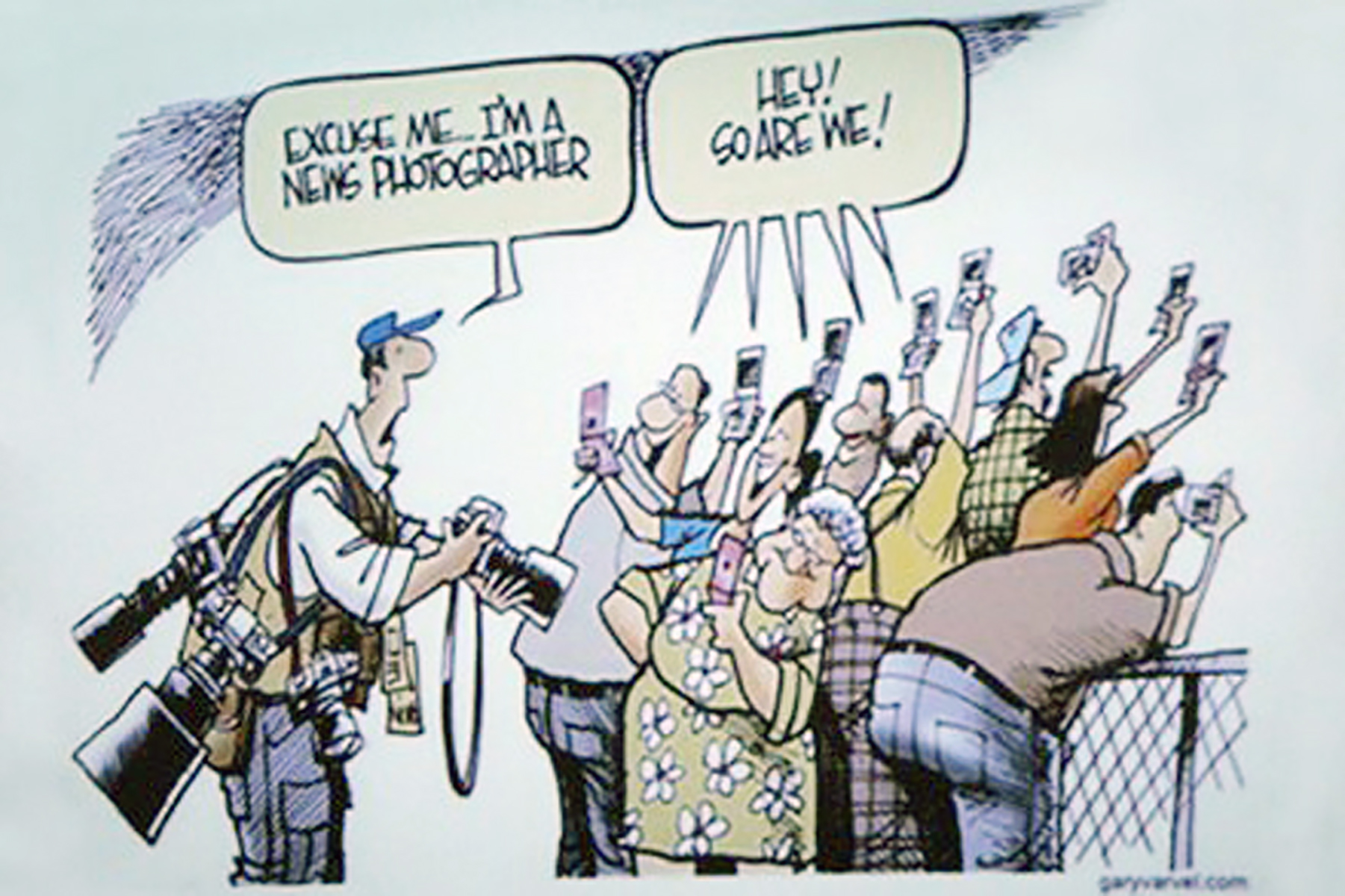
There was a time when we had to listen to the news organizations and accept the information they presented to us. The television, the radio, the newspaper and the magazine were the curated deliverers of our daily news and they shaped our understanding of the truth. The internet and smartphone have changed that relationship we have with the truth. Legacy media is dying and independent media is flourishing. The new curators are self-funded or at least self-initiated channels hungry for content feeding our algorithms on an hourly basis. Seeping into our phones and computers as an unending flow of analysis and opinion whether we like it or not.
I was a creative director twenty-five-years-ago and part of a ‘dot com boom’ initiative to launch a new daily newspaper. It was called peoplenews.com and like many such initiatives it failed. The money men lost their money because they didn’t understand the need for and the cost of content. Words and photographs. They suggested that we take them from BBC online. That was the level of the management’s naivity and ignorance.
Twenty-five years on and things have changed and they haven’t. They have as we are all now content creators, providers and publishers. They have not as legacy media have stuck with an old formula that no longer works. The difference is that today they don’t want to pay for the content they rely upon just like those misinformed venture capitalists I once worked for.
There is also a desire today for authenticity in the information we receive. In a world of fake news, lies and AI we are not as concerned by production values as we once were. Today, we are distrustful of highly produced and manipulative images and channels and more likely to believe the recordings and photographs made on a smartphone by a witness than we are a journalist’s report.
We are all now citizen journalists living our lives with the possibility of being in the right place at the right time (or perhaps the wrong place at the wrong time) to witness a story developing. Whether we choose to document that story we can only know in the moment, but the possibility is there. This democratisation of visual documentation was for many years decried by photographers threatened by the loss of their medium to the masses. Others saw it as the death of photography. In reality it is the opposite, but it has presented new challenges for the photographer.
A desire to use post-production techniques to create ‘perfect’ images without authenticity is no longer a sensible option in my opinion. Why create work that AI can do quicker and easier? The belief that moving image creation can be dismissed alongside writing and broadcasting as a photographer only acts a a barrier to potential creativity, platforms and income. Again this makes no sense.
Photography and photographers are in a new world of communication and that needs to be addressed. The bigger picture has to be seen, literally! Our personal experiences, beliefs and opinions have never been more important in developing a photographic practice. We have been given the tools to expand our communication possibilities and we should use them. Not to chase ‘likes’ but to make a differance. To be a citizen journalist through all of our photographic work, through the stories we tell and the subjects we explore. I think it is clear that this will be the work that history will recognise as being of importance. A good reason I think to make photographs that have a reason to exist outside of the frame on a wall. Photographs that have a reason to exist outside of the personal and in the universal. Historical documents of our lives today.
Further Reading
https://unitednationsofphotography.com/2025/08/29/mixed-up-confusion-or-are-photographers-lost/
https://unitednationsofphotography.com/2025/08/31/ai-needs-photographers-creatives-more-than-photographers-need-ai/
https://unitednationsofphotography.com/2022/10/28/the-past-informs-the-future-of-photography-but-it-doesnt-have-to-control-it/
https://unitednationsofphotography.com/2023/06/04/is-photography-eating-itself/
Dr.Grant Scott
After fifteen years art directing photography books and magazines such as Elle and Tatler, Scott began to work as a photographer for a number of advertising and editorial clients in 2000. Alongside his photographic career Scott has art directed numerous advertising campaigns, worked as a creative director at Sotheby’s, art directed foto8 magazine, founded his own photographic gallery, edited Professional Photographer magazine and launched his own title for photographers and filmmakers Hungry Eye. He founded the United Nations of Photography in 2012, and is now a Senior Lecturer and Subject Co-ordinator: Photography at Oxford Brookes University, Oxford, and a BBC Radio contributor. Scott is the author of Professional Photography: The New Global Landscape Explained (Routledge 2014), The Essential Student Guide to Professional Photography (Routledge 2015), New Ways of Seeing: The Democratic Language of Photography (Routledge 2019), What Does Photography Mean To You? (Bluecoat Press 2020) and Inside Vogue House: One building, seven magazines, sixty years of stories, (Orphans Publishing 2024). His photography has been published in At Home With The Makers of Style (Thames & Hudson 2006) and Crash Happy: A Night at The Bangers (Cafe Royal Books 2012). His film Do Not Bend: The Photographic Life of Bill Jay was premiered in 2018.
© Grant Scott 2026
Leave a Reply to JSP Visual Week In Review ~ 01.10.26 | JerseyStyle PhotographyCancel reply