
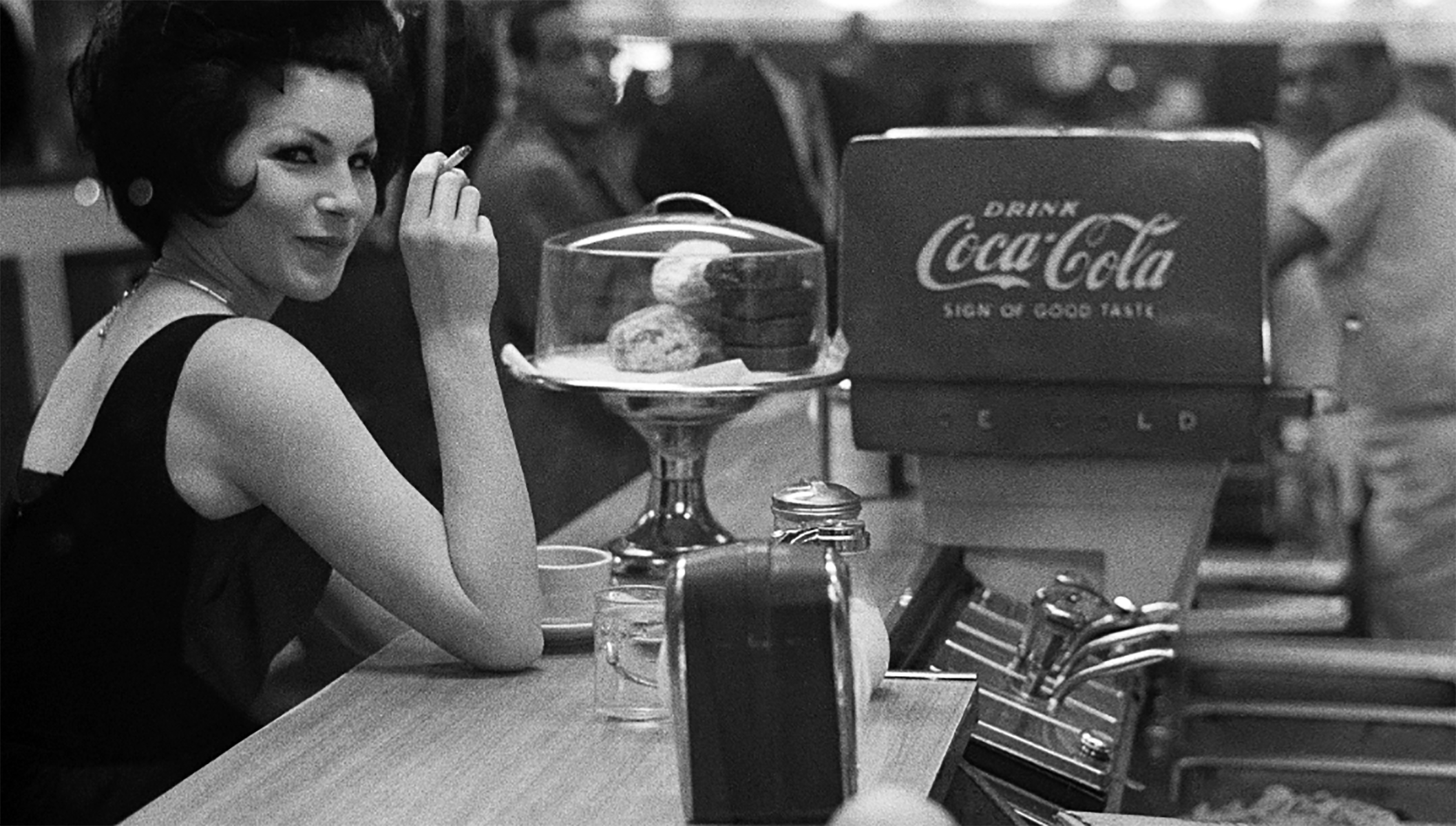
Digital photography allows photographers to shoot black and white or colour and make it black and white through post production. We know that. Whether it’s a good thing or not is up for debate. I think most photographers who come from an analogue background will concur that they are two different ways of seeing. A capture decision made when the camera was loaded, not when it was downloaded. Digital native photographers see it as a benefit.
But this is not an article addressing the pro’s and con’s of such practice. It is inspired by the Joel Meyerowitz book I have recently written about (link below for further reading). I think most people recognize Mayerowitz as a photographer working in colour and that would make sense as the majority of his most widely known images are evidence of his love of the medium. However, alongside his great friend Garry Winograd, Meyerowitz also worked in black and white on the streets of New York. It might be reasonable to believe that he began working in tones of grey as he has described the medium but that would be incorrect as colour was his starting point. As he says in the book “From the first moments as a photographer – the very first roll of film – actually I worked in colour and believed in its potential. Why wouldn’t I? The world was in colour!”
A section of the book, Where I Find Myself, contains images Meyerowitz made in the mid 1960s in colour and black and white with similar frames made at the same time on opposite pages. The question posed is which is most successful? Colour or black and white, but the question suggested has I believe an unexpected answer. Meyerowitz believes that colour wins out, “I felt that Kodachrome better described the moment.” However, I can see an alternative deciding factor. One that for me is the true basis of a photograph’s success or failure. That of composition.
It is the composition of the image that leads me to decide whether the colour or the black and white is the most successful not the chosen medium. Meyerowitz carried two cameras to make these images each loaded with different film and therefore the moment of capture is different even if the scene and its players are not. It is that moment of capture that defines the composition along with any physical adjustment of position or stance.
I often see photographers proclaiming that only black and white is true photography, that black and white is more artistic, that it’s more difficult, you get the picture. Or at least you know what I mean! This is of course ridiculous as Meyerowitz’s experiment shows. An unsuccessful is an unsuccessful picture whatever medium is used to create it and turning a colour photograph into black and white will not magically improve it. It may hide its deficiencies at best. It may make it worse through inexperienced post-production or over enthsuastic manipulation. A simple truth often demonstrated by photographers who post on social media two versions of an image asking people they have never met for an opinion on which one works best. A strange practice based on insecurity and a need for validation in my opinion.
The truth is that composition is all and it trumps all other considerations. It is the structure, the foundation on which an image is built. This should not be complicated to accept but it is difficult to master. All else that is contained within that structure is aesthetics. Now that is a statement guaranteed to start a debate that may or may not be worth having…
Further Reading
https://unitednationsofphotography.com/2026/01/01/you-only-need-one-photobook-and-this-is-it/
https://unitednationsofphotography.com/2024/04/20/thinking-in-black-and-white-not-just-dropping-the-colour/
Image: © Joel Meyerowitz
Dr.Grant Scott
After fifteen years art directing photography books and magazines such as Elle and Tatler, Scott began to work as a photographer for a number of advertising and editorial clients in 2000. Alongside his photographic career Scott has art directed numerous advertising campaigns, worked as a creative director at Sotheby’s, art directed foto8 magazine, founded his own photographic gallery, edited Professional Photographer magazine and launched his own title for photographers and filmmakers Hungry Eye. He founded the United Nations of Photography in 2012, and is now a Senior Lecturer and Subject Co-ordinator: Photography at Oxford Brookes University, Oxford, and a BBC Radio contributor. Scott is the author of Professional Photography: The New Global Landscape Explained (Routledge 2014), The Essential Student Guide to Professional Photography (Routledge 2015), New Ways of Seeing: The Democratic Language of Photography (Routledge 2019), What Does Photography Mean To You? (Bluecoat Press 2020) and Inside Vogue House: One building, seven magazines, sixty years of stories, (Orphans Publishing 2024). His photography has been published in At Home With The Makers of Style (Thames & Hudson 2006) and Crash Happy: A Night at The Bangers (Cafe Royal Books 2012). His film Do Not Bend: The Photographic Life of Bill Jay was premiered in 2018.
© Grant Scott 2026



Leave a Reply to Jim McQuaidCancel reply