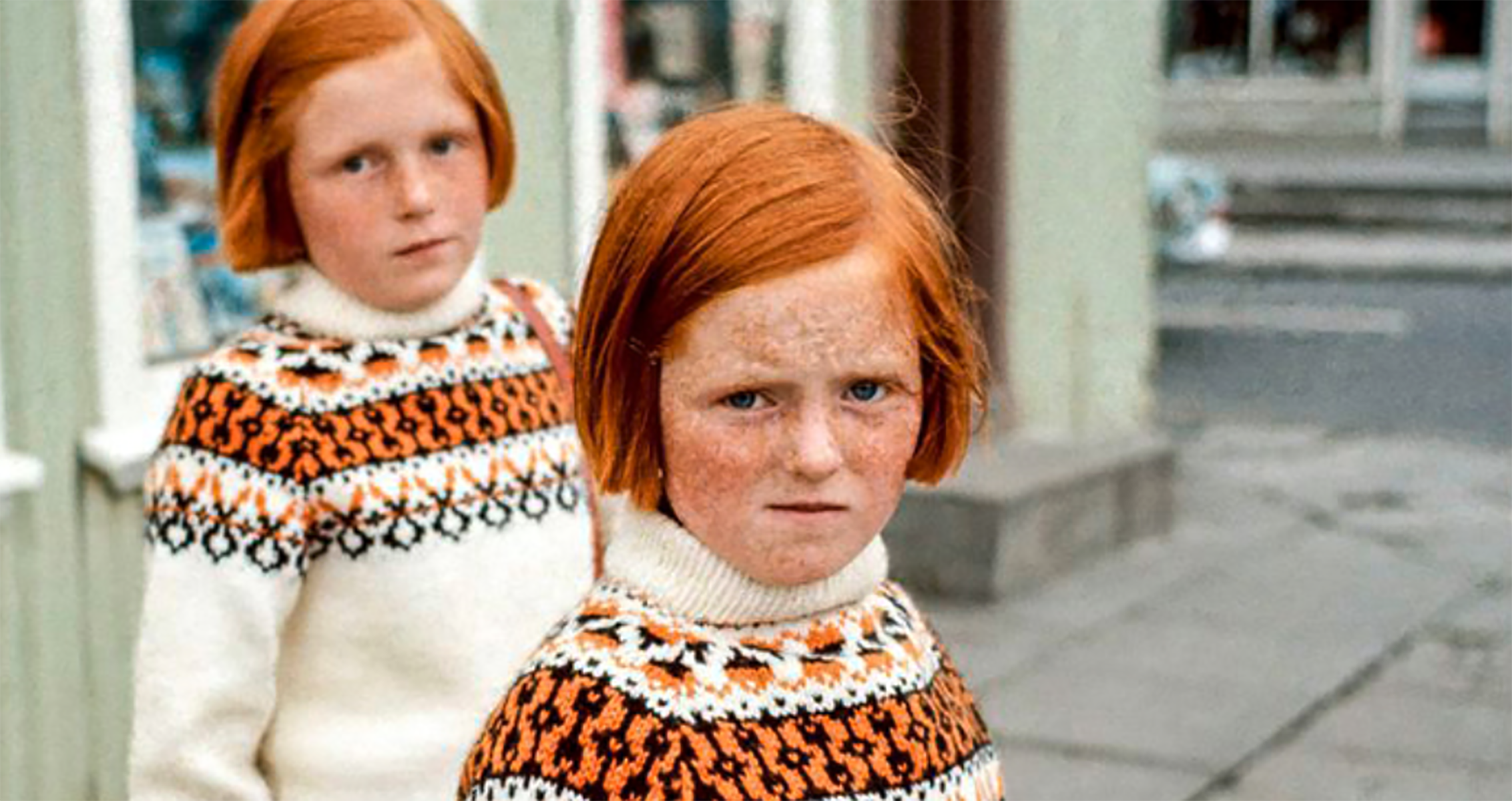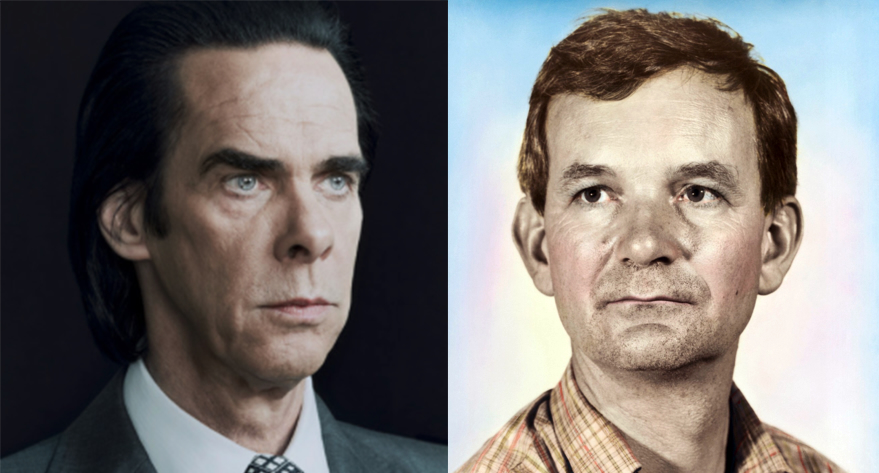
The recent death of Martin Parr (above right) made me think about his work more than I probably have before. Whilst others were arguing about his relevance, approach and colour photographs I started to realize that none of that was of importance. What was important was a central truth to all of his work that was obviously important to him. A truth founded in his childhood. Parr had eluded to this in his recent autobiography and in many interviews and talks but he never went into any depth. He left the photographs to do this. Suburbia and class were his truth.

I then watched a film on the work of Nick Cave (above left) that included archive footage and a selection of his collaborators over the years discussing Nick and his work processs. Many of the collaboraters were Australian, as is Cave, and they spoke of the importance of his childhood in Australia in his work. From The Birthday Party to the Bad Seeds, from novels to films. This drew me back to Parr. I don’t think you could find two more different creatives as Cave and Parr. One obsessed with their clothes, the other with no interest at all. One who wants to be noticed, the other that does not want to be seen. One who deals with the dark elements of life, the other obsessed with the mundane. And yet for me both have stayed true to that central truth in their beings that had been formed within their childhoods.

Whilst making the film Do Not Bend: The Photographic Life of Bill Jay I was often asked by people who had known Bill why he was so driven and so passionate about photography. I had no idea. I had never met him. Then during my research I came acroos a filmed interview with Bill conducted in the 1970s. The film had never been screened and remained in a vault at the Santa Monica Museum of Art. The film unlocked the secret that so many did not understand about Bill as he clearly described an experience in his teenage years that set him on a path with photography on which he vowed to prove everybody else wrong. His photographic evangelism was born in that moment and we started the film with this revelation.

Perhaps we all have a defining moment in our younger years that shapes us for life. Maybe negative, but always formative. I know I have at least one, maybe more. The secret is how to turn that moment into a positive truth, a well spring for creativity. A spine for a work practice. This does not mean that one specific outcome, aesthetic or process has to be adopted and remain throughout a creative life. In fact the identification of a central truth helps the creative to explore many varied and potentially contradictary outputs in the search for personal expression. However, others work within a defined visual language.

I remember speaking with the photographer Paolo Roversi about the dominant intense soft focus aesthetic in his images. Where did it come from I asked? He replied by describing his childhood in the mountains of Northern Italy. The dense mist, candle light and religious iconography. These were his central truth that defined his photography.

I hear many photographers talk about finding a style. The difficulty they have in doing so, and in my opinion their misplaced importance they place on having one. Style is transient and therefore unimportant. What they really need to do is to discover their central truth. The problem is that this can be difficult, it can be painful and it takes time. But nothing worthwhile is easy. Photography is not easy. At least photography that has a reason to exist isn’t. That is the differance between someone who makes photographs and a photographer. The photographer is willing to go deeper to explore the medium. Deeper than surface and likes. I cannot think of any creative person that does not go deep that is worth spending time exploring, understanding and appreciating. I hear much talk that analogue will save photography from AI. It won’t, the past rarely if ever saves the future, but one thing AI cannot do is see and replicate your central truth and therefore if you are looking to make photography that has lasting value that just maybe a good place to start.

Dr.Grant Scott
After fifteen years art directing photography books and magazines such as Elle and Tatler, Scott began to work as a photographer for a number of advertising and editorial clients in 2000. Alongside his photographic career Scott has art directed numerous advertising campaigns, worked as a creative director at Sotheby’s, art directed foto8magazine, founded his own photographic gallery, edited Professional Photographer magazine and launched his own title for photographers and filmmakers Hungry Eye. He founded the United Nations of Photography in 2012, and is now a Senior Lecturer and Subject Co-ordinator: Photography at Oxford Brookes University, Oxford, and a BBC Radio contributor. Scott is the author of Professional Photography: The New Global Landscape Explained (Routledge 2014), The Essential Student Guide to Professional Photography (Routledge 2015), New Ways of Seeing: The Democratic Language of Photography (Routledge 2019), and What Does Photography Mean To You? (Bluecoat Press 2020). His photography has been published in At Home With The Makers of Style (Thames & Hudson 2006) and Crash Happy: A Night at The Bangers (Cafe Royal Books 2012). His film Do Not Bend: The Photographic Life of Bill Jay was premiered in 2018.

Scott’s book Inside Vogue HouseOne building, seven magazines, sixty years of stories, Orphans Publishing, is now on sale.

© Grant Scott 2025


Discover more from The United Nations of Photography

Subscribe to get the latest posts sent to your email.

3 responses to “Staying True to a Central ‘Truth’ in Photography”

  1. Great read and nice to hear an informed voice above all the white noise on social media reminding us of what photography should be at its core when making images with intent, craftsmanship and meaningfulness.

    Even with my sparse engagement with social media, I have seen a torrent of posts following the death of Martin Parr, some of it mean and spiteful but most of it genuinely appreciative. I’m not a huge fan of his work, it doesn’t ‘speak to me’ or transport me to another place or make the hairs on the back of my neck stand up – it is maybe too close to much of my own upbringing – but that’s a personal opinion and it doesn’t stop me appreciating what his work is about and, more importantly, appreciating him as someone who, as you observe, ploughed his own furrow and produced work with integrity that reflected and explored his deeply rooted personal preoccupations – in another age, he might have been a painter or a writer, but what a gift photography was for him.

    The point is, photography is simply a medium – just as paint or ink or stone or clay are media for painters and printmakers and sculptors. It is not a meaningful creative activity in and of itself. If I stand in some particular spot to take a picture with my camera and then hand the camera to a complete stranger who happens to be standing next to me, that person could, in theory, point the camera in the same direction, press the shutter and capture exactly the same image as mine – but the initial observation, the pre-visualisation, the intent of the framing, the choice of lens and exposure and subsequent realisation of that image is an entirely different matter and inextricably linked to that central truth – for me pressing the shutter is a culmination of many actions, thoughts and intentions, not least of which is the motivation to keep doing it – for the stranger it would be merely a perfunctory action executed in the blink of an eye. Similarly, one wouldn’t think to draw a parallel between the work of Jackson Pollock and the countless anonymous tradesmen in the 1940s and 50s who also used Duco industrial paints for the infinitely more mundane tasks of painting car panels, kitchen units or steel doors.

    That ‘central truth’ in photography is a pre-requisite for meaningful engagement with the medium and true visual ‘style’ (a crappy but unavoidable term) arrives only as a by-product of getting to grips with the medium and forging a unique and personal visual language – but it is far from set in stone and certainly not the raison d’être for making images in the first place.

    It sounds so simple. Why then does such a large swathe of photography we see exhibit a tendency to put a whole heap of rather dubious carts before this ‘central truth’ horse? Photographs that shamelessly imitate the the distinctive ‘style’ of other photographers or flaunt the obvious stylistic hallmarks of particular photographic genres; photographs that are made to look painterly or are ‘digitally distressed’ to replicate the appearance of archaic processes; digital imagery that has to look like traditional film; traditional film that has to be un-retouched and un-manipulated, and so on and so forth – but all of it exhibiting little evidence of a deeper personal vision or engagement with image making beyond mere surface appearance.

    I think the answer is that not only is photography a paradoxically difficult and intractable medium for personal visual expression but virtually everything the average photographer now encounters in the photographic realm is hell bent on side-stepping dealing with that potentially awkward and challenging central truth in favour of a more benign and cosy world of tribal identities and mutual appreciation.

    In the first place, the effortless verisimilitude of photography beguiles and hoodwinks us – most of us can look at great painting or drawing in art galleries and instinctively understand that we probably wouldn’t have the wit or the wherewithal to do the same thing and we commonly say that talented artists are ‘gifted’ individuals – but photography is a fundamentally democratic medium and appears to offer something different: it promises that not only can anybody make extraordinarily detailed and faithful images that look every bit as good as the next person’s, irrespective of ‘talent’, but they can do it now, cheaply, with ease and little or no training.

    If that wasn’t enough, technology is giving us cameras that preemptively lock focus on moving subjects and start recording images even before the shutter is pressed – just in case you miss that seagull flying off with someone’s fish and chips – and the seemingly limitless supply of software filters, plug-ins and Ai driven editing tools, all available at the click of a button, can seduce us further into a sense of infallibility and an illusion of accomplishment when it comes to taking photographs – want to turn that unremarkable iphone shot into an image with a cool retro analog film vibe? click here, that’ll be £9.99 please.

    Another curve-ball photography throws our way is subject matter – subject matter is part of photography’s DNA – every photograph by definition has to have subject matter, you cannot have an abstract photograph – though you can of course have a photograph that looks like an abstract image – but the overwhelming tendency is to embrace the notion that subject matter in a photograph must be of some notable significance – preferably in sharp focus and in the middle of the frame – and the more impressive the subject matter, the more impressive the photograph – the notion that subject matter can be extremely mundane and compositions asymmetrical or even unbalanced and disconcerting is much less explored.

    And, for sure, the considered appreciation and exploitation of how three-dimensional real-world subject matter is translated via the camera into a two-dimensional flat space of tone, colour and shape, creating complex images that can transcend the reality they depict and become metaphors with a wider meaning, are as rare as the proverbial hen’s teeth. Ironically, if one looks at the pantheon of all the really great photographers, from photography’s early pioneers to contemporary practitioners, working across a wide spectrum of photographic disciplines, it becomes very apparent just how vigorously the majority of them have engaged with the medium in this more nuanced way – it’s all there, in thousands of photo books, plain to see, in black and white… and colour.

    As technology contrives more and more to take direct control over the process and the decision making out of the photographer’s hands, reducing engagement with the medium until it becomes little more than a 21st century painting by numbers exercise, it’s no wonder many photographers feel they are floundering and searching for answers in areas that inevitably prove creative cul-de-sacs.

    If that all sounds rather negative, like the tolling of the bell for photography, it’s not meant to be – in fact, I have great optimism that all the topsy turvy currently being wrought by Ai and the other technological advances will prove in time to be photography’s saviour, not its nemesis. And I agree, it won’t be by the well intentioned folks who like the smell of fixer in the morning and are screwing rose-tinted filters onto their vintage ebay lenses, it will be because photography, real photography, rich rewarding photography, demands not just the ‘central truth’ of the photographer but also engagement, direct real world engagement, with real places and real people. The more technology and Ai divorce us from that, the less satisfying the fare it has to offer becomes, and, sooner or later, people will get tired of the same old overcooked uniform slop that lacks bite and veracity, they’ll crave something raw and real… and photography is very good at that.

    1. Thanks for such a thoughtful and erudite response

  2. First off, so incredibly sad to hear of Martin Parr’s passing. As an expatriate Englishman (actually grew up down the road from you and I also went to Granada Tooting matinees as a child) his work had a particular resonance for me, especially once my parents retired to just outside Brighton, the seaside being such a fertile location for his work. He reminded me of the wonderful absurdity of the English, our ludicrous class structures that still define who we are and the very particular way we present ourselves publicly. I especially feel connected to his work exploring the intersection of the, shall we say, upwardly mobile working classes and the lower middle classes. I’m also a huge fan of Nick Cave and can’t wait to see The Death of Bunny Monroe when it’s released Stateside. A definite overlap there between Cave and Parr with the seaside of Brighton, the seaside town being central to both. Secondly, great point about AI and “truth”. Cory Doctorow is on the circuit here in the States with his new book talking about the “enshittification” of technology. I can’t but help see the commercialization of AI, your ChatGPT’s etc rather than the actually useful AI work being done in medicine and sciences, as being another step on the rung of corporate takeover of culture, the very deliberate enshittification of culture and art. I’m old enough to remember when punk emerged from the decaying corpse of what was still, in many regards, a post war London and Britain. It was about, at it’s heart, young people expressing themselves, telling their truth, in the face of not just overproduced 32 and 64 track music, but to a society that had forgotten them, that had no heart. And so back to Nick Cave, a young man who left Australia to see the (dying embers) of punk in London and make an almighty racket expressing his own truth.

Leave a Reply to gscott2012Cancel reply

This site uses Akismet to reduce spam. Learn how your comment data is processed.

Trending

Discover more from The United Nations of Photography

Subscribe now to keep reading and get access to the full archive.

Continue reading