
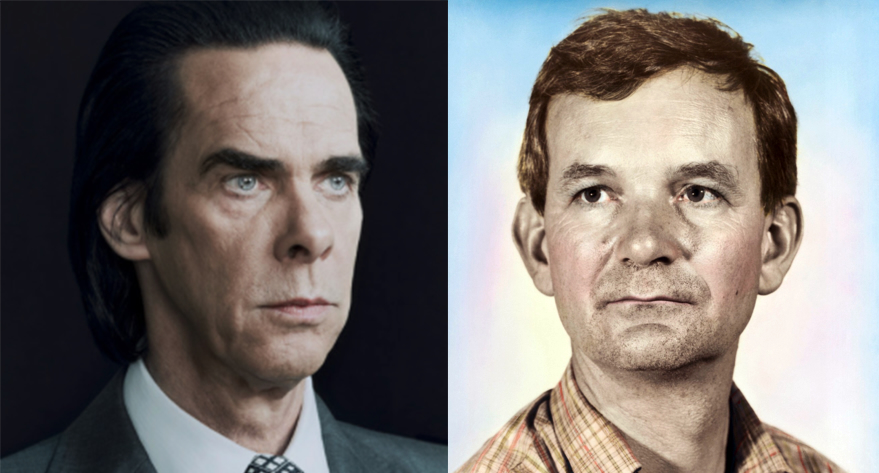
The recent death of Martin Parr (above right) made me think about his work more than I probably have before. Whilst others were arguing about his relevance, approach and colour photographs I started to realize that none of that was of importance. What was important was a central truth to all of his work that was obviously important to him. A truth founded in his childhood. Parr had eluded to this in his recent autobiography and in many interviews and talks but he never went into any depth. He left the photographs to do this. Suburbia and class were his truth.
I then watched a film on the work of Nick Cave (above left) that included archive footage and a selection of his collaborators over the years discussing Nick and his work processs. Many of the collaboraters were Australian, as is Cave, and they spoke of the importance of his childhood in Australia in his work. From The Birthday Party to the Bad Seeds, from novels to films. This drew me back to Parr. I don’t think you could find two more different creatives as Cave and Parr. One obsessed with their clothes, the other with no interest at all. One who wants to be noticed, the other that does not want to be seen. One who deals with the dark elements of life, the other obsessed with the mundane. And yet for me both have stayed true to that central truth in their beings that had been formed within their childhoods.
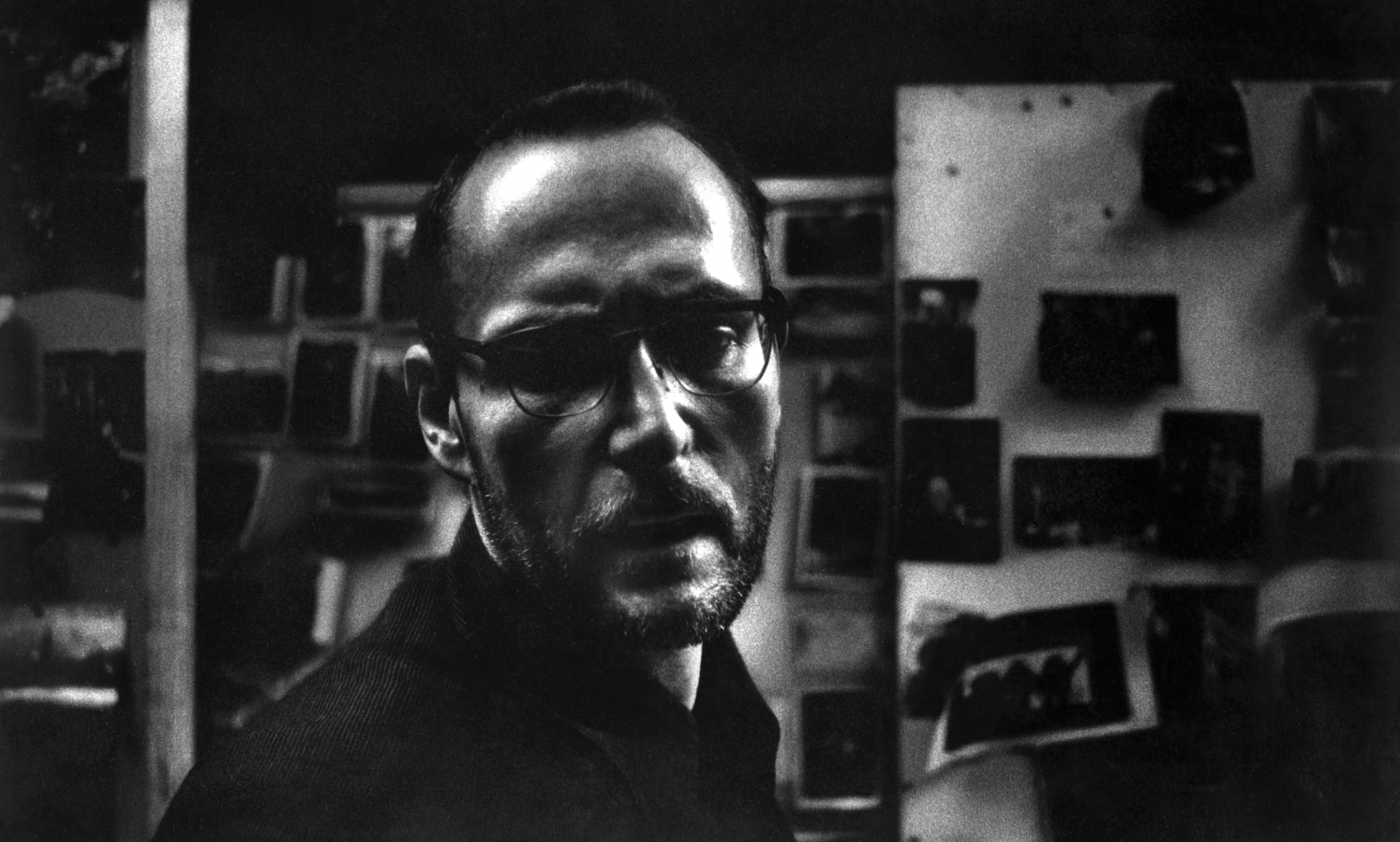
Whilst making the film Do Not Bend: The Photographic Life of Bill Jay I was often asked by people who had known Bill why he was so driven and so passionate about photography. I had no idea. I had never met him. Then during my research I came acroos a filmed interview with Bill conducted in the 1970s. The film had never been screened and remained in a vault at the Santa Monica Museum of Art. The film unlocked the secret that so many did not understand about Bill as he clearly described an experience in his teenage years that set him on a path with photography on which he vowed to prove everybody else wrong. His photographic evangelism was born in that moment and we started the film with this revelation.
Perhaps we all have a defining moment in our younger years that shapes us for life. Maybe negative, but always formative. I know I have at least one, maybe more. The secret is how to turn that moment into a positive truth, a well spring for creativity. A spine for a work practice. This does not mean that one specific outcome, aesthetic or process has to be adopted and remain throughout a creative life. In fact the identification of a central truth helps the creative to explore many varied and potentially contradictary outputs in the search for personal expression. However, others work within a defined visual language.
I remember speaking with the photographer Paolo Roversi about the dominant intense soft focus aesthetic in his images. Where did it come from I asked? He replied by describing his childhood in the mountains of Northern Italy. The dense mist, candle light and religious iconography. These were his central truth that defined his photography.
I hear many photographers talk about finding a style. The difficulty they have in doing so, and in my opinion their misplaced importance they place on having one. Style is transient and therefore unimportant. What they really need to do is to discover their central truth. The problem is that this can be difficult, it can be painful and it takes time. But nothing worthwhile is easy. Photography is not easy. At least photography that has a reason to exist isn’t. That is the differance between someone who makes photographs and a photographer. The photographer is willing to go deeper to explore the medium. Deeper than surface and likes. I cannot think of any creative person that does not go deep that is worth spending time exploring, understanding and appreciating. I hear much talk that analogue will save photography from AI. It won’t, the past rarely if ever saves the future, but one thing AI cannot do is see and replicate your central truth and therefore if you are looking to make photography that has lasting value that just maybe a good place to start.
Dr.Grant Scott
After fifteen years art directing photography books and magazines such as Elle and Tatler, Scott began to work as a photographer for a number of advertising and editorial clients in 2000. Alongside his photographic career Scott has art directed numerous advertising campaigns, worked as a creative director at Sotheby’s, art directed foto8magazine, founded his own photographic gallery, edited Professional Photographer magazine and launched his own title for photographers and filmmakers Hungry Eye. He founded the United Nations of Photography in 2012, and is now a Senior Lecturer and Subject Co-ordinator: Photography at Oxford Brookes University, Oxford, and a BBC Radio contributor. Scott is the author of Professional Photography: The New Global Landscape Explained (Routledge 2014), The Essential Student Guide to Professional Photography (Routledge 2015), New Ways of Seeing: The Democratic Language of Photography (Routledge 2019), and What Does Photography Mean To You? (Bluecoat Press 2020). His photography has been published in At Home With The Makers of Style (Thames & Hudson 2006) and Crash Happy: A Night at The Bangers (Cafe Royal Books 2012). His film Do Not Bend: The Photographic Life of Bill Jay was premiered in 2018.
Scott’s book Inside Vogue House: One building, seven magazines, sixty years of stories, Orphans Publishing, is now on sale.
© Grant Scott 2025



Leave a Reply