
I have previously written about this image and how I have been throughout my life unable to shake it from my subconscious vision. It is stuck in my mind. It is one of the reasons why photography intrigued me as a child. It took me to a place I had never been, have never been and never wish to go. It was a passport to darkness. I think I saw it in the Life magazine book of photographs titled The Best of Life published in 1973. Its called Shell-shocked US Marine, The Battle of Hue and its one of Don McCullin’s most iconic portraits that depicts a stunned soldier during the Vietnam War, in Hue, 1968. I was nine years of age when I was given the book as a Christmas present.

But it is not the only image in that book that has stayed with me. There is another which as a child I couldn’t look at. I had to turn the page quickly. As I grew older I looked more closely at it but with a deeply concerned fascination. I put in a Google search for the image to illustrate this article and the resulting search gave me a series of blurred boxes with content warning information. I therefore offer the same warning that the image in question is shown at the end of this article. Therefore, please do not continue reading or scrolling if you do not wish to see it.
The year the photograph was made was 1963, one year before I was born. Malcome Browne an Associated Press correspondent made a series of photographs that would shock a president and impact U.S. policy on the Vietnam War. One of them would also have a visceral and political impact on me ten years later. Browne was born in New York on April 17, 1931 and graduated from Swarthmore College in Pennsylvania with a degree in chemistry. He was working in a lab when he was drafted into the US Army in 1956, and was then sent to Korea as a tank driver, but by chance he got a job writing for a military newspaper, and he decided to trade science for a career in journalism.
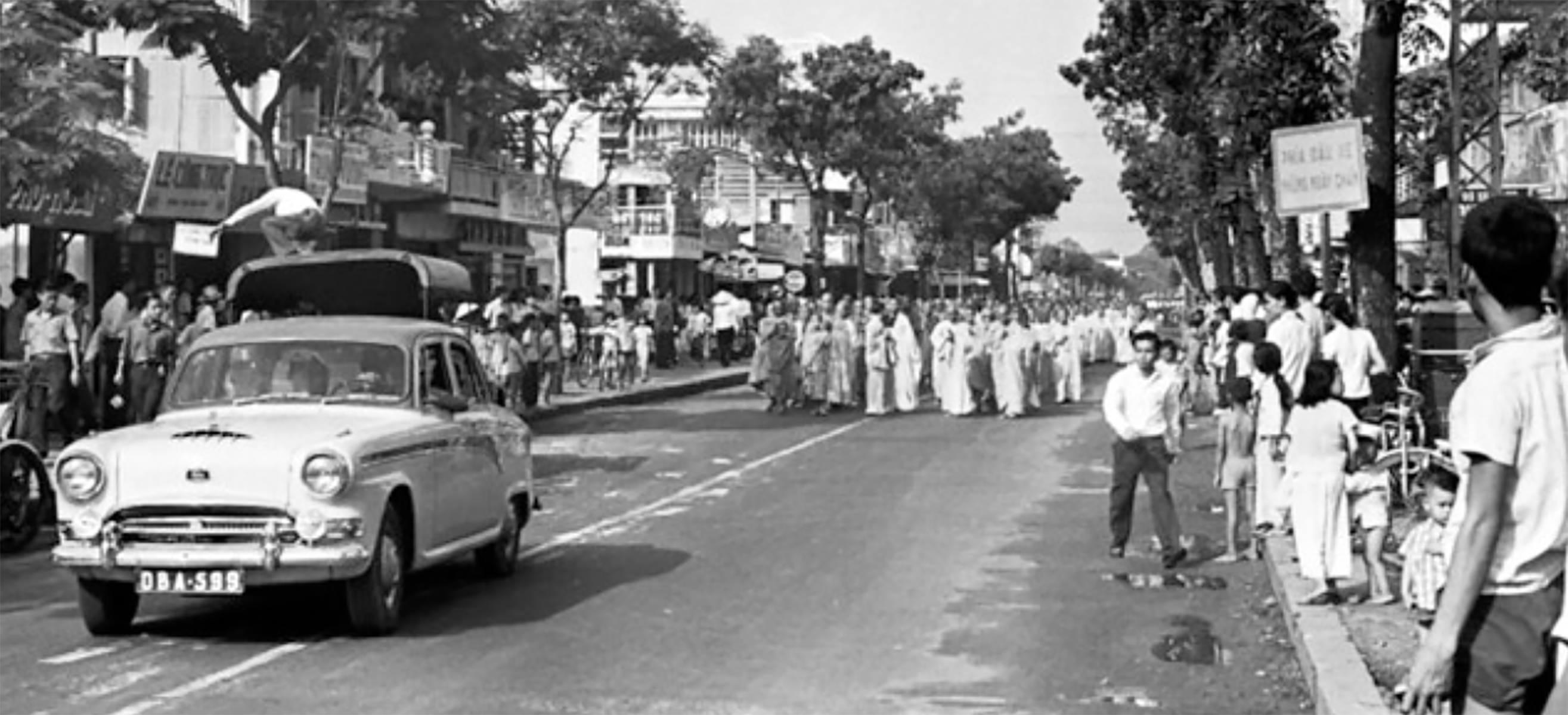
The story for Browne began at 9 p.m. on June 10, 1963, when he received a cryptic message that something important would happen at a memorial service being organized by Buddhist monks for the following morning. As day broke on June 11, the service started with nuns and monks chanting in a temple. After a while, the group moved onto the streets, chanting in a procession. The group paused to surround a car, and then took out a can of aviation fuel.
“I realized at that moment exactly what was happening, and began to take pictures a few seconds apart,” wrote Browne in a letter to AP General Manager Wes Gallagher on September 30th, 1963. One of the monks sat down in the street, and fellow monks covered him in nearly five gallons of fuel. Moments later, Thich Quang Duc struck a match and set himself ablaze. It was then that Browne made the photo that left an indelible impression on people across the globe, a scene shown below. The image was used in papers worldwide a mere fifteen hours after Thich Quang set himself on fire. The photo compelled then President John F. Kennedy to reassess U.S. policy on Vietnam, ultimately increasing the number of troops. The Vietnam War was escalated. Browne won a Pulitzer Prize.
Thich Quang Duc’s self-immolation has since become a symbol of resistance among Vietnam’s Buddhists, who now account for approximately 80% of the country’s population. “People watched in silence until the flames went out,” Thich Tri Quang, a monk who witnessed the incident has commented. Before his death, Thich Quang Duc wrote a message to President Ngo Dinh Diem, pleading with him to “be compassionate to the people of the nation and implement religious equality to maintain the strength of the homeland.”
This is the true power of photography. The importance it has in our lives as a record of history. Without Brownes photographs we would not be able to remember the level of one man’s sacrifice based on fate, belief and hope. There are many aspects of the photograph that have always intrigued me. The open bonnet of the car, the empty fuel bottle left at his side, the juxtaposition of the roof angles as a background. These are me thinking like a photographer. Deconstructing the composition, the shapes and forms within the rectangle but those thoughts mean nothing and are irrelevant. It is the central figure that we must consider.
We are living today in a word of fake news, image suspicion, image manipulation and image creation from the mind rather than from the eye. Images are dismissed and disbelieved. They are rejected and ignored. Life today moves too fast to spend time considering such a selfless act as this image forces us to view. This is why the photographer and the photograph are more important today than they have ever been. To counteract these notions with a sense of integrity and purpose.
I have never forgotten this image. It was etched on my formative mind when perhaps many would have considered me too young. But this was not a ‘horror’ image created to entertain, it was an elemental truth created to inform. That to me is what photography is. Memory made history and that is something that we should never forget or stop creating.

Dr.Grant Scott
After fifteen years art directing photography books and magazines such as Elle and Tatler, Scott began to work zas a photographer for a number of advertising and editorial clients in 2000. Alongside his photographic career Scott has art directed numerous advertising campaigns, worked as a creative director at Sotheby’s, art directed foto8magazine, founded his own photographic gallery, edited Professional Photographer magazine and launched his own title for photographers and filmmakers Hungry Eye. He founded the United Nations of Photography in 2012, and is now a Senior Lecturer and Subject Co-ordinator: Photography at Oxford Brookes University, Oxford, and a BBC Radio contributor. Scott is the author of Professional Photography: The New Global Landscape Explained (Routledge 2014), The Essential Student Guide to Professional Photography (Routledge 2015), New Ways of Seeing: The Democratic Language of Photography (Routledge 2019), and What Does Photography Mean To You? (Bluecoat Press 2020). His photography has been published in At Home With The Makers of Style (Thames & Hudson 2006) and Crash Happy: A Night at The Bangers (Cafe Royal Books 2012). His film Do Not Bend: The Photographic Life of Bill Jay was premiered in 2018.
Scott’s book Inside Vogue House: One building, seven magazines, sixty years of stories, Orphans Publishing, is on sale now.
© Grant Scott 2025




Leave a Reply