
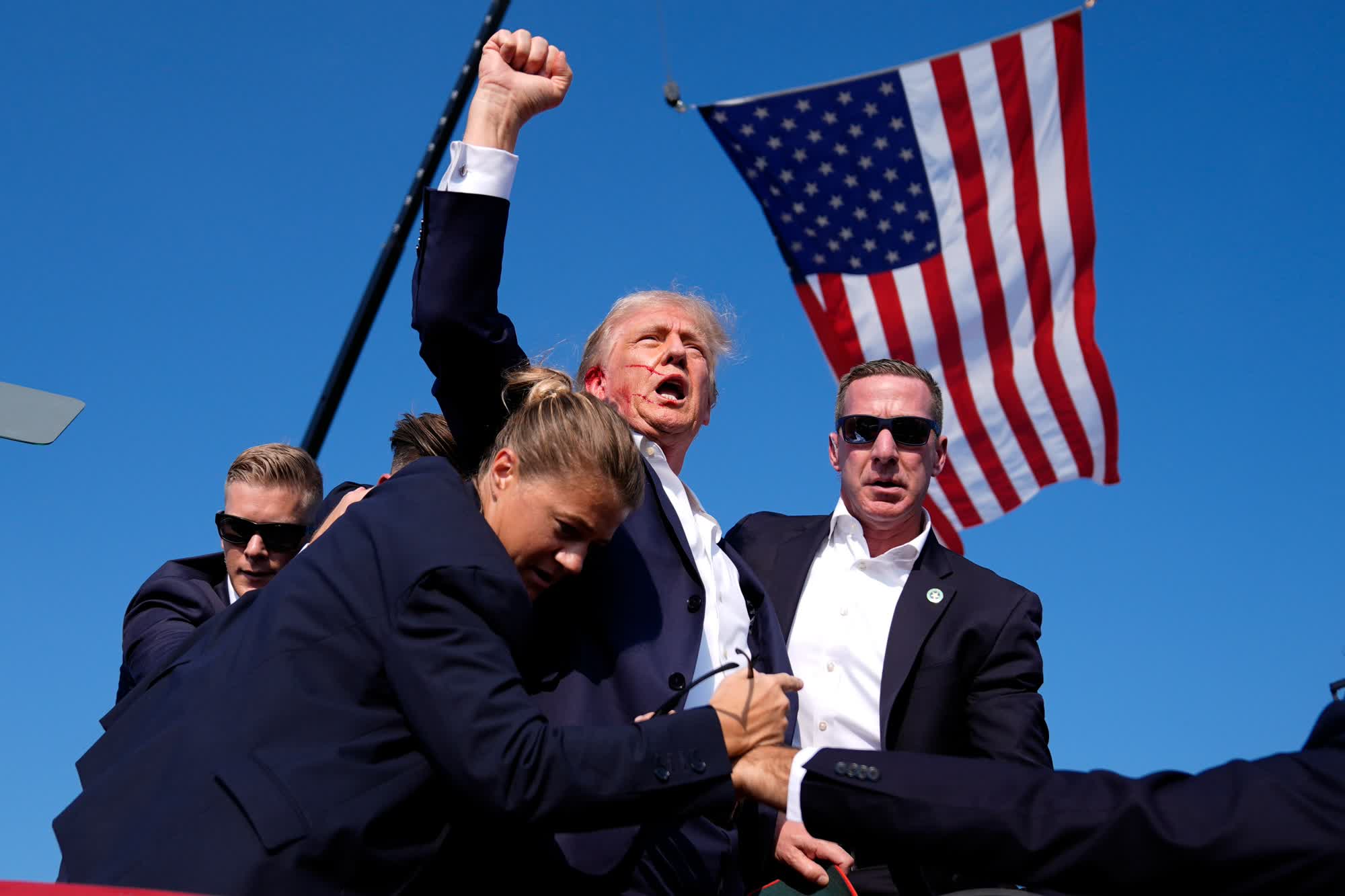
We all know this, but I think we sometimes forget what such a statement actually means. The moment I saw this image of Donald Trump I was reminded of Eugène Delacroix’s Liberty Leading the People of 1830. Not a photograph, but a painting. An interpretation of fact not a document of reality.

My mind then switched to the image of Robert Kennedy lying prone, shot, dying. It’s black and white intensity etched into my brain at an early age. Memory made history. The image captured by photographer Boris Yaro, in 1968. The image of his brother’s assassination similarly graphic and heart rending but ripped from an amateur cameraman’s super 8 footage. The Kennedy deaths provided us with pieces of visual evidence that cannot be dismissed although it can be and has been challenged.


The images of the attempted assassination of Trump could and would have done the same. Just like the murder of Lee Harvey Oswald by night club owner Jack Ruby, captured by photographer Bob Jackson and broadcast live to the nation. The visceral impact of a live shooting cannot be underestimated. We can only presume that such footage would have been seen once and once only, however, the Kennedy experience suggests that this may not have been the case.


Instead we are left with an iconic image of defiance captured by photographer Evan Vucci working for AP, suggesting what may have been. What actually happened is once again open to interpretation. This was not the case with the attempted assassination of Ronald Reagan, which presented nothing more than a series of black and white images suggesting confusion. As this image shows of a Secret Service agent brandishing a submachine gun while agents and police subdue the potential assaasin John Hinckley after he shot Reagan and others in Washington on March 30, 1981.

Trump is a skillful manipulator of fact and fiction. A man with an instinctual command of media image-making. I am not suggesting any form of conspiracy but where a vacuum of information is created others are eager to fill in the gaps and the online warriors have from both political sides. What we are left with is an image that documents a moment but also helps to shape a future and a multitude of narratives.
This is a photograph that has political capitol. It can and is being used to move a voting populace to believe that Trump like Liberty in Delacroix’s painting is an allegorical figure, a robust man of the people. A fierceness and determination in the eyes of the leader whilst the eyes of the others within the image are covered or cast down. Only Trump is reaching to the sky with of course the Stars and Stripes prominent just as Liberty carried the Tricolour which became France’s national flag after the events depicted. Delacroix understood the image he was creating and its potential power but Vucci could have had no idea in the split second he pushed the shutter how his image would be used outside of a traditional news context. Vucci has no control of how his photograph will be used politically in memes, banners, signs and on Trump merchandise. He can try but his attempts will be futile.
The death of the photograph has been announced many times as new forms of visual recording and dissemination have arrived. The truth of course is that the power of the single image will never diminish as long as it is created. Once the image is created its journey is undetermined by the photographer. It becomes a cultural artefact to be used and abused. Its message manipulated and interpreted to meet the needs of whoever wishes to use it. After he completed his painting of Liberty, Delacroix commented in a letter to his brother that, “My bad mood is vanishing thanks to hard work. I’ve embarked on a modern subject – a barricade. And if I haven’t fought for my country at least I’ll paint for her.” I wonder how Vucci now feels about the image he has given to the world.
Image: Evan Vucci/AP
Dr.Grant Scott
After fifteen years art directing photography books and magazines such as Elle and Tatler, Scott began to work as a photographer for a number of advertising and editorial clients in 2000. Alongside his photographic career Scott has art directed numerous advertising campaigns, worked as a creative director at Sotheby’s, art directed foto8magazine, founded his own photographic gallery, edited Professional Photographer magazine and launched his own title for photographers and filmmakers Hungry Eye. He founded the United Nations of Photography in 2012, and is now a Senior Lecturer and Subject Co-ordinator: Photography at Oxford Brookes University, Oxford, and a BBC Radio contributor. Scott is the author of Professional Photography: The New Global Landscape Explained (Routledge 2014), The Essential Student Guide to Professional Photography (Routledge 2015), New Ways of Seeing: The Democratic Language of Photography (Routledge 2019), and What Does Photography Mean To You? (Bluecoat Press 2020). His photography has been published in At Home With The Makers of Style (Thames & Hudson 2006) and Crash Happy: A Night at The Bangers (Cafe Royal Books 2012). His film Do Not Bend: The Photographic Life of Bill Jay was premiered in 2018.
Scott’s book Inside Vogue House: One building, seven magazines, sixty years of stories, Orphans Publishing, is now on sale.
© Grant Scott 2024



Leave a Reply to Martin HulbertCancel reply