
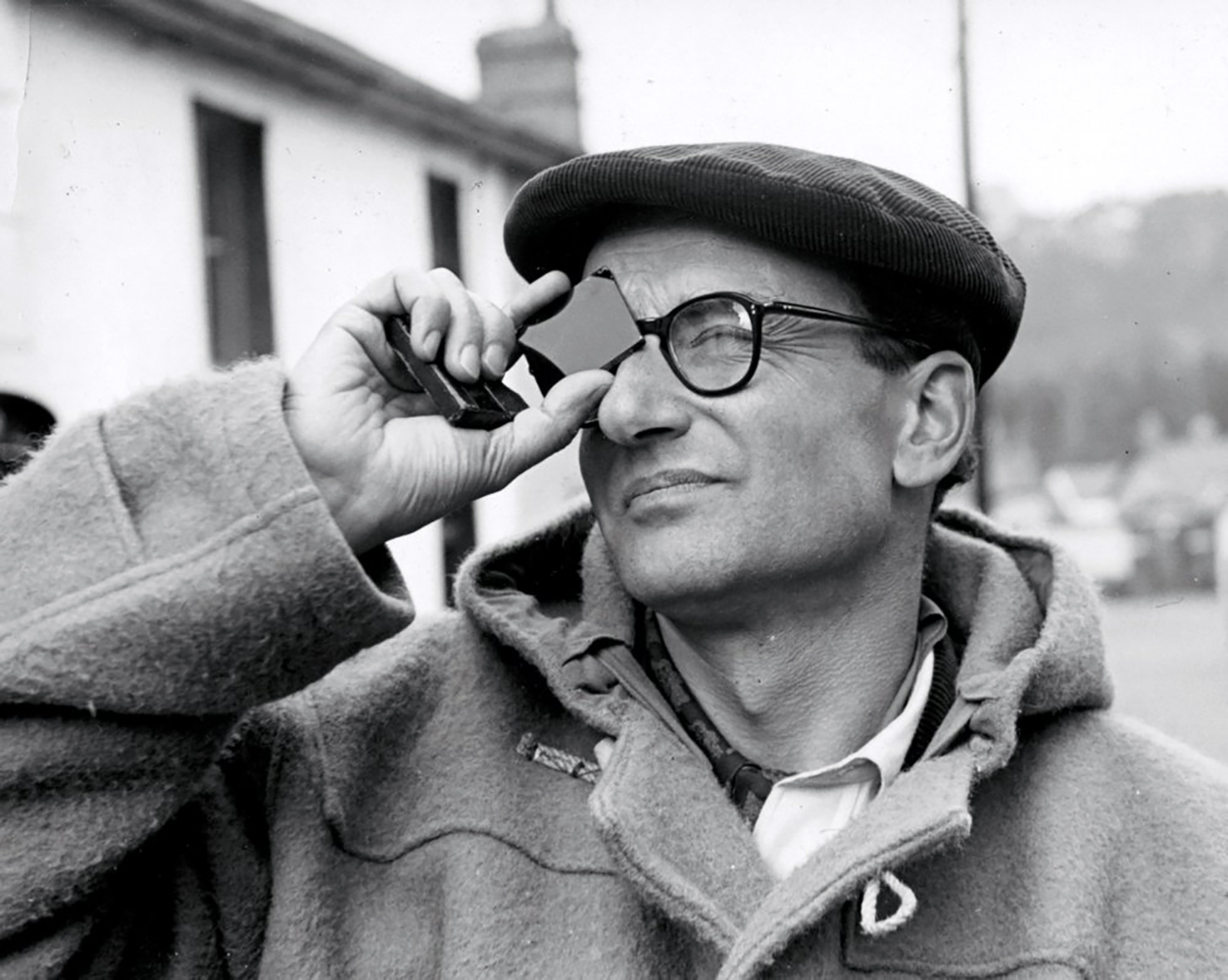
In 2012 I was fortunate enough to visit photographer and cinematographer Wolf Suschitzky in his Little Venice, London apartment. The previous evening he had been at the Austrian Embassy receiving an award for his life’s work. It had been a late night and he was tired when we spoke but despite his age (100) at the time, his memory was still sharp and accurate. I have had this full audio, recorded for a magazine article, since we met but this is the first time that I have made it generally available. I hope you enjoy it!
Wolfgang Suschitzky, BSC (29 August 1912–7 October 2016), was an Austrian-born British documentary photographer, as well as a cinematographer perhaps best known for his collaboration with Paul Rotha in the 1940s and his work on Mike Hodges’ 1971 film Get Carter. His photographs have been exhibited at the National Gallery, the Austrian Cultural Forum in London and the Photographers’ Gallery, and appear in many international photography collections.
Suschitzky was born in Vienna, Austria-Hungary. His father was of Jewish origin, but had renounced his faith in 1908 and become an atheist, or “konfessionslos”. He opened the first social democratic bookshop in Vienna (later to become a publisher), and Suschitzky was born in the apartment above the bookshop. His sister was photographer Edith Tudor-Hart (1908–1973). On the advice of the counsellor for education of Vienna, his father sent Wolf to a day boarding school to learn some discipline. However he continued to be mischievous and was often detained at school. Suschitzky’s first love was zoology, but he realised he could not make a living in Austria, so instead, influenced by his sister, he studied photography at the Höhere Graphische Bundes-Lehr-und Versuchsanstalt. At this time, the political climate in Austria was changing from a Socialist Democracy to Austrofascism. Being a Socialist and of Jewish origin, Suschitzky decided there was no future for him in Austria and in 1934 left for London where his sister lived; while he was in London his father committed suicide. Suschitzky married a Dutch woman, Helena Wilhelmina Maria Elisabeth (Puck) Voûte in Hampstead and they moved to the Netherlands. His wife left him after a year. He returned to England in 1935, and in 1939 married Ilona Donath, with whom he had three children.
Suschitzky’s first job was in the Netherlands photographing postcards for newsagents. This job lasted only a few months. He travelled to England in 1935 and became a film cameraman for Paul Rotha, with whom he had a long working relationship. Their work during the war included World of Plenty (1943) and government-sponsored information shorts and magazine programmes. With Rotha he graduated to feature films, working on No Resting Place (1951), which was one of the first British feature films shot entirely on location. The film was nominated for a BAFTA Award for Best Film in 1952. He then photographed Colin Lesslie’s production, the comedy The Oracle (1953), followed by another Rotha film, Cat & Mouse (1958). He also worked on Jack Clayton’s short film The Bespoke Overcoat which won an Oscar for “Best Short Subject, Two-reel“ at the 1956 Oscars. In the 1960s, Suschitzky work included Joseph Strick’s adaptation of James Joyce’s Ulysses (1967) and Hammer Film Productions’ Vengeance of She (Cliff Owen, 1968). He also photographed the British crime film The Small World of Sammy Lee (1963), directed by Ken Hughes. This film proved influential to screenwriter Mike Hodges, with whom Suschitzky worked on Get Carter (1971). His last film before photographing Get Carter was the adaptation of Joe Orton’s Entertaining Mr. Sloane (1970) directed by Douglas Hickox.
His other credits include two films directed by Jack Couffer, Ring of Bright Water (1969) and Living Free (1972), which was the sequel to Born Free. Issue 12 of Lid magazine featured a twenty-eight-page portfolio of Suschitzky’s photographs with a portrait and essay by Gerard Malanga. Suschitzky died on 7 October 2016 at the age of 104. The Wolf Suschitzky Photography Prize has been awarded every two years since 2018 by the Austrian Cultural Forum London: to reflect Suschitzky’s connection to his homeland as well as his adopted country, the prize is awarded simultaneously to one Austrian and one British photographer. A jury selects one winner from each country, who will receive prize money, exhibition opportunities and a residency in the other country. https://wolfsuschitzkyphotos.com


Leave a Reply