
Sitting above my desk is a book by the design critic and writer Deyan Sudjic. The title of the book is B is for Bauhaus. The text on the back of the book describes it as an essential tool kit for decoding contemporary culture. That is quite some claim!
I will not go through the whole alphabet with you or the complete book, but to give you a taste of how it is constructed and written, A is for Authentic, B is for Bauhas and Blueprint, C is for Car, Chair, Chareau, Collecting and Critical Design. You get the picture. This is a book written from a very personal perspective, for a defined design literate audience. P is for Postmodern. The most academic and difficult to read chapter in the book in my opinion. One that presents us with the thoughts of Jacques Lacan, as it should, to explain his proposal that the unconscious is structured like a language which allows a discourse between the unconscious and conscious and ensures that the unconscious plays a role in our experience of the world. I’ll just leave you with that for a moment.
I was once described by an academic as the most ‘post-modern person’ he had ever met. I didn’t really know what he meant, but I took the comment as a compliment rather than a criticism. I think it could have been either.
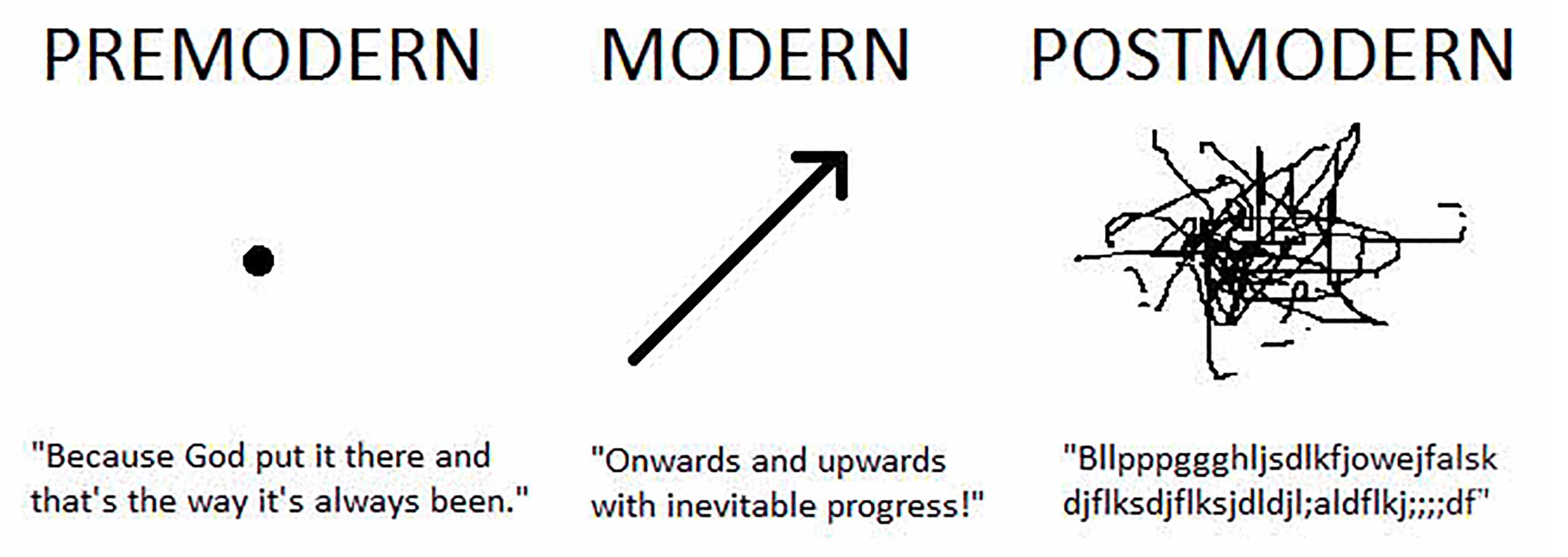
In simple terms Postmodernism can be seen as a reaction against the ideas and values of modernism, as well as a description of the period that followed modernism’s dominance in cultural theory and practice in the early and middle decades of the twentieth century. It is thought by many that Postmodernism is one of the most controversial movements in art and design history. Over two decades, from approximately 1970 to 1990, it attempted to shatter established ideas about art and design, bringing a new self-awareness about style itself. Postmodernism’s key principles are complexity and contradiction, two principles I attempt to avoid, but obviously the academic thought the opposite about me. At least that is my understanding.
Photography has not been adverse to adopting many of the Postmodernist principles. The work of Jeff Wall, Richard Prince and Cindy Sherman are obvious touchstones that illustrate this. Yasumasa Morimura is a lesser known photographer, but another exponent of the constructed photograph. I’m sure you can add more. It is a sense of self-aware construction of the image that informs the postmodernist photographer. The use of found images or other photographers images as a basis to create new outcomes also indicate a Postmodernist attitude to the medium. It is work based on the idea of a question. Using an intellectual, conceptual thought process to inform work that hopes to challenge the viewer. According to the Tate website Postmodernism is associated with scepticism, irony and philosophical critiques of the concepts of universal truths and objective reality. That is a lot of words and possibilities to successfully include within a photograph and convey to a viewer who is not on the same wavelength, or page, as the photographer. It is no surprise then that much of the work produced with this hoped for intention is seen by many as boring, bland or pretentious. Sometimes, even all three.
The reliance on accompanying text is commonplace to ensure the photographer’s intention/message is clear, if it isn’t in the image. We know this and have seen this. If written well with clarity and simplicity of language it can work. However, if it slips into an ‘academic word salad of incomprehensible nonsense’, its success is limited at best.
The belief that underpins Postmodernism is that it is anti-authoritarian in practice and outcome, rejecting the distinction between high culture and mass/popular culture. To achieve this it often attempts to be funny, clever, sly or deliberately ludicrous. Controversy is also an option. The contemporary art world embraces such behaviour, whereas the photographic world remains more wary of such ostentatious approaches. On reflection this could be why the academic described me as being Postmodernist, personally I prefer to use the term Post Punk! But I digress.
Groucho Marx stated that “I refuse to join any club that would have me as a member.” A statement that I have always lived by. I see no reason to describe my photography or anyone else’s with a label. I do not want to put anyone in a club that they may not want to be part of, and that is the issue with placing photography into a genre suggested by a psychoanalyst and psychiatrist from the last century. It may have academic rigour to do so, but by playing that game in my opinion it makes the work exactly what it claims not to be. It makes the anti-authoritarian part of the authority, part of the establishment, forced to conform to the rules of the genre. The freedom it claims to give is instantly constricted by the manifesto of the definition.
For me P is for photography. An all encompassing term that is democratic and inclusive. I feel no need to describe work as pictorialist, abstract expressionist, humanist, modernist, futurist, postmodernist or any other ‘ist’ you would like to offer. These may be useful labels for critics and curators, but I have yet to meet a photographer who enjoys being labelled. Therefore, may I suggest that we as photographers reject such pigeon-holing. In the words of Ice Cube, “I’m just an entertainer, man. I don’t like to pigeonhole myself to anything. I love to do it all.” Sorry, Deyan but on ‘P’ we don’t agree.
Dr.Grant Scott
After fifteen years art directing photography books and magazines such as Elle and Tatler, Scott began to work as a photographer for a number of advertising and editorial clients in 2000. Alongside his photographic career Scott has art directed numerous advertising campaigns, worked as a creative director at Sotheby’s, art directed foto8 magazine, founded his own photographic gallery, edited Professional Photographer magazine and launched his own title for photographers and filmmakers Hungry Eye. He founded the United Nations of Photography in 2012, and is now a Senior Lecturer and Subject Co-ordinator: Photography at Oxford Brookes University, Oxford, and a BBC Radio contributor. Scott is the author of Professional Photography: The New Global Landscape Explained (Routledge 2014), The Essential Student Guide to Professional Photography (Routledge 2015), New Ways of Seeing: The Democratic Language of Photography (Routledge 2019), What Does Photography Mean To You? (Bluecoat Press 2020) and Inside Vogue House: One building, seven magazines, sixty years of stories, (Orphans Publishing 2024). His photography has been published in At Home With The Makers of Style (Thames & Hudson 2006) and Crash Happy: A Night at The Bangers (Cafe Royal Books 2012). His film Do Not Bend: The Photographic Life of Bill Jay was premiered in 2018.
© Grant Scott 2026
Leave a Reply