
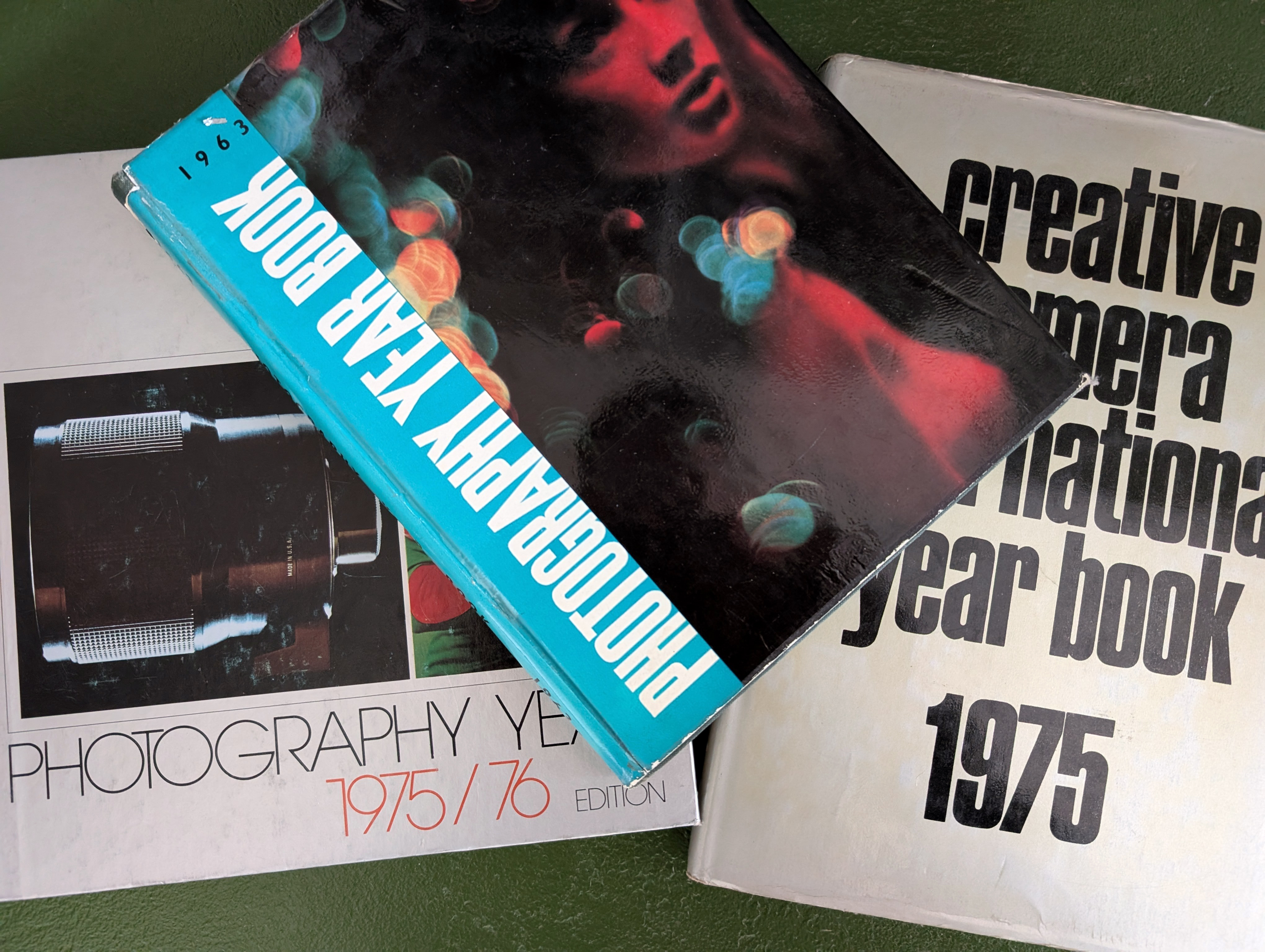
Have you ever been in a second hand book store, a charity shop or thrift store and found yourself looking at the photo books? Of course you have, we all have. Whilst doing so have you come across a photo annual or two? I guess, that you’ll say yes. The reason is that such photography annuals are like any greatest hits collections of any band or musician. They are the photo books most often bought as a present for someone interested in photography. They may not be wanted, but they are received. They are also an easy ‘go to’ if you want to see a selection of photography made over the course of a year. Either way they seem to be the first to go if you are looking to thin out your photo book collection. Hence their proliferartion in the second hand environment. The question is therefore, should you buy them? Are they of use for inspiration and aspiration and is the work on their pages still relevant?
The answer is not simple as in essence this is a subjective decision, but I do think that there are some key facts to consider to help your decision making process. Let’s start with two questions, why do photographic annuals exist? And why were they published? The ‘Annual’ became a publishing fashion from approximately 1823 and lasted as such until 1857. They were mass produced and contained text and etchings, usually of women, and as such, were the fashion magazines of there day. However, as time passed the desire for such publications faded. However, the 20th century saw the return of the ‘Annual’ with a sharp increase in the publication of annuals on specialized topics and as end-of-year summaries. In short a ‘cheap money making product’ and that is where most photo annuals began. Produced either using images published over the previous year, images sent in by readers or/and images requested by famous photographers to give an additional reason to buy.
I would argue that the best contain more work by known photographers than amateurs, but that is just my preference. The reason for this is that they can be a goldmine of images unpublished elsewhere. Images that were important to the photographer at the time, but perhaps dismissed or unknown by curators and publishers of the future. So, which are the ones to look out for? Well, my suggestion is that you start by thinking about countries and decades. This is what I do. My main interest in work is the 1960s and 1970s and so they are the decades I focus one, whilst always having an eye open for the 1950s and 1930s. I have no interest in the work of the 1980s or later than that in ‘Annual’ form. I have to say that despite being involved in commissioning photography during those decades the annuals of those periods seem to have dated the quickest just as the production values of so much 1980s music has condemmed great songs to the bin.
I have written previously (and made a feature-length documentary film!) about Creative Camera magazine and these are annuals I am going to begin with in my recomendations. Designed in silver and black, just like the magazines, the issues to look out for are 1975 and 1976. They are available and I found one for sale at just £5! Also from a UK perspective is the British Journal of Photography annual which began publishing its annual almanacs in 1859. I can’t find when they changed to a photographic annual format, but the one issue I would highly recommend looking out for is the 1964 edition (which I believe was the first of the new look). Overseen by its art editor Bryn Campbell (a friend of Bill Jay’s at Creative Camera) it includes work by such diverse photographers as F. M. Sutcliffe to David Bailey, Don Mcullin to John Bulmer, Robert Freeman to Minor White and Alfred Steiglitz to Mario Gaicomelli. It still contains pages and pages of technical text, but it proves that a well curated annual can evidence a powerful and eclectic portfolio of images. I found one on sale online for just £6!
Photography magazine under the editorship of Norman Hall was another influential UK magazine that produced annuals that you may come across. These are annuals that follow the same format as many of the US magazine annuals did. No technical text and lots of full bleed images, all in black and white. Ihave always found these to be hit and miss from year to year but the 1959 edition is particularly good. This features work by Wynn Bullock, Ernst Haas, Bill Brandt, Larry Burrows, Phillip Jones Griffiths and Robert Doisneau to name just a few of the international contributors. I found one of these for sale at £11!
I can’t imagine that there are many photographers who studied the medium through the 1970s and up to the early 2000s that are not aware of the Time Life series of books on photography with their black cloth spines and silver covers. These dealt with everything from the basics of the camera, and continued over seventeen books to cover every aspect of the medium. However, they also produced annuals from 1973 and the one I recommend looking out for is the 1975/76 edition. This includes work by Imogen Cunningham, Bruno Barbey, Luigi Ghirri, Anders Petersen and George Hoyningen-Heune alongside text dealing with trends, the marketplace and historical context. I couldn’t find this one for sale, but other years are availble.
That is just a few recomendations to get you started. It is not by any means an extensive list and I am sure that you will be able to add to my suggestions. However, I think what is clear is that they are worth looking out for as cheap editions to any serious library. The work within them can still be relevant even if much of the text will not be. What is required is a knowledge of photographers of the past so that you can look out for their names, whilst you scan the dusty, musty pages of any annual you come across. In effect you are searching for jewels amongst the glass and that requires a little knowledge, and some research. It may be that one annual contains both and at that stage it’s a question of balance. How much good stuff is there amongst the bland. Therefore, my suggestion is to not dismiss those cheap annuals you come across, instead spend sometime with them and possibly a few pennies. They may be more rewarding than you initially think.
Further Reading
https://unitednationsofphotography.com/2026/03/01/are-photo-magazines-worth-keeping-and-collecting/
Dr.Grant Scott
After fifteen years art directing photography books and magazines such as Elle and Tatler, Scott began to work as a photographer for a number of advertising and editorial clients in 2000. Alongside his photographic career Scott has art directed numerous advertising campaigns, worked as a creative director at Sotheby’s, art directed foto8 magazine, founded his own photographic gallery, edited Professional Photographer magazine and launched his own title for photographers and filmmakers Hungry Eye. He founded the United Nations of Photography in 2012, and is now a Senior Lecturer and Subject Co-ordinator: Photography at Oxford Brookes University, Oxford, and a BBC Radio contributor. Scott is the author of Professional Photography: The New Global Landscape Explained (Routledge 2014), The Essential Student Guide to Professional Photography (Routledge 2015), New Ways of Seeing: The Democratic Language of Photography (Routledge 2019), What Does Photography Mean To You? (Bluecoat Press 2020) and Inside Vogue House: One building, seven magazines, sixty years of stories, (Orphans Publishing 2024). His photography has been published in At Home With The Makers of Style (Thames & Hudson 2006) and Crash Happy: A Night at The Bangers (Cafe Royal Books 2012). His film Do Not Bend: The Photographic Life of Bill Jay was premiered in 2018.
© Grant Scott 2026
Leave a Reply