
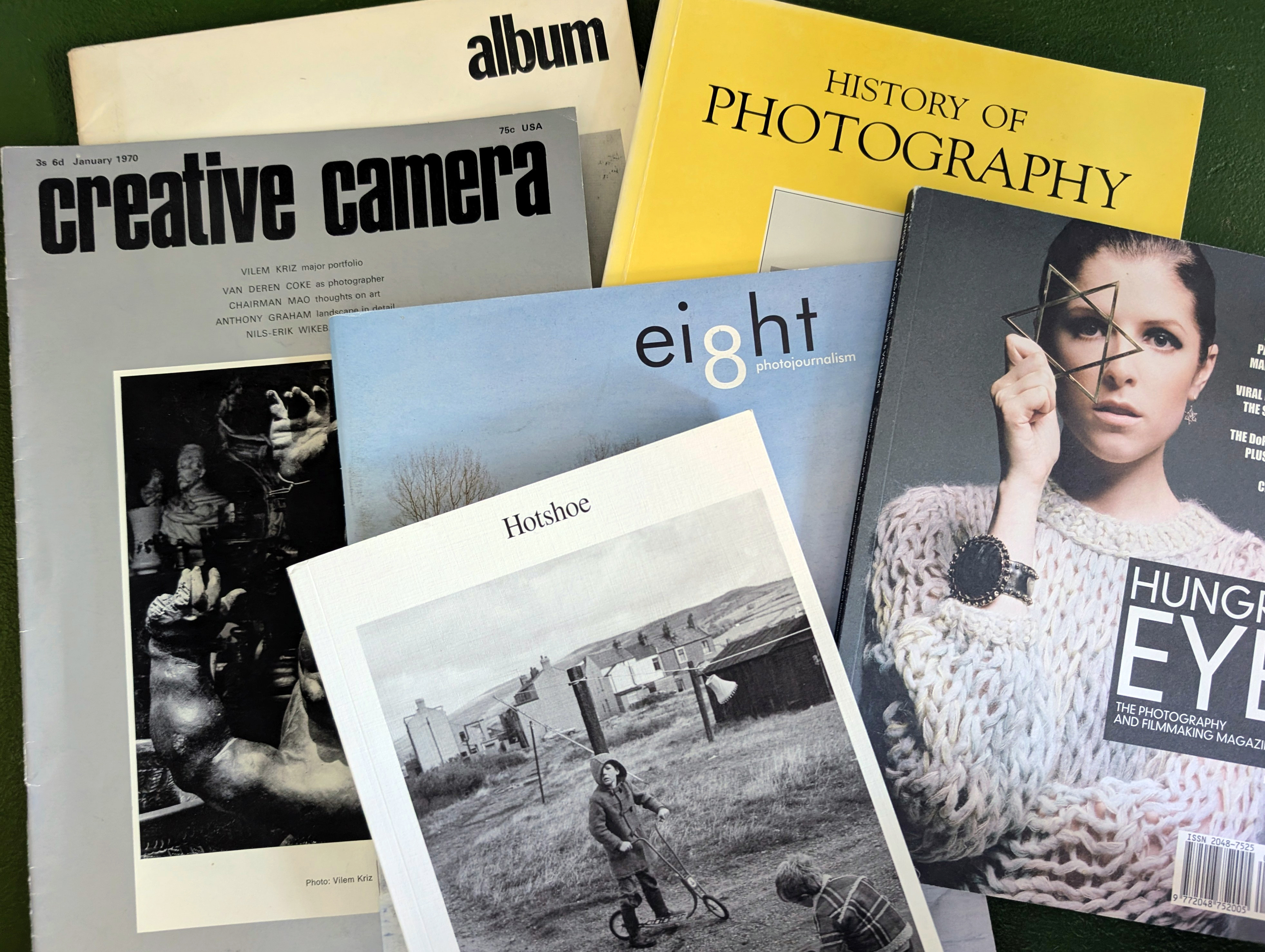
This is another article written in response to a reader email. The said reader wanted to know which photo magazines from the past and present I thought were worth holding on to and named a few of the usual supects, which he had in his collection including a few copies of Aperture, Blindspot and HotShoe. These are all worthy titles, but his enquiry made me think that this was an area worth considering as I rarely see it being discussed.
To start this consideration I decided to break down the magazines and journals those engaged with photography may buy and keep into three distinct areas. These are enthusiast/hobby magazines, magazines that include photography you may be interested in and finally academic magazines. The first is I think easy to define, these are the magazines filled with camera reviews, ‘how to’ articles and features on photographers who are primarily interested in wildlife, landscape and occasionally wedding photography. Monthly magazines that you can pick up from your local newsagent or supermarket. They offer gifts and discounts to get you to subscribe and are the titles most commercially affected by the profusion of similar information on the internet. These tend to be repetitive in their articles and cheaply printed. Therefore, they do not give a reason to be seen as a collectable item. To prove my point you will regularly see huge bundles of these at car boot sales unloved, unwanted and unrepurchased. The only copies of such magazines I have ever owned and continue to own are the copies of Professional Photographer that I edited and designed the covers of, and even I keep questioning why I keep them!
The second is less easy to group. These are the specialist magazines that professional photographers work for and therefore feature the photography that photographers should be interested in. The work by their competitors that is being commissioned. This could include fashion, food, sport, lifestyle, travel magazines or newspaper supplements. In fact anything that publishes photography. These inevitably get moved to the loft or the garage after some time, and are forgotten. Although I do still have thirty years of Italian and French Vogue carefully stored in my own library.
The third is perhaps the most obvious possible collectable. Magazines that deal with the medium’s history, ethics, conversations and photographers of note! Monthlies, quaterlies and annuals that focus on serious writing and high quality print production thanks to their small circulations. Magazines that rely on subscriptions and educational institutions to support their existence and meet their high issue price.
Anyone reading this probably has all three of the above in some shape or form, but a collection is something different from a muddle of paper as I have previously written concerning photobooks. I sadly, have yet to fully understand this! However, that is enough of my personal issues. The reader wanted to know what I recommend to the new collector so here goes.
There are some classics to look out for, but before I start I have to turn on a flashing warning light. *Whatever you buy you may never look at despite your good intentions*. Now you’ve seen the flashing light let’s deal with those classics. The first of course is Camera Work a photographic quarterly edited and published by Alfred Stieglitz in New York between 1903 and 1917. During this time, 50 numbered issues were released. Of the 50, 44 were regular issues, 3 were double issues (no. 34 & 35, no. 42 & 43, and no. 49 & 50), 2 were special numbers, and 1 was a supplemental issue devoted to the photography of Edward Steichen, who was also responsible for every publication’s cover design. A complete set of facsimilie issues will set you back $10,000,000.00.
If that is a little out of your price range (and of course it is) you could look out for copies of Aperture founded in 1952 by a consortium of photographers and proponents of photography including Ansel Adams, Melton Ferris, Dorothea Lange, Ernest Louie, Barbara Morgan, Beaumont Newhall, Nancy Newhall, Dody Warren, and Minor White. It was the first journal since Camera Work to explore photography as a fine art and is still publishing today. At $24.95 per issue it is not cheap, but you can pay for an international subscription for $110 per year and start your collection that way. I have to say that I did once subscribe to Aperture in the 90s, but soon found that its content was not what I wanted to read and soon cancelled. It was too erudite and self satisfied for my tastes. Today of course you can check their website to see if it’s the magazine for you without commiting financially. Blind Spot magazine travels a similar road to Aperture. First published in 1992 by founding editor and longtime Publisher Kim Zorn Caputo, and is dedicated to premiering significant photo-based works by contemporary artists. Its not my ‘cup of tea’, but it might be yours.
Anyway, lets get back to the classics. Camera magaine is one I would definitely recommend tracking down. The first German language issue of Camera was published by the engineer Adolf Herz and book-publisher C. J. Bucher in June 1922. However, it was during the post-war period that it become an important publication showing the earliest works of photographers such as Henri Cartier-Bresson, Robert Capa, Bill Brandt and Robert Frank. But, it was the arrival of Allan Porter in 1965 that saw the magazine take on true relevance in the photographic community and embrace multiple language editions. Always on the lookout for new and innovative imagery for Camera, Porter helped launch the career of many now-renowned photographers, including Josef Koudelka, Stephen Shore, and Sarah Moon. Porter’s Camera was also the first to showcase the more experimental work of photography’s greats, such as Richard Avedon. Camera closed in 1981 and it is the issues under Porter’s editorship which I recommend searching for. I found a complete set of leather bound editions when a university library was downsizing. Such downsizing is often a fruitful area for collectors to mine.
From a UK perspective there are three titles which are obvious contenders for collection. The British Journal of Photography began publishing in 1854 as the Liverpool Photographic Journal and became the British Journal of Photography in 1860. It has continued to publish ever since and is still on sale today. You could if you are looking for a magazine similar to Aperture and Blind Spot subscribe today, but my recomendation would be to look out for issues from the 1970s when it was a thin, but interesting weekly publication. These are fascinating time capsules of British documentary and humanist photography of the time with the occasional US or European photographer featured when new work demanded comment. At this point it was very much the magazine for the working photographer, rather than the academic and therefore is much easier to relate to and read.
The other two titles were both edited by the same person, Bill Jay. Creative Camera (also named Camera Owner and Creative Camera Owner in its evolution with Jay) under Jay’s editorship this magazine evolved into perhaps the most influential photography magazine in the UK and elsewhere in the 1960s. They can still be purchased on eBay so look out for them. When Jay had finished with Creative Camera and it had finished with him he launched Album magazine. It only lasted eleven issues, but every one is a classic. No advertising and no camera reviews, just great photography from Tony Ray Jones, Don McCullin, Elliot Erwitt and W Eugene Smith. Again, despite its limited print runs you can still find copies for sale online. I found every copy through diligent searching on eBay.
I should also add that Jay left Creative Camera at the end of 1969 and after a few weak issues in 1970 it continued through the 1970s under the excellent editorship of Pete Turner and those are well worth seeking out.
Inspired by Jay and featuring his writing before his death is the US magazine Lens Work founded and edited by Brooks Jensen. This is dedicated to serious black and white photography from the classic school and is worth checking out. Jensen’s passion for this work and knowledge of its practitioners is obvious in every issue. This quarterly magazine launched in 1993, and remains a much loved title for those dedicated to classic photography.
A similar but more academic journal you could consider is The History of Photography, founded in 1977 as an international journal, which literally does what it says on the tin. Like Lenswork it is published quarterly, but puts more importance on writing than photography in a dry, no-nonsense layout design. However, don’t let this put you off. It is a true collectable and issue by issue builds into a substantial resource to help understand the medium. Like some medicine or vitamins it may not be fun to look at, but it is good for your spirit and your mind. My issues sit on a shelf in my library rarely retreived, but reassuringly present if I need them.
I mentioned at the beginning of this article that the only enthusiast magazines I have in my collection are the ones I edited but they are not the only magazines with a personal connection that sit on my shelves. Hungry Eye the monthly magazine for photographers and filmmakers I launched, edited and art directed also sits alongside my photo books and journals. It only lasted in my iteration for nine issues, but I have recently noticed that they are now being sold for over £60 an issue in the collecting marketplace. You might like to look out for them!
Hungry Eye was a small publication of uncoated paper that smelt strongly of ink and could fit comfortably into your camera bag and you could say the same of the recent evolution of Hot Shoe magazine. Hot Shoe has had more costume changes over its history than Lady GaGa, but its latest look is well worth checking out out. Its decison to focus on specific photographers has instantly made it an obvious collection artefact as a journal/book with issues focused on Chris Killip and Stephen Shore of particular note. It’s not really a magazine, but as a hybrid publication it could be pointing to the future for those bored by overly academic text and self-obsessed design.
I’m going to end with two other recomendations from the past that may be hard to find and possibly expensive, but both are well worth spending some time trying to discover. Reportage was founded in 1993 by the quietly spoken Colin Jacobson, the great photo editor at The Sunday Times and The Independent newspapers, as a magazine for quality black and white photojournalism. Image led, it was hailed by some as a Picture Post for the nineties. But poor business decisions and Jacobson’s reluctance to compromise on quality led to its demise in 1995. An ending that echoed the same reasons for Bill Jay’s Album to close. Foto 8 magazine was launched in 2001 by a similarly well respected and passionate figure, but more loudly spoken than Jacobsen, in photographer Jon Levy. Levy started by producing a thin staple-bound magazine (which I art directed for a number of issues) and ended its life as a perfect bound, uncoated, beautifully printed journal. Foto 8 was very much of its time, with its gallery space, annual competition and strong sense of community, but sadly as with so many bright flames, it burnt brightly, but briefly. However, if you can find copies for sale today I highly recomend trying to build a full set of its strident issues.
I could go on and on with this article, but I will call a stop at this point. I am sure that you will feel that I have missed out titles that you feel I should have mentioned (please tell me what they are). I know I could have mentioned many other magazines, particularly those not written in the English language, but those are outside of my knowledge set. I could have recommended PHOTO, or Photo District News or Life or Picture Post or Eyeshot or Blink or Frames or GUP or any number of photo magazines of the past and present, but the ones I have mentioned are I believe the ones to consider as a foundation to any serious collection. Photo magazines are worth keeping and collecting if you chose the right ones, but as I previously warned like any collection they take up a lot of space, may cost you a considerable amount of money and rarely get looked at, but which collector ever took these considerations on as serious negatives? Not me for sure!
Dr.Grant Scott
After fifteen years art directing photography books and magazines such as Elle and Tatler, Scott began to work as a photographer for a number of advertising and editorial clients in 2000. Alongside his photographic career Scott has art directed numerous advertising campaigns, worked as a creative director at Sotheby’s, art directed foto8 magazine, founded his own photographic gallery, edited Professional Photographer magazine and launched his own title for photographers and filmmakers Hungry Eye. He founded the United Nations of Photography in 2012, and is now a Senior Lecturer and Subject Co-ordinator: Photography at Oxford Brookes University, Oxford, and a BBC Radio contributor. Scott is the author of Professional Photography: The New Global Landscape Explained (Routledge 2014), The Essential Student Guide to Professional Photography (Routledge 2015), New Ways of Seeing: The Democratic Language of Photography (Routledge 2019), What Does Photography Mean To You? (Bluecoat Press 2020) and Inside Vogue House: One building, seven magazines, sixty years of stories, (Orphans Publishing 2024). His photography has been published in At Home With The Makers of Style (Thames & Hudson 2006) and Crash Happy: A Night at The Bangers (Cafe Royal Books 2012). His film Do Not Bend: The Photographic Life of Bill Jay was premiered in 2018.
© Grant Scott 2026


Leave a Reply