
For many months we asked photographers to send us a piece of audio no longer than five minutes in length to include on our A Photographic Life podcast. These became a book which is now out of print but remain in audio form within the podcast archive, available wherever you get your podcasts . However, we are responding to listener requests and offering transcriptions of some of our favourite contributions. Enjoy!
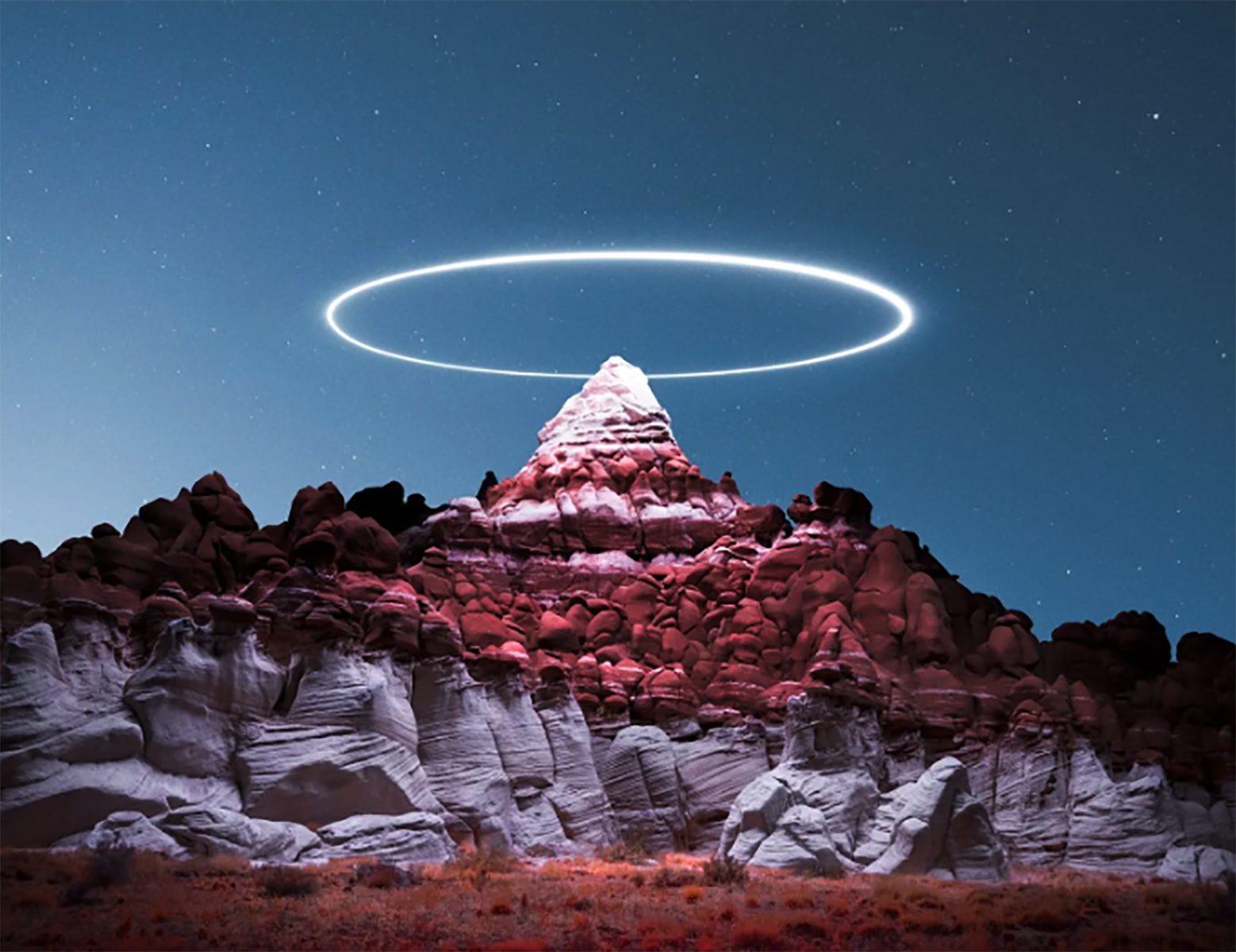
Reuben Wu grew up in North West England and trained in Industrial Design at Sheffield Hallam University. Wu graduated in 1997 and finished his MSc in 1998 at the University of Liverpool and worked as an industrial designer until going full-time with the band in 2002. He began to document his travels on tour with the band with photography and, when the band took a break in 2012, he was able to focus full-time on his own creative output. He has since created images for GE, Apple’s ‘Shot On iPhone’ campaign, Jaguar Land Rover, Google and the record label Interscope amongst others. In 2019 his work was exhibited as part of Aeroglyphs & Other Nocturnes at the PhotoEye Gallery, Santa Fe, The Photography Show presented by AIPAD with PhotoEye Gallery, New York City, NY and the GROUP SHOW also at the PhotoEye Gallery, Santa Fe, New Mexico. His pioneering work with aerial lighting and long-exposure photography has helped redefine contemporary landscape photography and belongs in the permanent collections of the Guggenheim Museum, The Metropolitan Museum of Art, and the MoMA.
“Photography is my third career. From a young age I always wanted to be an artist but my career began in the field of design. I worked as an industrial designer – up until then drawing had been my passion and I occasionally dabbled in photography. During that time, I formed a band with friends (Ladytron), and we released a track that ended up being the NME’s single of the week. Our first album followed soon after and we started to play live shows in the UK and Europe. As we became more and more recognised, we were signed to a label and a tour of the USA and Canada was lined up for us. I decided to quit my job and do music full-time and that is what I continued to do for the next ten years. Music was my passport to seeing the world but, because we were so busy, there was less and less time for drawing. I turned to my camera, my dad’s old Leica M3, to document my travels. My interest in photography grew and filled a creative gap while I was on tour. Rediscovering film and experimenting with the medium went hand-in-hand with travel. When we were booked to play somewhere far away, like Australia or Chile, I would get there a week or two in advance, rent a car and go exploring before re-joining the band. In 2011, after releasing five albums, the band took a break. I decided to pursue photography and video as my solo project.
My interest in landscape originated with my love of British National Parks. In 2013, I moved to the States and this enabled me to explore the country in my own time, connect with like-minded individuals and slowly build a career in photography. My personal work continued to centre around remote, dramatic landscapes but I was interested in showing them in new ways using whatever tools and techniques were available to me. I got to a point where my need for art in photography hit a ceiling. I felt that I was pointing a camera at the right moment and taking credit for it. It didn’t sit well with me, so I began to look for ways around it. I discovered the answer by accident in 2014, when a truck with its headlights on drove into my time-lapse one night in the desert. What I thought had ruined my picture was a new direction where I could use artificial light in a natural environment. I’d also been using drones as flying light beams. I now had a new way of showing a landscape that had only previously existed in my imagination. Like stills from films that don’t exist. My main motivation with this work is to ask a question. Can I change my perception of a place by showing it in a new light? If I can change my own perceptions, can I shift other peoples? Will this make a difference to how we care about our natural environments? My practice is informed by both music and design and I wouldn’t be here doing this without them.”
© Grant Scott 2026
Leave a Reply