
For many months we asked photographers to send us a piece of audio no longer than five minutes in length to include on our A Photographic Life podcast. These became a book which is now out of print but remain in audio form within the podcast archive, available wherever you get your podcasts . However, we are responding to listener requests and offering transcriptions of some of our favourite contributions. Enjoy!
Daniel Meadows studied at Manchester Polytechnic where he rented a barber’s shop in 1972, and invited people to come into the Free Photographic Shop to have their photographs taken for no charge before he travelled around England in the Free Photographic Omnibus. This work was published in Living Like This, 1975. Meadows went on to photograph the northwest of England in the 1970s and in the 1980s the people of the London suburb of Bromley published as Nattering in Paradise. In 1983 David Hurn invited him to teach at Newport College of Art and Design and from 1994 he taught at Cardiff School of Journalism, Media and Cultural Studies. From 2001 to 2006 Meadows was creative director of Capture Wales, a BBC Wales project. The Bodleian Libraries of the University of Oxford acquired his archive in 2018 and in 2019, and celebrated the acquisition with an exhibition of Meadows’ work, Now and Then.
“I’m going to answer this question in two parts. Part one, Bill Brandt. I was eighteen years old and up in London from the West Country, where I was
completing my tenth year in boarding school. Yes, I’d been sent away as an eight-year-old but I hadn’t thrived and was filled with something far more
furious than mere adolescent rage. Anyway, this was a school trip and I was in my uniform. I went to the Hayward Gallery and I saw the Bill Brandt retrospective and it blew my socks off! Here I was, a D grade student, certain of only one thing, that I knew nothing. I knew no one working class, I knew no women, no one of colour, I’d never been in a factory, I’d never been in an office. As I say, nothing, but I was fizzing with curiosity. Here were the photographs of a man who had taught himself about the world by using his camera like a passport to slip between the social classes. As soon as I understood what he’d done, I knew that I wanted to do it.
Part two. As someone who has been in documentary practice for half a century, I sometimes get asked to offer up my rules of engagement. So here they are. The brief version is to always treat people as individuals, never as types and read Let Us Now Praise Famous Men by James Agee and Walker Evans because it is the bible. Here’s the longer version. One, know why you are doing your work, who you are doing it for and where those represented by it can see it when its finished. Two, practice explaining what you do including who benefits from it. Be clear and succinct. Three, when deciding your subject matter, research it on the ground and in books, familiarize yourself with all the ways in which it has already been covered and begin work only if you think you can bring something new to it. Four, once you’ve committed to a project, immerse yourself in it. Live close to it, as close as you can and in a way that is sustainable. Nothing must be more important than your work. Five, work by yourself and be disciplined. Do it for at least eight hours every day and do it as well as it can be done. Six, make a habit of engaging with strangers particularly with people whose attitudes are not your own. Be polite, don’t argue, listen, be curious and respectful. Seven, celebrate, wonder. Eight, catalogue everything you produce as you go along. Nine, don’t call yourself an artist. Ten, don’t expect anyone to be interested in what you’ve done for at least twenty years. That’s what photography means to me too, and just maybe some of this is what I saw as being the possibilities of a career in documentary practice myself when I turned up as a schoolboy at the Hayward for the Bill Brandt Retrospective.”
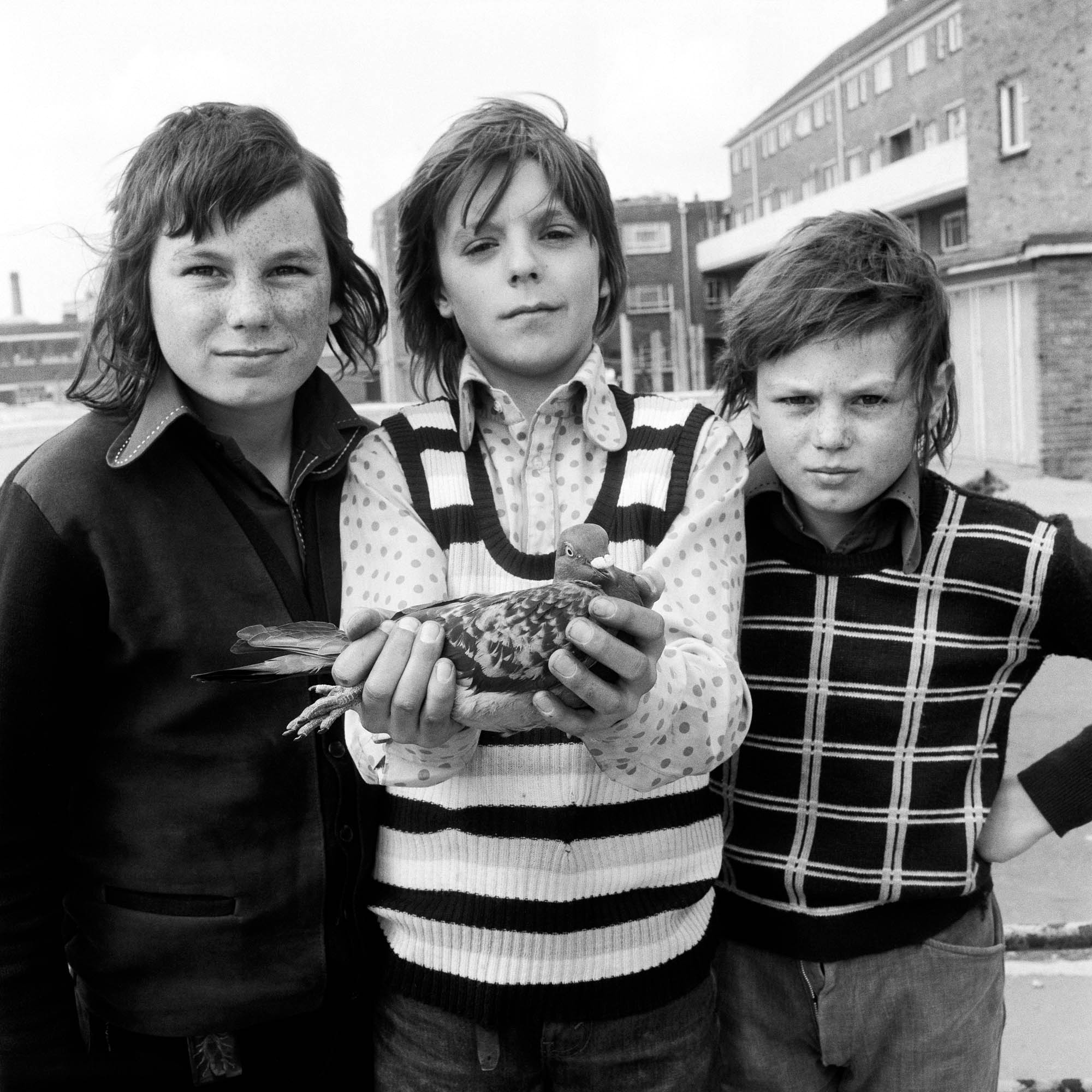
Image: John Payne, aged 11, with pigeon Chequer and friends; left Michael White, right Kalvin White, brothers, Portsmouth. Friday 26 April 1974. © Daniel Meadows
© Grant Scott 2026
Leave a Reply