
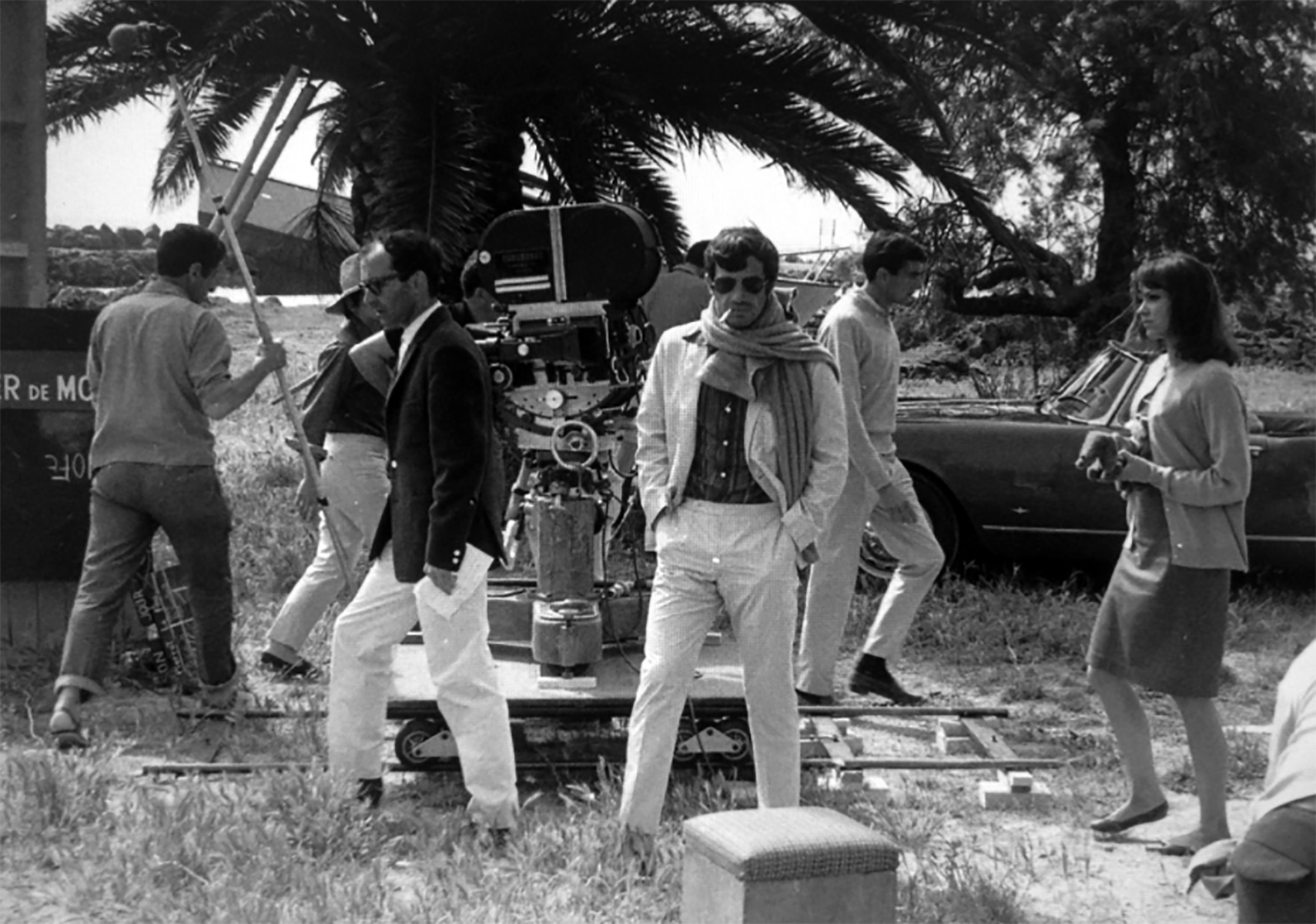
I came across the image below on a website advertising an exhibition in Paris, dedicated to the French actor Alain Delon. The link was sent to me by a friend, as we had both independently been reading a book about the actor and seen him in a film shown locally. I wrote about that here https://unitednationsofphotography.com/2026/09/24/film-but-not-that-kind-of-film/. The website page was in French, a language I am not fluent in, but the one photograph on the page spoke to me.

There was no photographer credit attached to the image and initially it seems to be a chaotic composition. However, what I saw was a photograph based on movement and transition, with only one figure being aware of the photographer. It was this that initially drew me in.
Let’s talk about the central figure first. Delon, as cool as any man could be. Standing and challenging the photographer. The scarf, the glasses, the cigarette, the stubble, his hands inside the pockets of his white suit trousers. All of this screams macho cool. Not aggressive macho, but French macho. A cool insolence that French men do so well, especially in films of the 1960s. He stands seemingly unaware of his surroundings. The people and their movement. Too concentrated on how he looks and reacts to the camera’s lens. A box at his feet further drawing out attention to his statuesque presence. A plinth for an icon.
The man in the dark blazer and white trousers is the director Jean Luc Goddard. One of the godfathers of the Nouvelle Vague approach to filmaking. His stride appears confident and considered. He knows where he is going and appears determined to reach his destination. He is ignoring Delon whom it would appear he has just passed, just as he is the photographer.
To Delon’s right a woman seems to be following Goddard holding a felt to, perhaps a dog. The lead actress? A member of the film crew? We don’t know, but what we can see is that her clothing is simple. Worn not to draw attention to herself. Unlike Delon. Her position and stance present her as a follower of Goddard either physically or literally. Or perhaps both.
The figures in the background are also caught in positions of movement. All moving to the right in opposition to Goddard. All wearing narrow trousers and lightweight sweaters. The costume of the cool European modernist at the time.
Beyond them is an open top sports car. Maybe a Ferrari, a Lancia or a Mercedes. Whatever it is it is the kind of car that would be perfect to drive along the smooth winding coastal roads of the South of France. To drop into St.Tropez for lunch at Club 55. A possibilty suggested by the boats beyond the trees.
All of this is important. However, the central focus of the image is a film camera, on railroad tracks. The profile of its film canisters and sturdy tripod iconic silhouettes of the filmmaking of the period. Its inclusion clearly identifies why the disparate characters have been drawn to one location and included within the photographic frame.
The camera explains their professions and why they are there, but it is the palm tree that acts as an umbrella for their narrative. A narrative of impeccable French cinematic cool. This is my interpretation of this image. This is what it tells me. It may give you another story, but it is the story in any photograph that talks to me. I could live with this image forever and never get bored of looking at it. I don’t expect it to talk to you, or to touch you in the same way as it does me, but it may, it just may…
Dr.Grant Scott
After fifteen years art directing photography books and magazines such as Elle and Tatler, Scott began to work as a photographer for a number of advertising and editorial clients in 2000. Alongside his photographic career Scott has art directed numerous advertising campaigns, worked as a creative director at Sotheby’s, art directed foto8 magazine, founded his own photographic gallery, edited Professional Photographer magazine and launched his own title for photographers and filmmakers Hungry Eye. He founded the United Nations of Photography in 2012, and is now a Senior Lecturer and Subject Co-ordinator: Photography at Oxford Brookes University, Oxford, and a BBC Radio contributor. Scott is the author of Professional Photography: The New Global Landscape Explained (Routledge 2014), The Essential Student Guide to Professional Photography (Routledge 2015), New Ways of Seeing: The Democratic Language of Photography (Routledge 2019), and What Does Photography Mean To You? (Bluecoat Press 2020). His photography has been published in At Home With The Makers of Style (Thames & Hudson 2006) and Crash Happy: A Night at The Bangers (Cafe Royal Books 2012). His film Do Not Bend: The Photographic Life of Bill Jay was premiered in 2018. Scott continues to work as a photographer, writer and filmmaker and is the Subject Coordinator for both undergraduate and post graduate study of photography at Oxford Brookes University, Oxford, England.
Scott’s book Inside Vogue House: One building, seven magazines, sixty years of stories, Orphans Publishing, is now on sale.
© Grant Scott 2026
Leave a Reply