
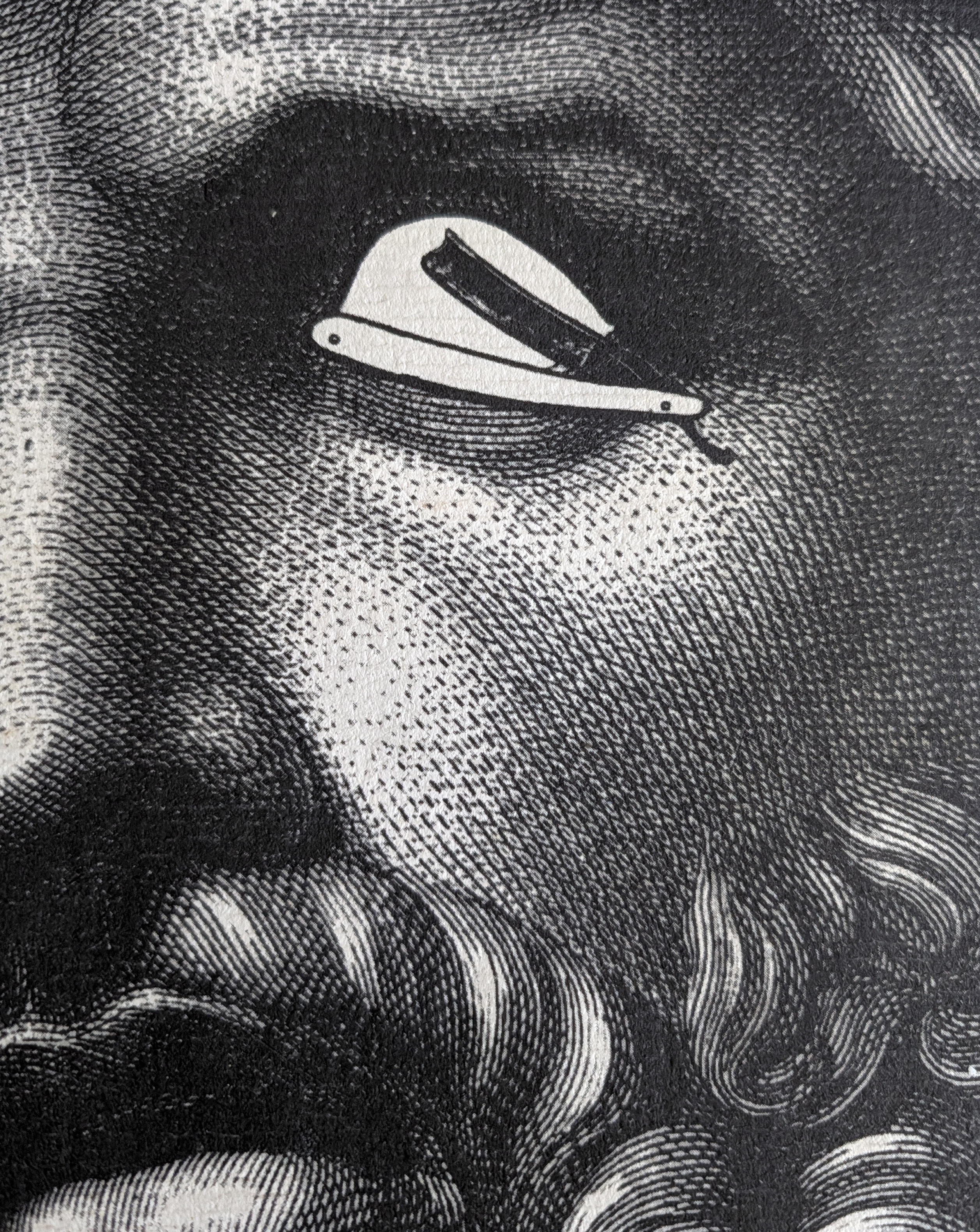
I first came across the use of the theory of Occam’s Razor thanks to the writer and photography teacher Bill Jay. It is the title of what I consider to be his best book. The book that spoke most directly to me. The book that inspired me to make the film Do Not Bend: The Photographic Life of Bill Jay (https://youtu.be/wd47549knOU?si=j2rzYJ7pylEuJZmP).
But, what does Occam’s Razor mean and what is its relevance to photography? Let’s start with the definition of Occam’s Razor. A simple one. Put simply, it tells us that the simplest, most elegant explanation is usually the one closest to the truth. Less simply, it is the problem-solving principle that recommends searching for explanations, constructed with the smallest possible set of elements. It is also known as the the ‘law of parsimony’, attributed to William of Ockham, a 14th-century English philosopher and theologian. Popularly, it is a principle often paraphrased as “of two competing theories, the simpler explanation of an entity is to be preferred”. Or you could use the incorrectly attributed Colonel Sanders phrase concerning chicken, “keep it simple stupid!”or KISS!
I often find that photography is over complicated, technically, conceptually and contextually. In the words of Bill Jay, “The pseudo intellectual makes the error of assuming, that simplicity is the opposite of profundity.” Bill said that in 1992 and I agree with him today. So, why do so many people feel the need to add complication to the photographic medium? I don’t want to get too academic here, but I also agree with the Italian Dominican friar, priest, theologian, and philosopher Thomas Aquinas, when he said in the 13th century, “If a thing can be done adequately by means of one, it is superfluous to do it by means of several.” But Occam’s Razor is not a theory stuck in the past. It is now also being connected with AI, as scientists have discovered that deep neural networks (DNN) prefer simpler mathematical functions while learning. This simplicity bias enables DNNs to overcome overfitting – a scenario where the model gets overwhelmed with noise due to the presence of too many parameters. Ever feel overwhelmed by your photography?
I think that we can all think of examples when photography loses itself, within an over-stocked buffet of ‘word salad’. When the functionality of a camera is beyond even the smartest of manual readers. Where post-production layers become a game of finding a ‘needle in a haystack’. That moment when a concept becomes so complicated, that even the person whose idea it was, can’t explain it.
None of these have anything to do with photography, with making a photograph. A process that in practice could not be simpler. Maybe that’s the problem. It’s too simple.
When something is simple it can be perceived to be shallow, worthless and intellectually weak. Such thought misunderstands the difficulty of simplicity. I spend much of my time saying to students and photographers that they need to simplify their ideas and approaches to making work. As I always say, a simple story is easier to tell and easier to understand, than a complicated one, told badly. Occam’s Razor tells us that the simplest solution to a problem takes us closest to the truth. Something that most photographers aspire to. It may be their truth, but it is a form of truth.
Despite the benefit of understanding the power of simplicity, I have never heard of Occam’s Razor featuring in any photography workshop or teaching. People often suggest that they can teach simple photography, they sell courses on the basis of this promise, but rarely do they suggest that they can teach photographic simplicity, and that is a shame. By adding complexity we introduce barriers to entry. Perhaps that is also deliberate. The desire to make something simple, to choose the simple solution, can be seen by some as removing a sense of mystique or difficulty. As a result technical proficency is seen as a the mark of the master.
This adoration of technical ability reminds me of the days of prog rock. A time of ‘the more, the better’. I am not sure if William of Ockham would have been a fan of The Sex Pistols, Never Mind The Bollocks, but I am pretty sure that he would not have enjoyed Genesis’s The Lamb Lies Down on Broadway! Now, please do not misunderstand me. By questioning, I am not condemning. I am not anti-technical-ability, but I perhaps do not put the importance upon it that many people do within photography. I am also dubious of its importance, when used as a badge of professionalism.
An image can be complex, even when the process that made it is simple and I think that is where we can apply the concept of Ockham’s Razor to improve our photography. The full title of Jay’s book, which I mentioned at the beginning of this article is Occam’s Razor: An Outside-In View of Contemporary Photography. In the introduction to the book, he states that the Occam’s Razor concept had been a guiding principle of his teaching for over thirty years as an editor, writer, lecturer, educator and photographer. It has been the same for me, without being aware of the concept. I have always believed in the importance of the simplification of a message, or process to ensure maximum understanding. This is based on two pieces of advice I was given at the beginning of my career. The first was to use ‘mass market tactics’ to sell ‘up-market concepts’. The second was to think of the least educated person and always aim to communicate with them. If that works, was the advice, everyone else will ‘get it’.
Jay continues in his book introduction to say that “Photography is, at heart a very simple act, but exceedingly difficult to do well. It is a visual response to an emotional confrontation with the subject. The aim is to create a picture of this confrontation which can be divorced from the emotion which triggered the response. After that, anyone (including the photographer)can say anything about the image with varying degrees of relevance, because all subsequent meaning is supplied and applied with the veiwer.” I agree with Bill. Simple. Occam’s Razor and photography? It seems to me to be a perfect partnership.
Dr.Grant Scott
After fifteen years art directing photography books and magazines such as Elle and Tatler, Scott began to work as a photographer for a number of advertising and editorial clients in 2000. Alongside his photographic career Scott has art directed numerous advertising campaigns, worked as a creative director at Sotheby’s, art directed foto8magazine, founded his own photographic gallery, edited Professional Photographer magazine and launched his own title for photographers and filmmakers Hungry Eye. He founded the United Nations of Photography in 2012, and is now a Senior Lecturer and Subject Co-ordinator: Photography at Oxford Brookes University, Oxford, and a BBC Radio contributor. Scott is the author of Professional Photography: The New Global Landscape Explained(Routledge 2014), The Essential Student Guide to Professional Photography (Routledge 2015), New Ways of Seeing: The Democratic Language of Photography (Routledge 2019), and What Does Photography Mean To You? (Bluecoat Press 2020). His photography has been published in At Home With The Makers of Style(Thames & Hudson 2006) and Crash Happy: A Night at The Bangers(Cafe Royal Books 2012). His film Do Not Bend: The Photographic Life of Bill Jay was premiered in 2018.
© Grant Scott 2026
Image: Illustration from the cover of Occam’s Razor: An Outside-In View of Contemporary Photography by Bill jay.


Leave a Reply