
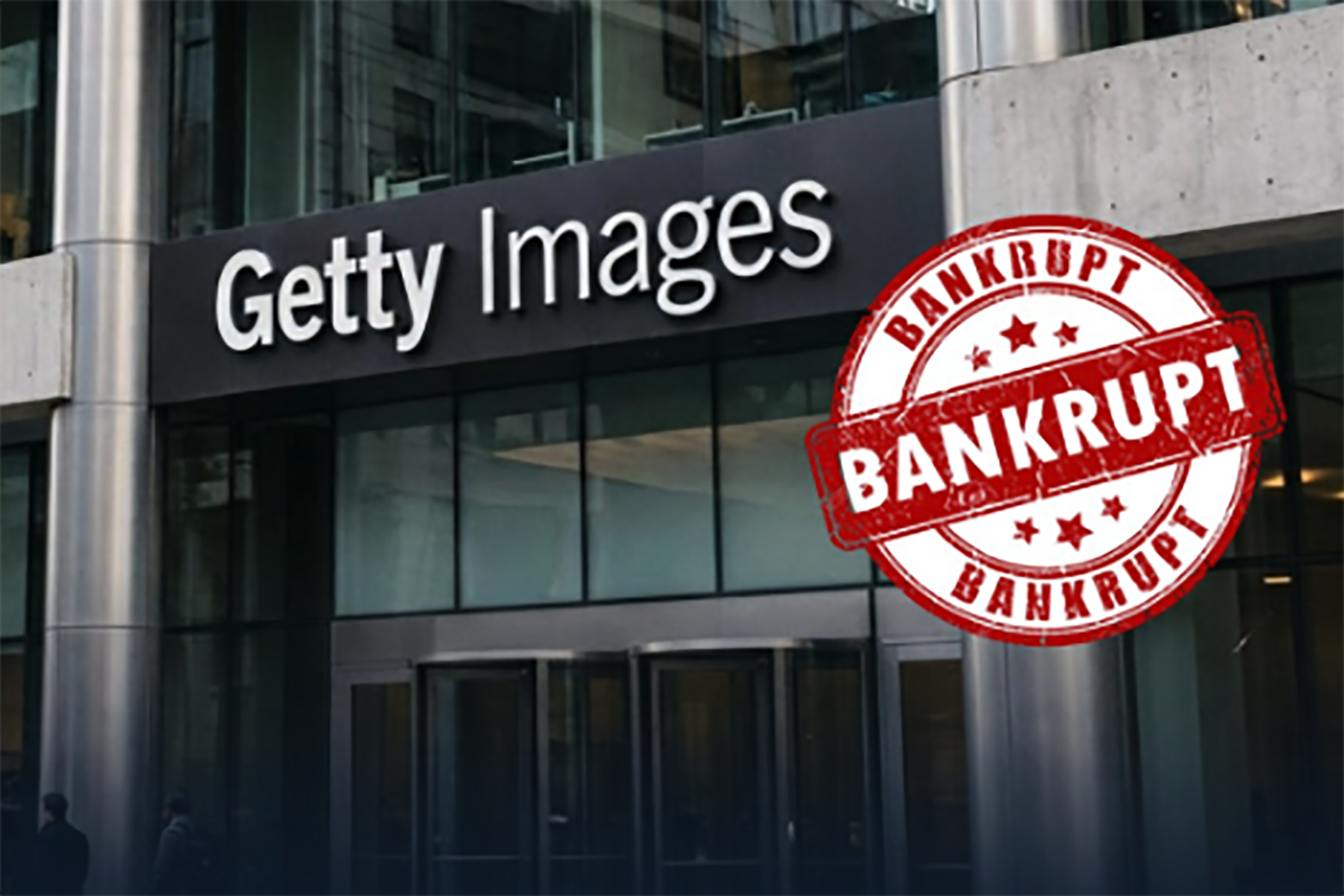
The recent announcement that Getty Images are entering into a restructuring agreement and plans to begin a prepackaged Chapter 11 process in the coming weeks was no surprise to me. Not because I have magical powers that allow me to see into the future, but because I have followed the death of the photographic stock industry for over twenty-five years.
Back in 1999 I was employed by Getty to point to the future of stock. I had spent the previous fifteen years commissioning photography for luxury brands and magazines in the UK, across Europe and the US. This was the reason for my employment, as they paid me to travel across the world to give talks to stock photographers at all of the agencies that Getty was buying up and rebranding. The idea was that there was little future in low payment, generic images, which at the time were being offered as ‘royalty free’ on CDs. Clients could buy a CD, then use the images on it as often as they wanted, how ever they wanted for free. This was a common practice at the time and the beginning of the devaluation of the stock photograph. My role was to encourage the photographers, who had made a good living for many years, from providing images, to ‘up their game’. To make work that could be seen as premium to be sold at premium prices. ‘Boutique stock’ was the term being used at the time.
The issue was that the majority of the photographers aligned with the agencies that had been purchased (including FMP in the US and The Telegraph Colour Library in the UK) were unable to make the work that these clients wanted and having made strong money for years from the work they had been making, they were unwilling to change. A further issue was that these were the days of analogue and therefore, with a digital future on the near horizon Getty needed to persuade these photographers to not only change their ways of working, but to also buy new cameras and the appropriate equipment for digital workflow. At the time this was an expensive investment that few wanted to make. However, I am aware of some who invested vast amounts of money in setting up their own scanning studios, only to find themselves with large, expensive, useless monuments to a bygone age within a few years. In the meantime, Getty had brought agencies across the world for their archives of negatives, transparencies and prints. This required them to employ teams of experienced, expensive scanning operatives and to run huge printing scanners day and night. To scan images that were dated and had little if any resale value.
After a year, I realised that there was little point in me trying to deliver my message to the stock faithful and so I left. Over the following years, stock photography continued its race to the bottom, as Getty decided to work on a ‘stock ’em high, sell them cheap’ logic. With the idea of dominating the market through mass sales at low prices. In the meantime digital capture and fast broadband led to multiple stock based companies opening and closing. Often with unpaid photographers being the ultimate outcome of overly positive, ill-informed venture capatilist funded initiatives, that were big on promise and low on delivery.
Other agencies dropped both standards and ethics accepting any image from any photographer, captured on any camera. The result was photographers being sued and the agencies saying it was nothing to do with them. This resulted in large legal fees and concern for photographers who had no knowledge or experience of copyright, model releases, property releases or general professional practice. I could name names at this point, but their is no point, as the future for all stock photography has come to an end. That is due to the arrival of AI image making.
Stock had become a quick-fix image solution, for people looking for a generic image, for their printed material or website. Low level images for people who didn’t need exclusivity or be creativly challenged. Exactly the kind of image AI can supply, cheaper and quicker than any agency can offer or supply. This is something I spoke in depth about here https://unitednationsofphotography.com/2023/12/27/podcast-a-photographic-life-episode-plus-3/ and here https://youtu.be/NTY0n7QhfEA?si=YWS3T7lPAMJVsAzz.
In my opinion Getty has been dying since its inception and sadly taking a role in stock photography’s slow demise. Just as the decline in magazine publishing over the last twenty years has impacted on a photographers potential income, the diminishing returns of stock have also forced photographers to reconsider their revenue streams. The truth is that photographers are the victims here. They have been the foundation for stock photography and the poor business decisions that have been made, were implemented without consultation with the very people who were going to be most impacted by there failure.
Of course, any failure that impacts on photographers cannot be seen as positive. I am not pleased that Getty are in the situation they are now in. However, stock photography has been dispespecting photographers for years, as companies such as Getty tried to make a broken model survive. Stock has been on a life support system for too long and it is now in danger of the machine being turned off. Realistically, that may not be a bad thing. As with publishing and broadcast, technology is changing the way in which we interact with visual communication and inevitably old failing ways will be replaced with new business modules that respond to new situations. The challenge for photographers is to understand and respond to a new environment. When old ways no longer work, new ways are required. We wait to see what the future is for Getty, but whatever it is, if it is to succeed in a new form, it will need photographers to buy into its vision. Something they should consider.
Dr.Grant Scott
After fifteen years art directing photography books and magazines such as Elle and Tatler, Scott began to work as a photographer for a number of advertising and editorial clients in 2000. Alongside his photographic career Scott has art directed numerous advertising campaigns, worked as a creative director at Sotheby’s, art directed foto8 magazine, founded his own photographic gallery, edited Professional Photographer magazine and launched his own title for photographers and filmmakers Hungry Eye. He founded the United Nations of Photography in 2012, and is now a Senior Lecturer and Subject Co-ordinator: Photography at Oxford Brookes University, Oxford, and a BBC Radio contributor. Scott is the author of Professional Photography: The New Global Landscape Explained (Routledge 2014), The Essential Student Guide to Professional Photography (Routledge 2015), New Ways of Seeing: The Democratic Language of Photography (Routledge 2019), and What Does Photography Mean To You? (Bluecoat Press 2020). His photography has been published in At Home With The Makers of Style (Thames & Hudson 2006) and Crash Happy: A Night at The Bangers (Cafe Royal Books 2012). His film Do Not Bend: The Photographic Life of Bill Jay was premiered in 2018. Scott continues to work as a photographer, writer and filmmaker and is the Subject Coordinator for both undergraduate and post graduate study of photography at Oxford Brookes University, Oxford, England.
© Grant Scott 2026


Leave a Reply