
During a conversation with creative director Fiona Hayes for the A Photographic Life podcast, our photo exhibition reviewer, revealed the question her teenage niece asked her, whilst visting an exhibition in Paris. The question gave me the title for this article. If you listen to the podcast you will hear the discussion the question instigated between myself and Fiona. However, after the conversation was over, I started to give the question more thought.
In the conversation we focused on the opportunity multiple platforms give us today to share and exhibit our photography. Online, in magazines and in books, therefore why is there a need for a physical experience with work on walls? Fiona gave the example of a photographer who had created an environment in which to show the work, using objects and clothing with hand-made frames using tuna and olive tins. I was not convinced!
My feeling was that if a photographer needs to build an environment and ‘gimmick’ frames, how strong is the photography? Does it not stand up on its own? On reflection, I may have been a little reactionary in the moment, but with the benefit of hindsight my opinion has changed little. I don’t see why a photo exhibition needs to adopt the role of a theme park to excite the visitor. Unless, of course, it is not strong work.
I have been to many art installations where ‘concept’ is part of the work, and often is the work. The term ‘installation art’ is used to describe large-scale, mixed-media constructions, often designed for a specific place or for a temporary period of time. What makes installation art different from sculpture or other traditional art forms is that it is a complete unified experience, rather than a display of separate, individual artworks. The focus is on how the viewer experiences the work and the desire to provide an intense experience for them. The photographer, Fiona mentioned seems to be embracing this idea, but is this the way forward for experiencing physical photography?
It is something that other forms of sharing cannot offer. So, perhaps it is worth considering. Let’s consider this. Firstly, it is not a new idea. Photographers have toyed with the idea of adding context through the addition of artefacts for many years. One that comes to mind immediately is the first showing of Martin Parr’s iconic Last Resort body of work. This was in 1985 at the Open Eye Gallery, Liverpool in a joint exhibition with fellow photographer Tom Wood. The show was a success. It featured a Punch and Judy show and a special stick of rock made for the opening with guests bringing lilos and wearing swimming costumes.
I’m sure that there are many more examples that you are aware of, but I think that this is a particularly good example of a sense of humour and context being aligned with a body of work, that is still in print and being exhibited today, forty years on. I think that we can agree that the addition of fun elements has not been detrimental to the work. I do not think that anyone would have attended purely for the rock or the Punch and Judy, but a willingness to play with the accepted form of showing photographs is perhaps to be welcomed.
Perhaps this is the answer to the question. The reason for having photography exhibitions is to connect with an audience from the perspective of the photography, but also the personality of the photographer.
Smells, sounds, objects, textures and colours can all be used to create an environment, in which to view photographs, but why would you use any of these? This I think is the big question and possibly the big mistake. As always in photography the ‘why’ is always the most important question to ask, but the question that is too often ignored. I am always dubious of gimmicks. I prefer the industrial designer Dieter Rams’s motto, “Less, but better”. However, I am not closed to experimentation, if the conclusions are appropriate to the work and do not suffocate that work with concepts. My experience shows me that this is too often the case. I am not saying that all photography exhibitions have to be similar size prints, in black frames in a white walled room, but that is a format that works. One that allows the viewer to spend time focused purly on the work without distraction.
Before any photographer builds an environment in which to show their work they have to consider if it is appropriate for that work. An exhibition is needed to experience photographs in person. To look at the printing, framing and positioning decisions the photographer has made that best fulfill their intention for the work. That includes context through captions, text and associated ephemera.
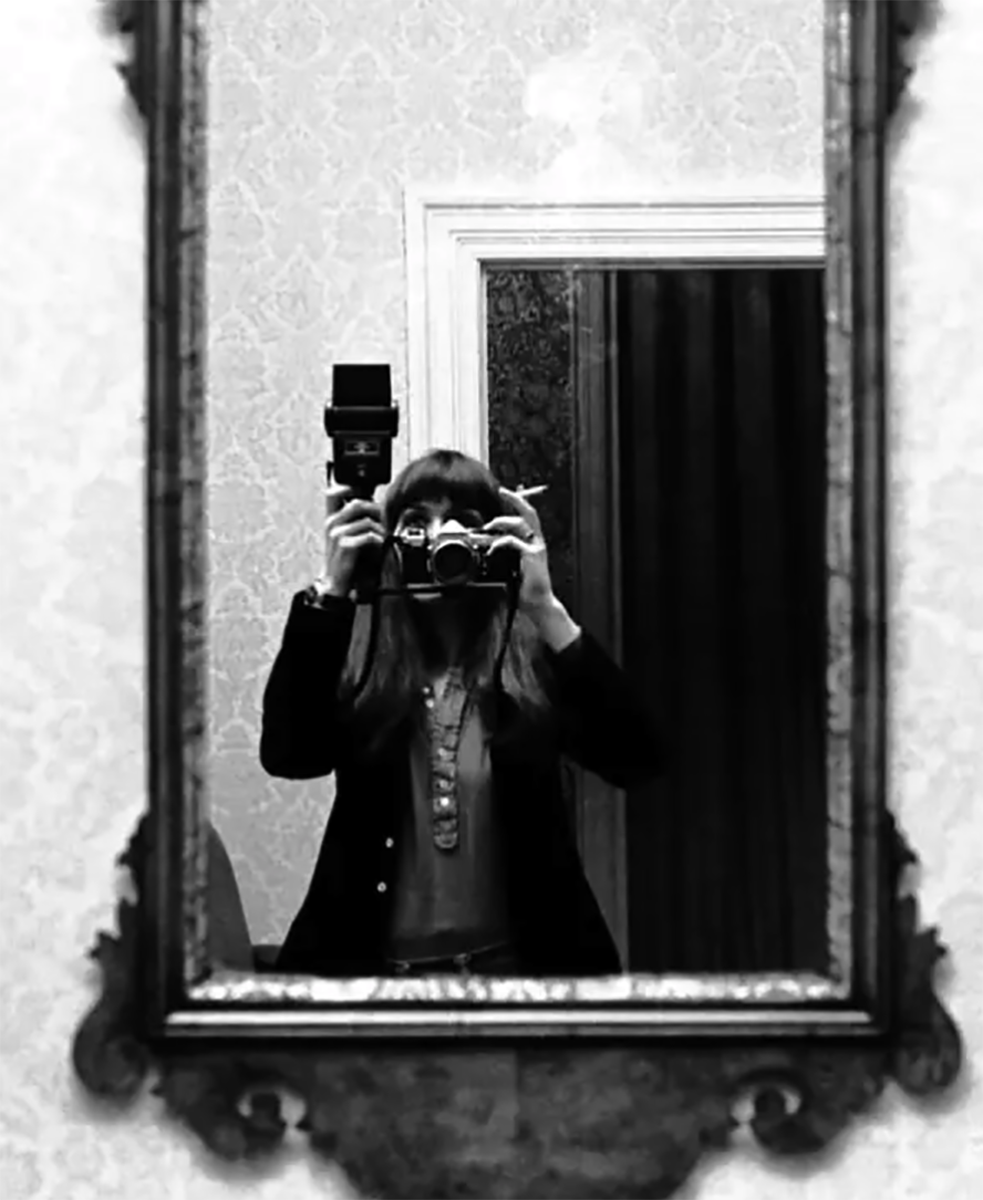
A great example of this was at a Tish Murtha exhibition where the camera used to make the images was included, alongside a note stating how photographer and her lecturer David Hurn supported the purchase of the camera. It expanded the narrative of the work, but it didn’t overwhelm the work. A recreation of 1970s Newcastle-Upon-Tyne was not needed to provide context. The work spoke for itself.
I may have rambled slightly in answering why we need photography exhibitions, but in doing so I’ve answered the question for myself. We need them to get closer to the photographer, through their work and often in person. In this sense it is a social interaction that a book, website or magazine cannot deliver. That is enough. There are many forms of presentation that can be used, just don’t feel your work needs to be supported by ‘stuff’. If it does, maybe it is not ready to be shown and that is a photo exhibition we don’t need.
Further Listening:
Dr.Grant Scott
After fifteen years art directing photography books and magazines such as Elle and Tatler, Scott began to work as a photographer for a number of advertising and editorial clients in 2000. Alongside his photographic career Scott has art directed numerous advertising campaigns, worked as a creative director at Sotheby’s, art directed foto8magazine, founded his own photographic gallery, edited Professional Photographer magazine and launched his own title for photographers and filmmakers Hungry Eye. He founded the United Nations of Photography in 2012, and is now a Senior Lecturer and Subject Co-ordinator: Photography at Oxford Brookes University, Oxford, and a BBC Radio contributor. Scott is the author of Professional Photography: The New Global Landscape Explained(Routledge 2014), The Essential Student Guide to Professional Photography (Routledge 2015), New Ways of Seeing: The Democratic Language of Photography (Routledge 2019), and What Does Photography Mean To You? (Bluecoat Press 2020). His photography has been published in At Home With The Makers of Style (Thames & Hudson 2006) and Crash Happy: A Night at The Bangers (Cafe Royal Books 2012). His film Do Not Bend: The Photographic Life of Bill Jay was premiered in 2018.
Image: Tish Murtha (Self Portrait). © Ella Murtha
© Grant Scott 2026
Leave a Reply