
I will put my cards on the table from the beginning. I have no time for Donald Trump. I consider him to be one of the most dangerous people in power in the world today. His beliefs are not mine, his approach to life is not mine and his actions as the President of the United States of America are in my opinion unacceptable in every way. I hope I have made my position clear. I don’t like Trump. As a UK citizen I have no party allegiance in the US, therefore my view of Trump is based on him as a person, businessman and President, not on party politics lines.
And yet, I cannot escape his career progression through photography. I first came across him on the cover of the brilliant Spy magazine in April 1988. In a non-digital age the image below could be created in camera and anyone willing to behave in such a manner would have to show a sense of humour and a willingness to laugh at themselves. If you were someone with a rampant desire to do anything for publicity you may also agree. The alternative was a ‘comp’ made with knives and glue. I think we know which of these fuelled this photo shoot and legendary cover. Deborah Feingold photographed the body and Joe McNally photographed the head.

Photography has an incredible power to act as an indicator of ‘unseen reality’ with the benefit of hindsight. Trump loved being photographed in the 1980s, 90s and 00s by multiple photographers. Most seem to be directed by him as to where and how he would be photographed. Showing off his gold apartment, in his gold tower, with its gold staircase or the view of Manhattan from his office windows. However, for me it is the faux presidential demeanor in so many of the portraits, along with his wife Ivana’s varied gold dresses that point at a more controlling and ambitious truth. Using the medium to present a presidential image of himself, even when he was going bankcrupt and spending money he didn’t have. Through photography he could promote himself as the person he thought he was and wanted to be. On the whole the photographers obliged.


Portraits of Trump fall into two main categories. The home portrait and the conceptual portrait, both aiming to promote the same sense of his self-perceived power, but both show an incredible lack of personal awareness.
The conceptual portrait is invariably controlled and conceived by the photographer and/or publication. It often takes time and money to set up, and has to be ‘sold’ to the person being photographed. It is in this ‘selling’ of an idea to ensure compliance that the dual nature of any concept may need to be concealed. The subject may be told one thing, but the viewer of the finished image may be able to read subtle or not so subtle narratives that were not part of the original pitch. A rampant desire for publicity can often blind the subject, in this case Donald Trump, to such dangers.Appealing to a person’s ego is a simple way to achieve such images. Look at the following images and see what you think. Did he understand how he would look? Or how he was told he would look?


Photography can be an essential food stuff for the narcissist. It can reinforce feelings of control, success and importance, but it can also reveal who someone is, not just what they look like, or wht they were wearing. Often the suject of the portrait reveals their true self, without being aware of the revelation they have just delivered. A review of the images of Trump over the past five decades evidences his insatiable appetite for photography as a vehicle to be seen, but does he know how he is being seen? I can’t post them all here, but Google is your friend if you wish to do your own research.
I previously stated that there are two specific categories of approach to the Trump portrait, but there is a third, one which he cannot control. However, hard, he might try. That category is news photography and it is this that upsets him the most.
Whether these are images of him with Jeffrey Epstein, or unflattering images that reflect a man who is ageing, Trump’s inability to control their making and distribution goes to the root of his relationship with the photographic image and the context in which it is read. The cover of Time, or a story in Vanity Fair or The New York Times magazine work for him. They suggest success and wealth. Acceptance by the intellectual elite. News images can appear anywhere and be edited by those who hate Trump, or perhaps less often those who love him. Flattering lighting, stylists and post-production improvement are not the considerations of the photo journalist. I should add that they were also not a consideration for Christopher Anderson in making his White House portraits earlier this year (https://unitednationsofphotography.com/2025/12/19/is-this-photojournalism-no-its-portrait-photography-at-its-best/).
We have all become familiar with the term ‘Fake News’ since Trump came to office in 2016, but ‘Fake News’ in photography is harder to claim or prove. Multiple cameras and angles quickly dispell claims of photoshop use to create unflattering images. It is interesting that he has turned to AI to create images of himself to post on his Truth Social platform. If you can’t control the images of yourself, why not make your own seems to be the clear message. Or perhaps steal the images and profit from them. The New York Times reported that, Trump blocked his own White House photographer, Shealah Craighead’s plan to publish a book of her images, created of her time photographing him (images that are all in the public domain). He then made up to $20m from publishing the same images in his own memoir. You cannot deny that Trump knows the value of the photographic image.
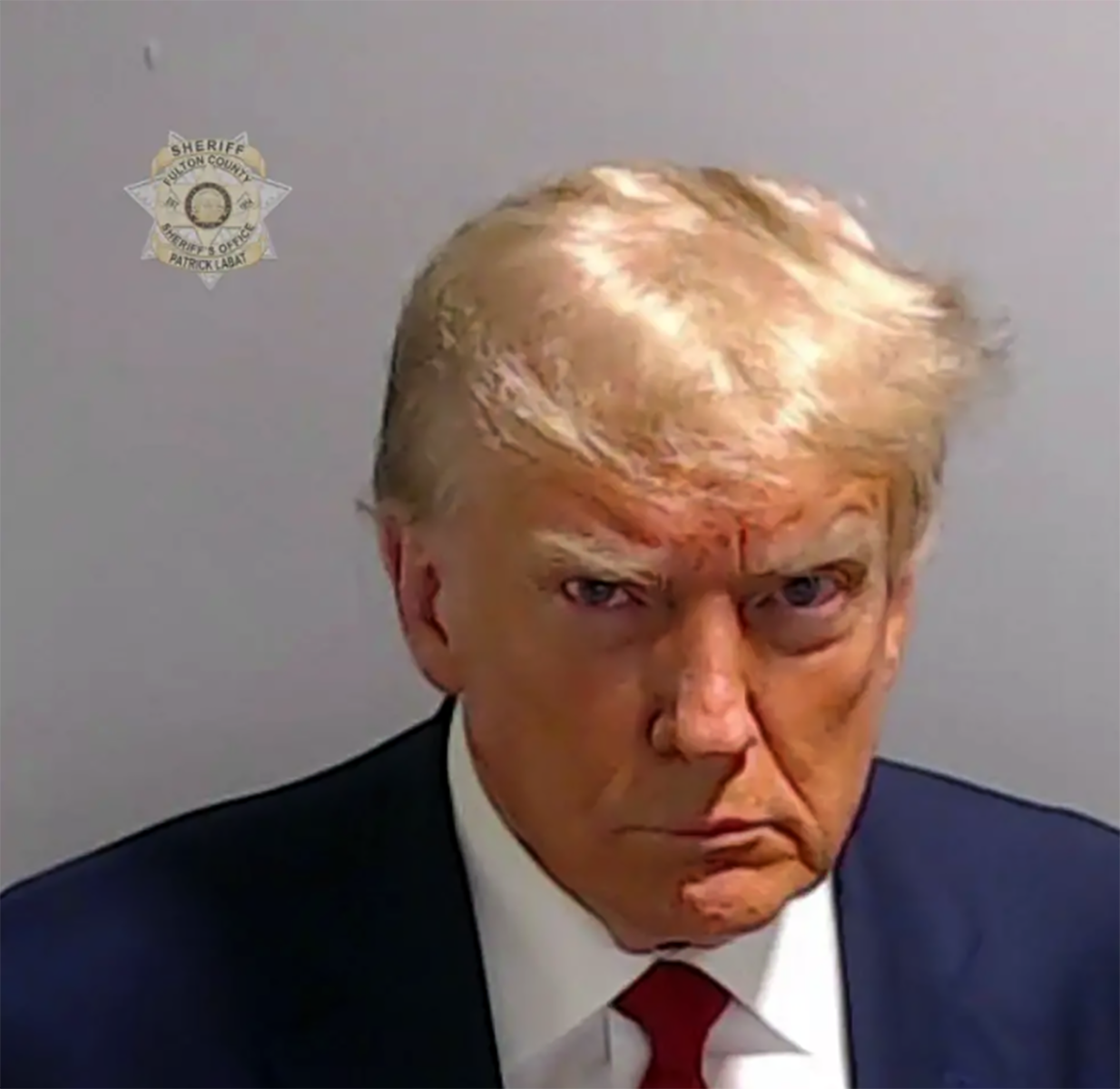
The photographs of Trump with Epstein at parties with girls and young women, from the past, may well finally catch up with him as evidence within a court of law, but there are two defining photographs that have been equally newsworthy that he seems to like the most. These two images have been used by him to define his belief, that he is a warrior and a fighter, despite his personal history showing an opposite reality. Neither of which he could control or have predicted. However, they are perhaps the two most important photographs of Trump that we have so far. The first is of the attempted shooting on July 13, 2024, at an open-air campaign rally at the Butler Farm Show Grounds in Meridian, Pennsylvania by 20-year-old Thomas Crooks. The second was taken on August 24, 2023, at the Fulton County Jail in Atlanta, Georgia. After he was indicted on racketeering and related charges.


Gone is the tycoon swagger, and golden backgrounds. Instead we have an angry man, with eyes filled with hate staring at the sky and the police photographer. He is proud of both of these images and they have been used on everything from a commerative coin to a mug, from a t-shirt to a painting in the White House. After all these years he is still using the power of photography to convey his message. It’s just that the nature of the message has changed. Who nows what is to come. I think that we can be sure that more iconic images are going to be captured by photographers whose role is to define and record Trump’s presidency for future generations. Whilst listening to the Inside Trump’s Head podcast I heard writer and Trump historian Michael Wolff state that Trump’s favourite photographer was New York Times photographer Doug Mills. Mills has covered the White House since 1983. He has won three Pulitzer Prizes for his work including for his images of the attempted assasination of Trump. Perhaps this is what appeals to Trump. Perhaps he hopes that Mills will supply him with further images that can be used to further his destiny. One thing is for sure, Donald Trump will not stop seeing the importance of photography as a promotional tool. He will not stop creating and manipulating tableaus in which he is the hero. That is until he is no longer able to do so.
Dr.Grant Scott
After fifteen years art directing photography books and magazines such as Elle and Tatler, Scott began to work as a photographer for a number of advertising and editorial clients in 2000. Alongside his photographic career Scott has art directed numerous advertising campaigns, worked as a creative director at Sotheby’s, art directed foto8 magazine, founded his own photographic gallery, edited Professional Photographer magazine and launched his own title for photographers and filmmakers Hungry Eye. He founded the United Nations of Photography in 2012, and is now a Senior Lecturer and Subject Co-ordinator: Photography at Oxford Brookes University, Oxford, and a BBC Radio contributor. Scott is the author of Professional Photography: The New Global Landscape Explained(Routledge 2014), The Essential Student Guide to Professional Photography (Routledge 2015), New Ways of Seeing: The Democratic Language of Photography (Routledge 2019), and What Does Photography Mean To You? (Bluecoat Press 2020). His photography has been published in At Home With The Makers of Style (Thames & Hudson 2006) and Crash Happy: A Night at The Bangers (Cafe Royal Books 2012). His film Do Not Bend: The Photographic Life of Bill Jay was premiered in 2018. Scott continues to work as a photographer, writer and filmmaker and is the Subject Coordinator for both undergraduate and post graduate study of photography at Oxford Brookes University, Oxford, England.
© Grant Scott 2026
Leave a Reply