
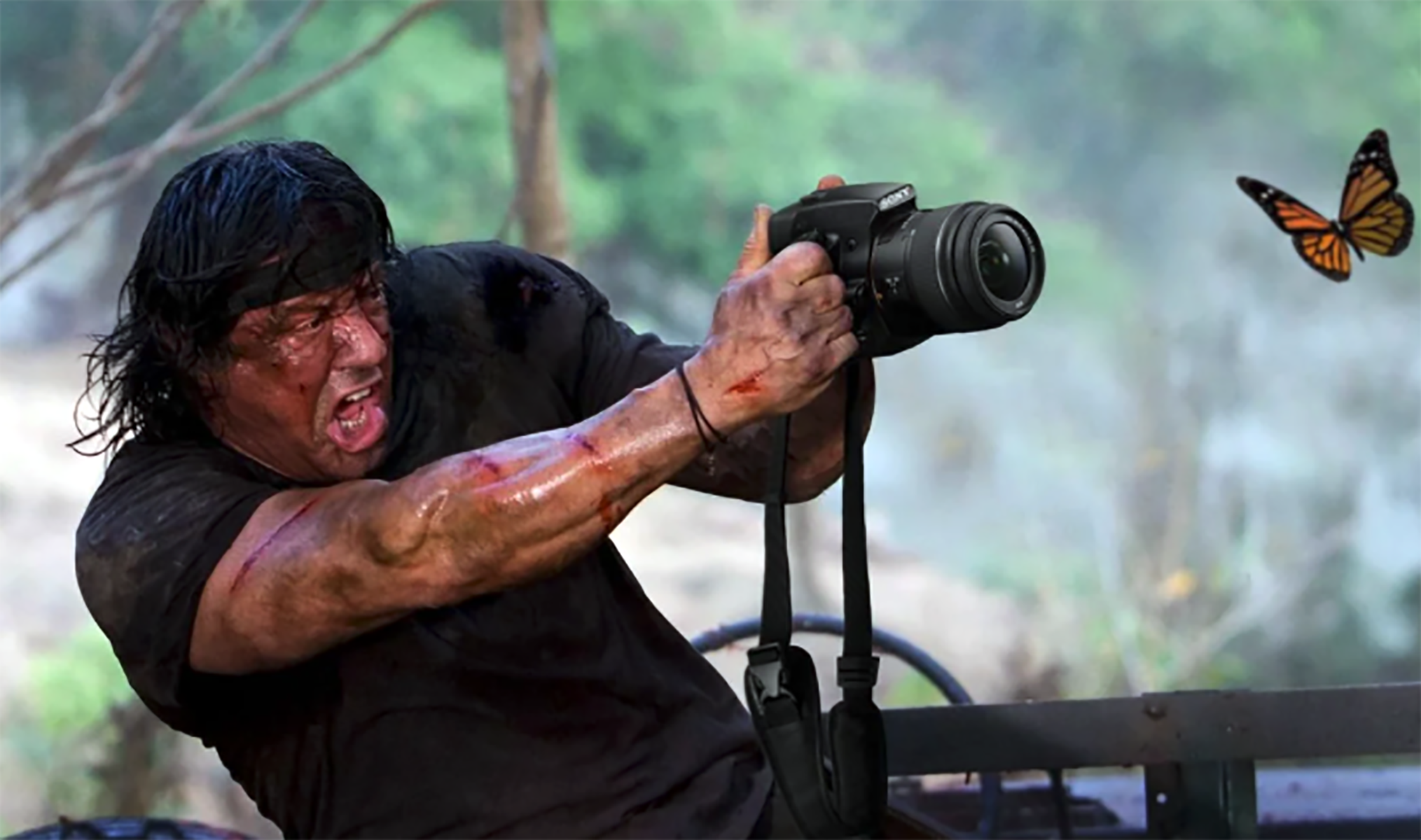
There is a common trait amongst content creators on YouTube, with motoring channels. It goes something like this. Buy the cheapest version of a car, that you may not expect would be cheap, the worst condition the better, get it working and then get a supplier to give you lots of parts for free to ‘pimp’ the ride or at the least get an MOT. There are travel Youtubers who take a similar approach, by taking the worst coach, train or plane routes across the world, that cost the least and then report how bad they are. Some food review Youtubers visit takeaways and restaurants with the lowest hygiene ratings and the worst reviews, to create content. This is all content creation based on going to the extreme to create entertainment.
Photography is not adverse to such an approach. Buying cheap and forgotten cameras (the cheaper the better) and proclaiming them to be lost gems, creating street portraits in dangerous areas of a city and travelling to extreme climates and environments to make images, are all grist to the mill for photography YouTubers. The chase for likes and subscribers, often leads to increasingly more extreme and desperate solutions. In the words of the old newspaper adage, ‘if it bleeds, it leads’. The issue with this is that although it can be entertaining, it is unsustainable. When the content beast needs to be fed, and it is a hungry beast, all sense of reason and ethics can go out of the window. I use the rise and fall of the Jerry Springer show as an example of what happens in such a situation.
Here are a few recent hyperbole driven, photography Youtube thumbnail headlines at random, ‘How To Take Banger Photos In Boring Places’, ‘My Street Photos Sucked… Until I Learned This’, ‘In 11 Minutes I’ll Improve Your Photography Composition by 111%’, ‘This Is the Greatest Digital Camera Ever Made’, ‘The most important PHOTOGRAPHY SKILL that nobody teaches’, ‘Photography from $100 to $10000’, ‘The Photography Rule That’s Killing Your Best Images‘, ‘I Committed Photography’s Biggest Sin… (And I’m Not Sorry)’. This list could have gone on forever, but you get the picture, literally!
Most of these photographers channels are sponsored by Squarespace or MPB, many are very popular and I understand the importance of a ‘catchy’ headline to gain listener or reader attention. I do it myself, it’s a skill I learnt producing magazines and working on newspapers. The issue for me though, is how photography and the process of learning photography is being presented. I have no problem with dispute resolution, when handled by experienced professional people, who are able to listen and proffer informed advice. However, the intensity of a self-fulfilling bear pit, such as the Springer show, does nothing for me or the people involved. Nobody learns anything, despite the audiences braying for more.
The photography channels are far from the Springer show, but they are part of the same broadcast world. Both need an audience to survive and drive advertising revenue. The problem for photography content creators who are focused on cameras and/or teaching photography is that both are a shallow well, that soon runs dry. Camera reviews are reliant on new launches, which occur only a few times a year at best, there are only so many old cameras worth mentioning and the basics of photography are simple. The result? Desperation to make two films a week and extreme actions take hold. Just as Top Gear and The Grand Tour featured cars, the more extreme the adventures became, the less of a car show they were.
Therefore, the advice, suggestions and examples become ever more unrealistic and unachievable. Presenting photography as a lens-based version of the television programme Ninja Warrior or It’s a Knock Out is not photography. It does not require additional physical challenges outside of pressing a button to make images. They may come as part of the stories being made, but that is different. That is part of the process, not the process itself.
I am all for photography being entertaining for both the participant and the viewer. However, when it is consumed by concept and conceits it is diverted from its true power. Photography should not be based upon or require extremes to be made, it needs an understanding of the personal. Unfortunately, for the majority of content creators, that doesn’t make very engaging shorts and films. So, do not be misled by the hype, focus on the photography, it may be quieter and more serious, but it will be far more rewarding. The race to the extreme inevitably leads to burn out or worse.
Dr.Grant Scott
After fifteen years art directing photography books and magazines such as Elle and Tatler, Scott began to work as a photographer for a number of advertising and editorial clients in 2000. Alongside his photographic career Scott has art directed numerous advertising campaigns, worked as a creative director at Sotheby’s, art directed foto8 magazine, founded his own photographic gallery, edited Professional Photographer magazine and launched his own title for photographers and filmmakers Hungry Eye. He founded the United Nations of Photography in 2012, and is now a Senior Lecturer and Subject Co-ordinator: Photography at Oxford Brookes University, Oxford, and a BBC Radio contributor. Scott is the author of Professional Photography: The New Global Landscape Explained (Routledge 2014), The Essential Student Guide to Professional Photography (Routledge 2015), New Ways of Seeing: The Democratic Language of Photography (Routledge 2019), What Does Photography Mean To You? (Bluecoat Press 2020) and Inside Vogue House: One building, seven magazines, sixty years of stories, (Orphans Publishing 2024). His photography has been published in At Home With The Makers of Style (Thames & Hudson 2006) and Crash Happy: A Night at The Bangers (Cafe Royal Books 2012). His film Do Not Bend: The Photographic Life of Bill Jay was premiered in 2018.
© Grant Scott 2026
Leave a Reply