
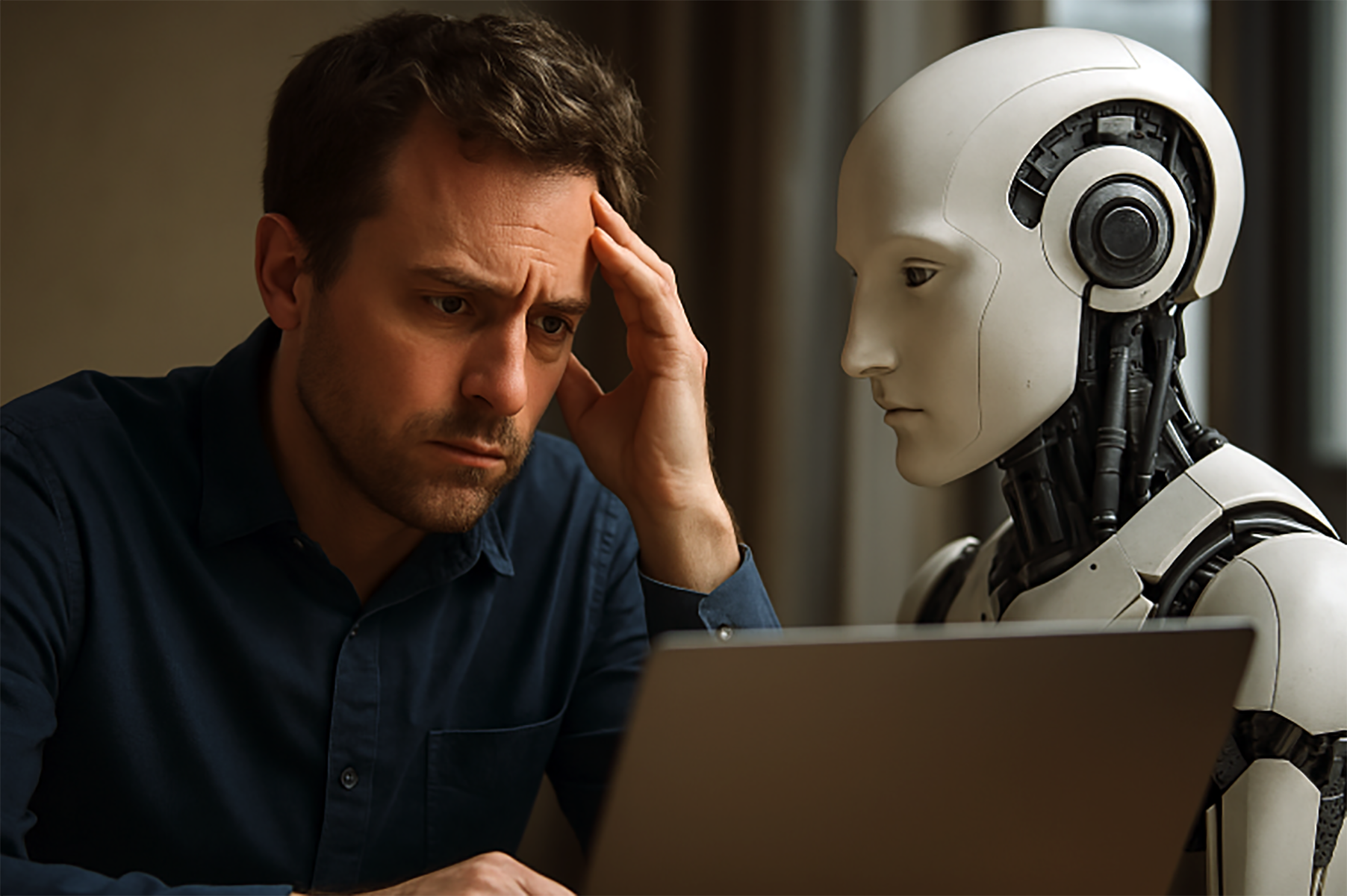
I was asked recently what scared me about AI, in a workshop, hosted to discuss how it impacts on learning. I replied with one word, nothing! My response was directly related to photography and it is on that basis that this article is written. I am not scared, because I understand the importance of the ‘personal’ in creativity. AI is a replicator, it is not an instigator. It can replicate the personal, but it can never be a person. It does not have the unique life experience, empathy or ability to respond from a place of original thinking.
My wife works with her friend Claude, to remove tedious writing tasks from her daily workload. She refers to him as ‘he’ rather than ‘it’, but he is not a real friend. She speaks of her relationship with him and how she has to mark his homework. In effect she is training her friend, to be what she wants him to be. To do what she wants him to do. I have suggested to her, that this is not a very healthy relationship. She is teaching her friend, but her friend is not a great student. He often tries to do what he wants, he ignores her teaching and her suggestions. Without my wife checking his work, Claude fails. Claude needs my wife, to do his job.
She is not scared of her friend Claude, as she knows, that she is his boss. Her employer’s know this as well. Claude aids efficency, but he doesn’t replace a writer. My wife provides the personel, that he cannot. Claude does not exist in the real world, he lives in the world of code.
We are all using AI when we make an image with our smartphone and in our post-production. Whether we are aware of this, or like this, is of no importance, it is what’s happening. AI is here and we can’t fight that fact. Of course we can remove ourselves from the digital world, but that is a strong stance to take against technological evolution. I can understand why some people would wish to do this from a social, political, economical or ecological perspective, but actually doing it completely, is a tough life commitment, that few are able to make.
I am not a proponent of AI image making, so please do not see my stance as a willingness to reject ‘serious’ photography for digital collage. However, I can see how it will be used by photographers. Research for projects is an obvious starting point, help with writing is another. Post-production is an obvious AI reality for most photographers, as is in-camera software image manipulation. I am not talking about how AI will impact on the world of professional photography here, (I have spoken at length about this previously, which you can read or hear via the links below). I am talking about all photography, created by all photographers, from beginner, to enthusiast, to professional.
Such uses should, in my opinion, be seen as positives, not negatives. Certainly nothing to be scared of. The issue from my perspective is a lack of knowledge and context. In my opinion, photographers have literally focused on the wrong impact of AI on photography. Too much concern has been placed upon the image and the creation of fake imagery. This is a concern, but should not be the central concern. Photography will always be based on the personal, in experience and observation, in creating an image. Not the creation of a final image, without substance or context, a photograph for the sake of a photograph. AI based artists will emerge, but my belief is that they will define themselves as such, rather than as photographers. Photography will exist, and use AI, but not be dominated by the opportunities it offers.
That is my opinion and I may be wrong. Only time will tell, but in the present it seems to make sense to me. It may make sense to you also and if it does, I hope that it soothes any fears you may have. I know that many commentators and experts disagree with me, but then again do you remember the fear surrounding the Millenium Bug? If you don’t Google it and if you do, you know where I am coming from!
Further Reading/Listening
https://unitednationsofphotography.com/2025/08/31/ai-needs-photographers-creatives-more-than-photographers-need-ai/
https://unitednationsofphotography.com/2026/04/19/photography-connection-and-avoiding-the-fakery/
https://unitednationsofphotography.com/2023/12/27/podcast-a-photographic-life-episode-plus-3/
https://unitednationsofphotography.com/2023/05/15/is-ai-the-end-of-stock-photography/
Dr.Grant Scott
After fifteen years art directing photography books and magazines such as Elle and Tatler, Scott began to work as a photographer for a number of advertising and editorial clients in 2000. Alongside his photographic career Scott has art directed numerous advertising campaigns, worked as a creative director at Sotheby’s, art directed foto8 magazine, founded his own photographic gallery, edited Professional Photographer magazine and launched his own title for photographers and filmmakers Hungry Eye. He founded the United Nations of Photography in 2012, and is now a Senior Lecturer and Subject Co-ordinator: Photography at Oxford Brookes University, Oxford, and a BBC Radio contributor. Scott is the author of Professional Photography: The New Global Landscape Explained (Routledge 2014), The Essential Student Guide to Professional Photography (Routledge 2015), New Ways of Seeing: The Democratic Language of Photography (Routledge 2019), What Does Photography Mean To You? (Bluecoat Press 2020) and Inside Vogue House: One building, seven magazines, sixty years of stories, (Orphans Publishing 2024). His photography has been published in At Home With The Makers of Style (Thames & Hudson 2006) and Crash Happy: A Night at The Bangers (Cafe Royal Books 2012). His film Do Not Bend: The Photographic Life of Bill Jay was premiered in 2018.
© Grant Scott 2026
Image: Created with ChatGPT 4o by James Presbitero Jr.
Leave a Reply