
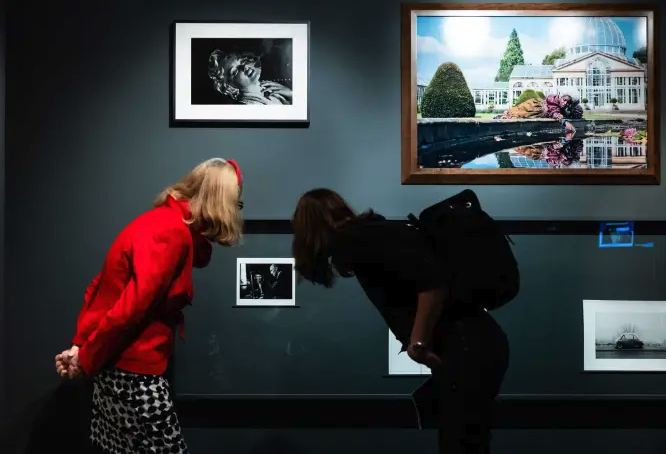
There is a reality to selling photographic prints that may be a hard pill to swallow. That is that your photograph will be part of an interior design scheme. The Gestalt theory suggests that the mind instinctively organises what it sees into a whole, looking for order and pattern. Let’s add to that the Cognitive Load theory, which says that we can take in only so much information at once. Too much detail overwhelms and distracts. Therfore if we are going to sell work we need to consider what type of work people want to live with, and the space in which it will live, the frame.
Frames matter because, photographs matter. They provide the image a space for a photograph live and breathe. Framing can help simplify, a busy, complicated image, possibly within a plain frame with a generous mount. A very simple picture can also benefit from a decorative frame. When it comes to framing, the lesson to be learnt is that the frame and the photograph must exist as one entity. A whole.
And yet, so often the frames chosen are generic and cheap. At worst with an acrylic version of glass. A simple box moulding in white, black, beech, ash, or oak. On a recent A Photographic Life podcast episode (https://unitednationsofphotography.com/2026/10/21/podcast-a-photographic-life-episode-451-fiona/) we discussed a photographer who uses old tuna and olive tins to frame his portrait work. That is definetly not generic, but is it going to far? I think so, but at least he is thinking more about the context in which his work was seen. The bigger question has to be, does such framing encourage or discourage purchases? After all the idea of selling prints, is to sell them.
I see many images for sale both online and in the physical world and the same question often comes to my mind. A question that came to sharp focus with the launch of the latest Magnum Photos print sale (https://store.magnumphotos.com/pages/square-print-sale) whch ended on the 1st November. The first of these sales, staged a few years ago, allowed people to buy a square print, at a set size, for a set fee. If memory serves me well it was $100. I may be wrong, but either way, Magnum photographers were invited to submit a print from their archive that reseponded to a theme. The images in that first sale were strong and varied. I bought one my self. Just a print, unframed. Not surprisingly it was of Bob Dylan. The most recent sale is titled Fact/Fiction. That is the theme.
This is what it says on the Magnum website, “Where is the line between documentation and storytelling? Fact/Fiction, the October Square Print Sale, brings together 75 images exploring the space between truth and imagination. Available as limited-edition, signed or estate-stamped prints, these photographs have the power to make documentation feel dreamlike and unlikely moments seem believable. From surprising narratives to mysterious illusions and reflections, the selection blurs the boundaries between how things appear and how they really are. For the first time, photographers and estates have been invited to offer their works in both 6×6″ and 9×9″ formats. The larger 9×9″ format is available for selected works, at the discretion of each photographer or estate.“
All of the prints are available framed or unframed, and you guessed it, the frames are generic white or black. The choice of a frame also puts the price of the print up considerably. Much higher, I would suggest than such a simple frame demands, but that is a discussion for another day! Not one of the prints will be sold in a frame that was part of the photographer’s vision for how the image should be seen and experienced. The framing is a centrally controlled, commercial decision. In addition, scrolling through the images, I got the feeling of a ‘fire sale”; of images being submitted to fit a theme, not to make a sale. I do not blame the photographers for this, as the theme seemed so open for interpretaion, that confusion as to what was required to me seems inevitable. However, it does raise the question, as to how much thought do photographers give to what kind of an image someone wants to put on their wall, to live with for many years.
Most people only put framed photographs in their homes if they are of family and friends. Or perhaps a hero from music, sport or film. Therefore, to persuade the general public to spend a considerable amout of money on a photograph, takes a considerable amount of work. Just referering to your photographs as ‘art’, getting a cheap print and a frame from Costco, Walmart or The Range is not going to fly.
The selling of prints for photographers today is an obvious potential revenue stream. It seems easy. Make some photographs, choose the ones you like, and put them up for sale, on your website. No need to understand the ‘dark art’ of limited editions, gallery politics or printing inks and archival papers. Pile them high and sell them cheap. Although, most are not cheap! Despite there cheap production. The reason for this is that the photographer has to meet their costs, including postage and customs taxes, and make a profit. A profit that is large enough to warrant the time and efforet put into the process of marketing and selling.
Just as in all retail enterprises, the Holy Grail is a product that appeals to the masses, or at least to enough people to create a business. A print is that, a product! You may want to call it art, but like all art in the art market, it is a product looking for a buyer. It is up to you how saleable you want that photograph to be. A photograph may mean a lot to you, but your emotional attachment dosen’t make it a desired commodity. If you are not selling, then by all means ignore the idea of an audience. However, if you want to sell your work, you need an audience. A customer base. You need to offer them something that they want to own, and that includes the frame, the image and the service you provide in understanding their wants and needs. Let’s be clear and honest, selling photography requires a commercial transaction to take place. That may not sit well with the way in which you make and see your work, but that is the reality. Your choice is wherever or not you want to accept the truth. Put in the hard yards in printing, framing and selling and recognise that what you like may not sell.
Further Reading:
Dr.Grant Scott
After fifteen years art directing photography books and magazines such as Elle and Tatler, Scott began to work as a photographer for a number of advertising and editorial clients in 2000. Alongside his photographic career Scott has art directed numerous advertising campaigns, worked as a creative director at Sotheby’s, art directed foto8magazine, founded his own photographic gallery, edited Professional Photographer magazine and launched his own title for photographers and filmmakers Hungry Eye. He founded the United Nations of Photography in 2012, and is now a Senior Lecturer and Subject Co-ordinator: Photography at Oxford Brookes University, Oxford, and a BBC Radio contributor. Scott is the author of Professional Photography: The New Global Landscape Explained(Routledge 2014), The Essential Student Guide to Professional Photography (Routledge 2015), New Ways of Seeing: The Democratic Language of Photography (Routledge 2019), and What Does Photography Mean To You? (Bluecoat Press 2020). His photography has been published in At Home With The Makers of Style(Thames & Hudson 2006) and Crash Happy: A Night at The Bangers(Cafe Royal Books 2012). His film Do Not Bend: The Photographic Life of Bill Jay was premiered in 2018.
© Grant Scott 2026
Leave a Reply