
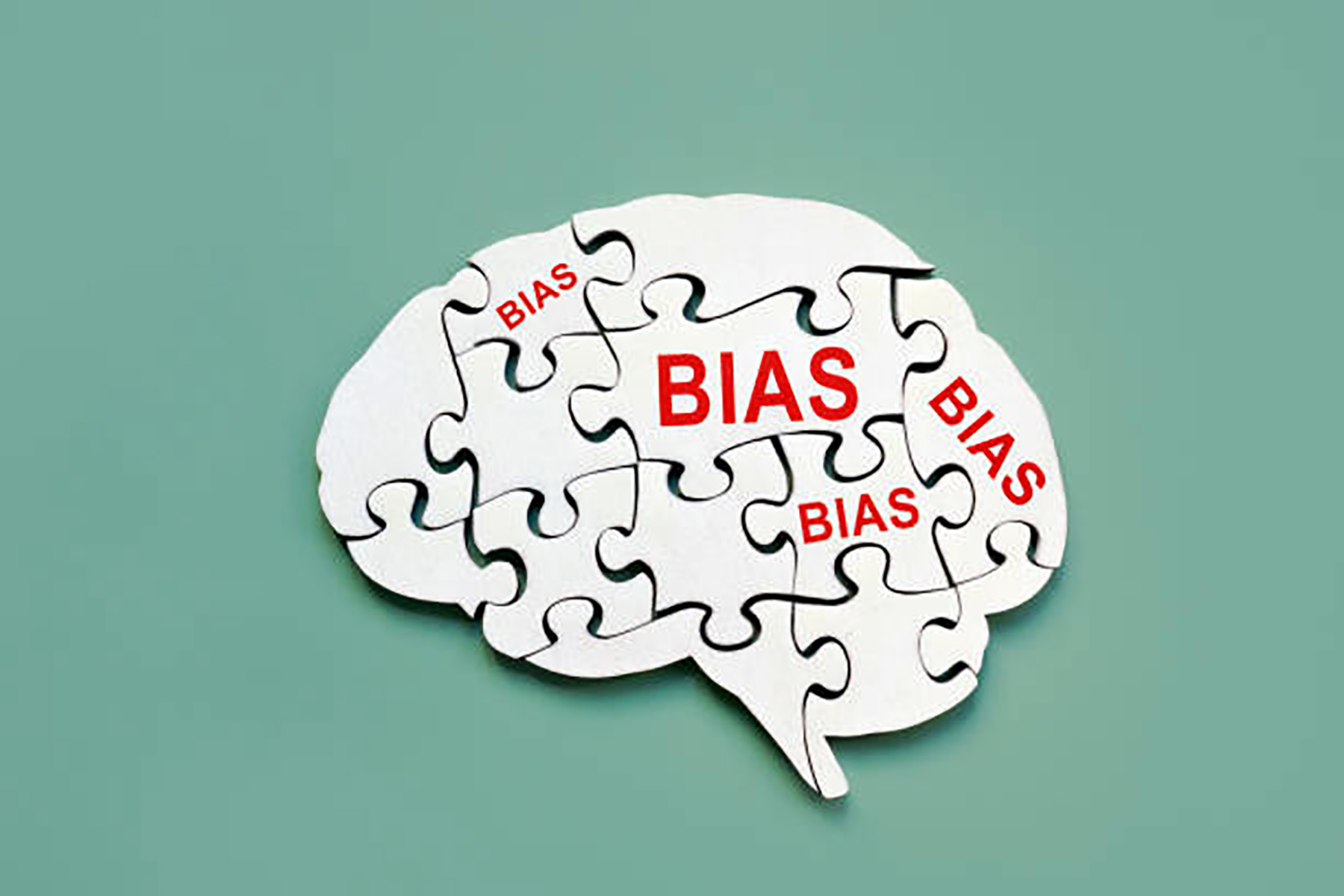
Unconscious bias is when you’re subconsciously drawn to what you’re used to, without thinking about your choice. A decision made within your comfort zone. Conscious bias is a decision made that aligns with personal beliefs and attitudes, made with clear intent. I suggest, that at different times in our lives, we all engage with both approaches. That is normal. That is life.
A simple metaphor for understanding how our minds work is to think of them as a series of pockets of information, in which we place every experience we have. However, this process of mental orginisation does create a problem. It means that we make choices in the present moment, that are actually based on the past. This past can shape our biases towards certain people, places and situations in a negative, or positive way. However, it is the context in which we adopt one or the other biases, that is important.
Alongside this metaphor of pockets, that may create biases, it is useful to consider ways in which our behaviours, attitudes and biases can be generated and upheld. Social, cultural and institutional factors can shape and support our ways of seeing and behaving in the world. We can be socialised to play certain roles with attitudes, behaviours and outcomes being influenced by an unequal distribution of power and by a personal and collective reluctance to break our developed cycles.
If you have ever been interviewed for a job, or been an interviewer, you will be well aware of the potential issues that bias can create. Objectivity is essential in such a situation, where decisions must be made based on facts. Unconscious bias could lead to excluding people without good reason, and conscious bias could lead to a similarly unfair process of recruitment. Now, we’ve addressed the facts concerning bias in decision making, let’s talk about photography competitions. In a sense, a ‘pay to enter’ interview. A process of choosing.
I have written previously concerning the importance of researching the judges, on any judging panel, connected with a photography competition (link below). The reason for this is to avoid dissapoinment. The dissapointment of investing in something that may not give you a return on your investment and as a result create a negative feeling of rejection. The truth is that the people on any judging panel, will inform the type of work chosen. That may seem obvious, but some panels are less open to a variety of work than you may hope. You and others, may argue that this is not the case, but to those who do, I suggest they research the judges and winners of a few competitions. That will be all of the proof you need. A judging panel of curators and artist photographers, inevitably choose work they like or that is part of their world. A panel of advertising photographers are inevitably going to do the same and lean towards work similar to ther own experience of photography. You can add your own categories to these examples. These are all process’s of conscious and unconscious bias. In an interview situation this aims to be avoided through objectivity, but in a photography competition everything is subjective.
In an interview, a set of people interviewing, will often be given a set of questions, which they will all agree upon. The same person will ask the same question of each applicant. The questions will also be asked in the same order. This is done to avoid any perception of favouritism or impropriety. A consistency of message, hoping to create a fair and equable playing field. I have been the interviewer and interviewee in this process and although it can be perceived as being dry and overly formal, it is good to know that a strict process is being used, to attempt to remove bias. I have even been sent questions days in advance of an interview, to ensure that the interview process is as conversational as possible and without any nasty shocks.
This is not the case with photography competitions, where no such structures or formats exist. Instead, each judge brings their own views and hopefully, through informal conversation, a compromise/decision is reached. In my experience, this is not always a satisfactory process, as too often the loudest voice or voices win. Not neccersarily the most informed, or open-minded. It can also be the case that one judge may be coming from a different perspective from the rest and therefore have their opinions dismissed. I have been on panels where both of these situations occur.
Over recent years, judging panels have become more diverse, and that is a good thing, but diversification does not remove bias. It may alter the direction of certain biases, but it is human nature to bring personal experience into decision making, whatever that lived experience may be. A strong leader of a panel may act as a referee, but they may also have their own sense of bias. It is inavoidable within a situation of creative decision making.
Too often judging panels are chosen not for the excellence of the judges objective veiwpoint, but to make the holders of the competition ‘look good’. I am not saying that this is always the case, but it does happen. This can take many forms, but big names in the photo industry inevitably brings weight and kudos to any competition. They also bring entries and therefore revenue, as photographers hope to have their work seen and perhaps chosen by their photographic heroes. With the proliferation of photographers on social media, proudly proclaiming their involvment in judging, I also wonder how many are picked for the size of their social media following and the resultant free promotion the competition expects to receive. Maybe, I am being a little cynical here, but that was certainly the case when competitions chose magazines to be their ‘media partners’.
My answer to the question at the top of this article is yes! Of course it does, and that is okay. It would be disingenous, to say that it doesn’t. Just as it would be dishonest to say that bias did not exist in life. The important factor is to accept that reality in life and that it will inevitably exist within the judging of a photography competition. The judge who is completely without bias is a rare beast indeed. As Sybil suggested concerning a happy guest in an episode of Fawlty Towers, “perhaps we should have him stuffed and mounted on the wall!” So, if you want to enter a photography competition, and have the funds to do so, bear this in mind. If you have work you think the judges will like based on their own work and tastes, by all means enter. If you don’t, my suggestion is to keep your money firmly in your pocket. I am not biased against photography competitions. I have judged many, set up a few and even succeded in being a finalist in two. However, I do question their processs, importance and relevance to photography. As a writer on photography, a podcaster and photographer, that seems to me to be the right thing to do.
Dr.Grant Scott
After fifteen years art directing photography books and magazines such as Elle and Tatler, Scott began to work as a photographer for a number of advertising and editorial clients in 2000. Alongside his photographic career Scott has art directed numerous advertising campaigns, worked as a creative director at Sotheby’s, art directed foto8 magazine, founded his own photographic gallery, edited Professional Photographer magazine and launched his own title for photographers and filmmakers Hungry Eye. He founded the United Nations of Photography in 2012, and is now a Senior Lecturer and Subject Co-ordinator: Photography at Oxford Brookes University, Oxford, and a BBC Radio contributor. Scott is the author of Professional Photography: The New Global Landscape Explained (Routledge 2014), The Essential Student Guide to Professional Photography (Routledge 2015), New Ways of Seeing: The Democratic Language of Photography (Routledge 2019), What Does Photography Mean To You? (Bluecoat Press 2020) and Inside Vogue House: One building, seven magazines, sixty years of stories, (Orphans Publishing 2024). His photography has been published in At Home With The Makers of Style (Thames & Hudson 2006) and Crash Happy: A Night at The Bangers (Cafe Royal Books 2012). His film Do Not Bend: The Photographic Life of Bill Jay was premiered in 2018.
© Grant Scott 2026
Leave a Reply