
I regularly post on Threads. Usually a link to an article on here, or to that week’s podcast. Occasionally, I might make a comment, but not nearly as often as I used to on ‘pre-Musk’ Twitter. That really did have a sense of community and I made some good friends there. Indulged in interesting, mutually respectful conversations and learnt ‘stuff’. On Threads the conversations do not seem to occur. I don’t know why, they just don’t. Therefore, I was taken aback recently by the level of hate and unpleasantness a post I made received.
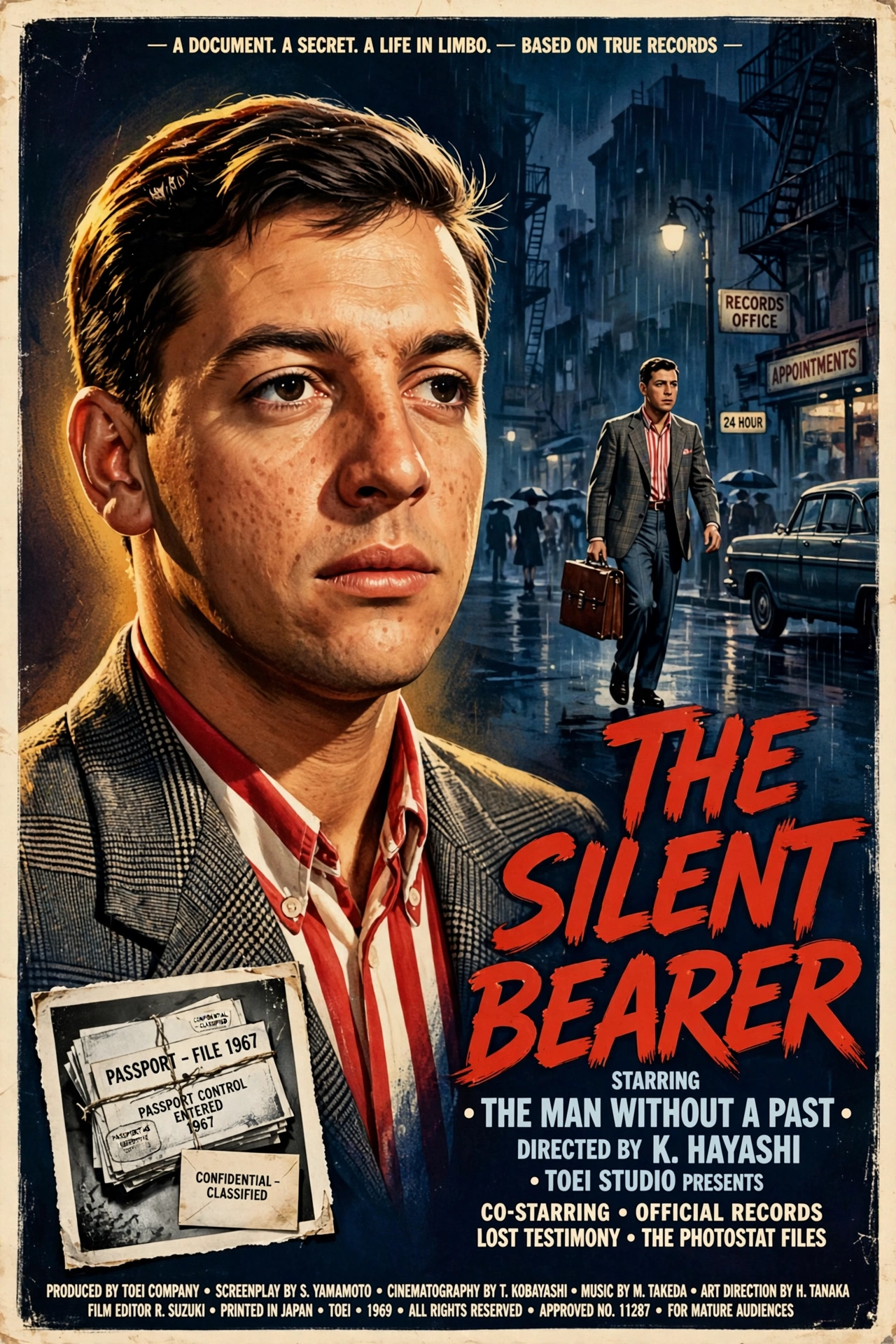
It was a simple post, that showed an AI created film poster, that I had made, with an image I had lying around on my desktop, of me as a teenager. It was actually my passport photo from when I was 18. Facebook offered me the opportunity to make a Japanese inspired film poster, referencing the 1960s and 70s with just one click and I was intrigued. What would the outcome be? How would this be done? And what would it look like?
I clicked the button and waited. Within a few minutes, the ‘AI Gods’ had turned my passport photograph into a multi-image poster, including text, narrative and credits, without any prompts from me. This is the poster:

Before you comment I was wearing that shirt and jacket combination in the original passport photograph. It was taken in 1987 after all. However, I was looking at the camera and now I was looking off-camera. Everything else, including the slighty non-sensical film title, was created for me, without any help or prompt. Having studied graphic design and created many posters in my time I was intrigued and impressed. Sure, it looked like an AI created image, but the ability to create such an image, in such a short period of time, to me points to an ‘interesting’ future for any graphic designer. Anyway, as I am in the process of exploring all areas of AI creation, I filed it in my mind bank of research. I should add that I am doing this to gain insight, not to adopt these processs. I never condemn anything I don’t try to understand.
I then decided to share this experiment with the Threads community through a post of the image and some short text. This explained that it was a test and that its useful to know what AI can do before commenting on it. The immediate wave of attacks on me, from people I did not know, came as a surprise. Evidently I was an arrogant moron. People wanted to know what I could possibly have learnt from such an experiment. That I had no taste and that what I had done was embarrassing. Only one commentator was positive.
Now, I know that none of this is unusual on social media. I have been on it since 2010 and I know the score. However, what surprised me was, that it was this post that caused so much hate and anger. It wasn’t controversial in anyway, in my mind, but obviously it was to others. This made me think. What was it that was so offensive? And of course the answer was there straight in front of me. It was AI.
I have been writing about computational photography for years with little interest from anybody. Any article I wrote was roundly ignored, but that didn’t stop me. I have always believed that it is important to be aware of change, to question it, interrogate it, if required, and try to understand how it will impact on me and the creative process I am involved in. I guess, this began in 1991 when I was given my first Apple Mac on which to design magazines. I put my scalpels and glue to one side and embraced the new world which was coming. I had no choice.
I feel the same about AI, but obviously others are scared and dismissive of what is coming, what is happening. If not, why would they be so angry? I am not saying that AI is a good thing, I’m as sceptical as the next man or woman. I don’t like the hyper- realism that seems to be its dominant aesthetic. I don’t agree with it from an ethical perspective. I don’t like the social economic impact it is having and may have in the future. However, I don’t shout at people and abuse them for engaging with it. I believe in the concept of knowing your enemy.
Of course AI may not be my enemy. I have recently written on how my wife works with Claude on a daily basis and how it has become part of her writing workflow. It may have to become part of mine, I don’t know. Just as the Apple Mac did, and digital photography has done. The same may be true for the hate club members on Threads.
This past Summer I have spoken with people about AI who refuse to use it. Who do everything they can to avoid it. I do not pass judgement on them, but I am surprised by such a stance, when they are often using it in their daily lives without knowing, and this is the problem for the deniers and haters. AI is here and it is not going away soon. If we can accept that fact, I see only benefits in exploring its capabilities. By doing so I am learning and that is not something I ever want to stop. I might not like what I learn, but isn’t that the way with so much learning?
Dr.Grant Scott
After fifteen years art directing photography books and magazines such as Elle and Tatler, Scott began to work as a photographer for a number of advertising and editorial clients in 2000. Alongside his photographic career Scott has art directed numerous advertising campaigns, worked as a creative director at Sotheby’s, art directed foto8 magazine, founded his own photographic gallery, edited Professional Photographer magazine and launched his own title for photographers and filmmakers Hungry Eye. He founded the United Nations of Photography in 2012, and is now a Senior Lecturer and Subject Co-ordinator: Photography at Oxford Brookes University, Oxford, and a BBC Radio contributor. Scott is the author of Professional Photography: The New Global Landscape Explained (Routledge 2014), The Essential Student Guide to Professional Photography (Routledge 2015), New Ways of Seeing: The Democratic Language of Photography (Routledge 2019), What Does Photography Mean To You? (Bluecoat Press 2020) and Inside Vogue House: One building, seven magazines, sixty years of stories, (Orphans Publishing 2024). His photography has been published in At Home With The Makers of Style (Thames & Hudson 2006) and Crash Happy: A Night at The Bangers (Cafe Royal Books 2012). His film Do Not Bend: The Photographic Life of Bill Jay was premiered in 2018.
© Grant Scott 2026


Leave a Reply