
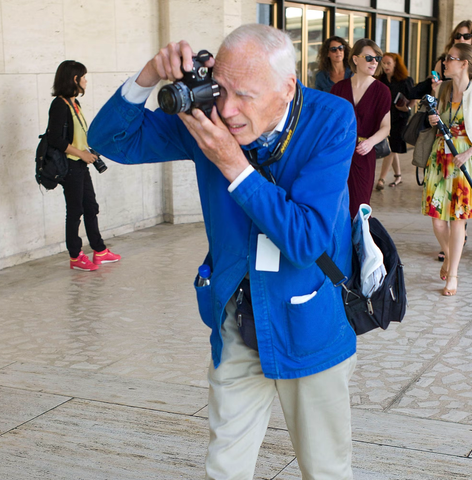
This is not a scientific argument, it is a personal one, based on personal experience. Every person I know who is older than 75, that is still of sound mind, and body, never gave up. What they never gave up on was being intellectually inquisitive. A desire to exercise the mind and to never stop learning. They have also retained communication with those from generations much younger than themselves.
I personally know people in their 70s, 80s and 90s who are fully engaged with politics, who continue to play tennis, attend book clubs, are members of walking clubs, who garden and of course make photographs. It is the latter pursuit that combines all of the elements required, to remain young and active in my opinion.
The intellectual inquisitiveness of research. The physical exercise involved in making the photographs and the social interaction involved in making and showing work. It really is the perfect triumvirate of activity. Yet, it is common for me to hear older photographers explain how they have fallen ‘out of love’ with the medium.
As we age, it is natural that we become tired of the processes we have repeatedly undertaken, as well as physically tired. In my opinion it is essential to remain relevant and active, despite the creeping years. Photography can solve these issues. Or at least go some way to alleviate them. Of course, I accept that serious illness is a hurdle we may all have to face and one that cannot be overcome by pressing a button on a box with a lens, but even illness can be addressed with a more positive attitude if we have remained mentally strong. We put a great store by physical health, as we should, however our mental health is just as important as we grow older.
An interest in photography gives you these opportunities. Listening to podcasts, watching interviews, visiting exhibitions, reading and looking at books, attending talks, exhibiting your own work, making friends at private views, in camera clubs, and online. All of this is available outside of making photographs! Perhaps photography should be available on the NHS! Just like Mounjaro. Photo walks as a weight loss regime anyone? I am being flippant here, but there is an element of truth in such a statement.
So, here is my suggestion. One from a doctor, although not that kind of doctor! If you have been engaged with photography throughout your life, don’t stop! If you know someone who would benefit from photography, encourage them to start. Express the positives and dispel false negatives. There are no barriers that cannot be overcome. It’s a simple, if unusual prescription. Take photographs every day, there is no dangerous dosage and if you start feeling better, take more! That’s good medicine.
*The author is sixty-two years of age.
Dr.Grant Scott
After fifteen years art directing photography books and magazines such as Elle and Tatler, Scott began to work as a photographer for a number of advertising and editorial clients in 2000. Alongside his photographic career Scott has art directed numerous advertising campaigns, worked as a creative director at Sotheby’s, art directed foto8magazine, founded his own photographic gallery, edited Professional Photographer magazine and launched his own title for photographers and filmmakers Hungry Eye. He founded the United Nations of Photography in 2012, and is now a Senior Lecturer and Subject Co-ordinator: Photography at Oxford Brookes University, Oxford, and a BBC Radio contributor. Scott is the author of Professional Photography: The New Global Landscape Explained(Routledge 2014), The Essential Student Guide to Professional Photography (Routledge 2015), New Ways of Seeing: The Democratic Language of Photography (Routledge 2019), and What Does Photography Mean To You? (Bluecoat Press 2020). His photography has been published in At Home With The Makers of Style(Thames & Hudson 2006) and Crash Happy: A Night at The Bangers(Cafe Royal Books 2012). His film Do Not Bend: The Photographic Life of Bill Jay was premiered in 2018.
© Grant Scott 2026
Image: Bill Cunningham At New York Fashion Week Spring 2012


Leave a Reply