
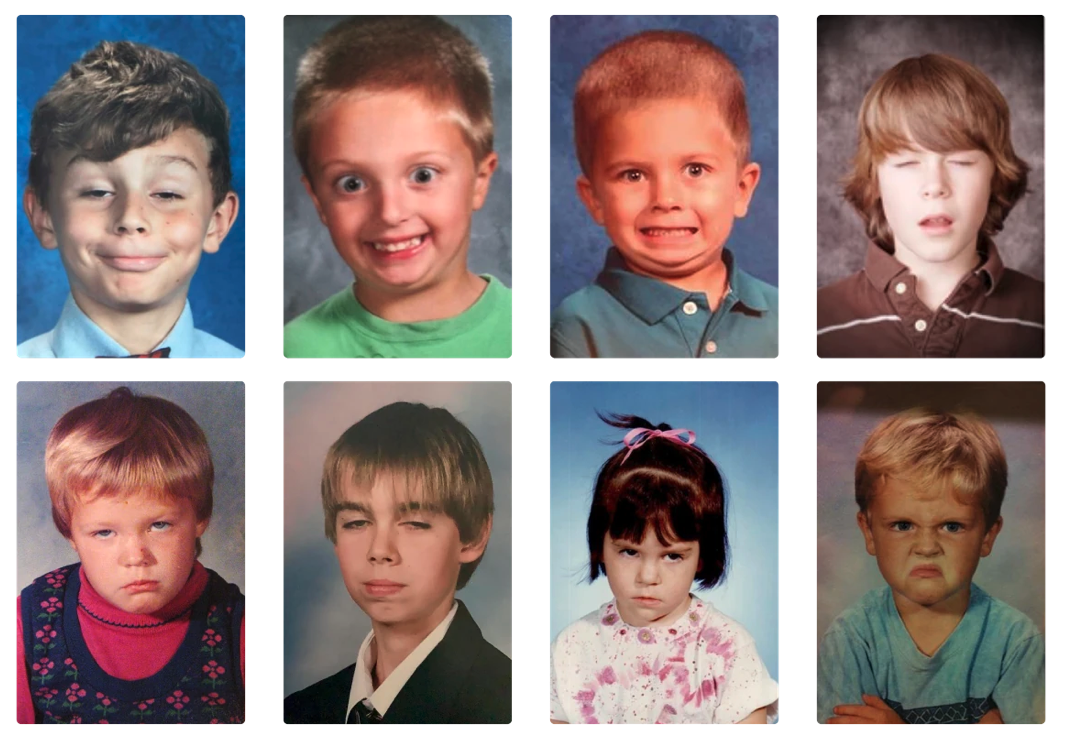
I am sure that we all have a school portrait of us, from some point in our time at school, that our parents paid for. A portrait that marks a moment in time, when we as children were photographed by a professional photographer. There was a time when this was ‘bread and butter’ income for local high street photographers, who also photographed weddings, christenings and studio portraits. Photographers who knew their trade and needed to maintian a high quality of service, to remain the local photographer of choice. Most people knew their local photographer, as at least one member of the family would pass through their door at some point in their lives.
My family always used the same photographer in Streatham High Street, in South London, next to the bus stop, opposite the church were my parents were married. He photographed their wedding and made portraits of my mother, which he hung in his window for many years. He also photographed my christening and my first school photographs. Today, the local independent photographer on the hight street is largely a thing of the past. National companies now own this territory, and the quality of work and service has dropped off a cliff.
Now, this is in my experience of having two daughters pass through the school system and one who is still making her way through. You may disagree. However, let’s look at the problems from my subjective viewpoint. The first problem, as I see it, is that local autorities make deals with companies to provide school photography. They have no idea as to the quality of that photography, or the prices that will be charged. The schools are then told who will arrive to photograph their children and the image factory begins. Schools do not want their children to lose class time and therefore as many children pass in front of the photographers lens, as quickly as possible. No child is treated as an individual person and the white backdrop is the same for all. None of this is the photographer’s fault or decision, but the soul destroying nature of such a system is not going to attract the best photographers out there. Add to that the fact that according to the C.S. Mott Children’s Hospital National Poll, 64% of children are self-conscious about at least one aspect of their appearance. Among teens, that number climbs to 73% for girls and 69% for boys and one in five teens actively avoids being in photos because of how they feel about how they look.
This ‘sausage factory’ approach and lack of photographer experience explains the poor quality post-production to make the background whiter, when it has not been lit correctly, the awkward posing and the repetitious corporate nature of every image. In my opinion this is a broken process. Why? Because very few people buy the photographs, but their poor quality is only one small part of the failure of such school photography. Let’s discuss what else is broken.
After the photographs are taken you are given a QR code, to see your images online at the company’s website and it is then that you see the prices. There is a lack of transparency until that point. Now, let’s no forget that these are given in a world where you can get free prints from your phone through an ‘App’ with no issue of a reasonable quality. You also cannot see the prices without giving your email address to the company. Data capture of the worst kind.
Now, let’s accept that most people own a smartphone with a good to excellent camera function, with which they can make images of their children whenever they wish, including in school uniform. Images that will feel natural, authentic and fun. Unlike the forced portrait of the school photographer. I am sure that if you are a school photographer, working independently, you will have lots to say about how you can provide something better than a ‘phone snap’. This may be true, but I know that my wife, who has no photography training, takes great images of our daughter, with her phone and has been doing so for years. I as a professional photographer have no problem with that and neither should you, I would suggest.
I am not saying that school photography is over. I just think that the current approach is not working, for the children or the parents. It’s time for a change. However, I dont think this is a quick or simple fix. My daughter’s school employed a local photographer to document the school’s annual theatrical production last year. The photographer created a series of images that were so overly post-produced that the images were comically bad and had nothing to do with the actual performance. They were all about what she could do in Photoshop! Again, the cost of a print was extortionate. Cameras had been banned from the performance and therefore parents were caught in a trap. Buy or have no photographs. Despite this few were sold.
So what is the answer? Well, as a photographer and a parent I would like to see images that show some creativity, some authenticity and personality. Perhaps photographed in an area of the school that has some sence of place. My daughter photographed with her friends, or looking relaxed. In fact, I would support any approach that encourages competent photographers to get involved. Then they might give parents a reason to buy something better than a badly printed passport photo!
Dr.Grant Scott
After fifteen years art directing photography books and magazines such as Elle and Tatler, Scott began to work as a photographer for a number of advertising and editorial clients in 2000. Alongside his photographic career Scott has art directed numerous advertising campaigns, worked as a creative director at Sotheby’s, art directed foto8 magazine, founded his own photographic gallery, edited Professional Photographer magazine and launched his own title for photographers and filmmakers Hungry Eye. He founded the United Nations of Photography in 2012, and is now a Senior Lecturer and Subject Co-ordinator: Photography at Oxford Brookes University, Oxford, and a BBC Radio contributor. Scott is the author of Professional Photography: The New Global Landscape Explained (Routledge 2014), The Essential Student Guide to Professional Photography (Routledge 2015), New Ways of Seeing: The Democratic Language of Photography (Routledge 2019), and What Does Photography Mean To You? (Bluecoat Press 2020). His photography has been published in At Home With The Makers of Style (Thames & Hudson 2006) and Crash Happy: A Night at The Bangers (Cafe Royal Books 2012). His film Do Not Bend: The Photographic Life of Bill Jay was premiered in 2018.
©Grant Scott 2026
Leave a Reply